
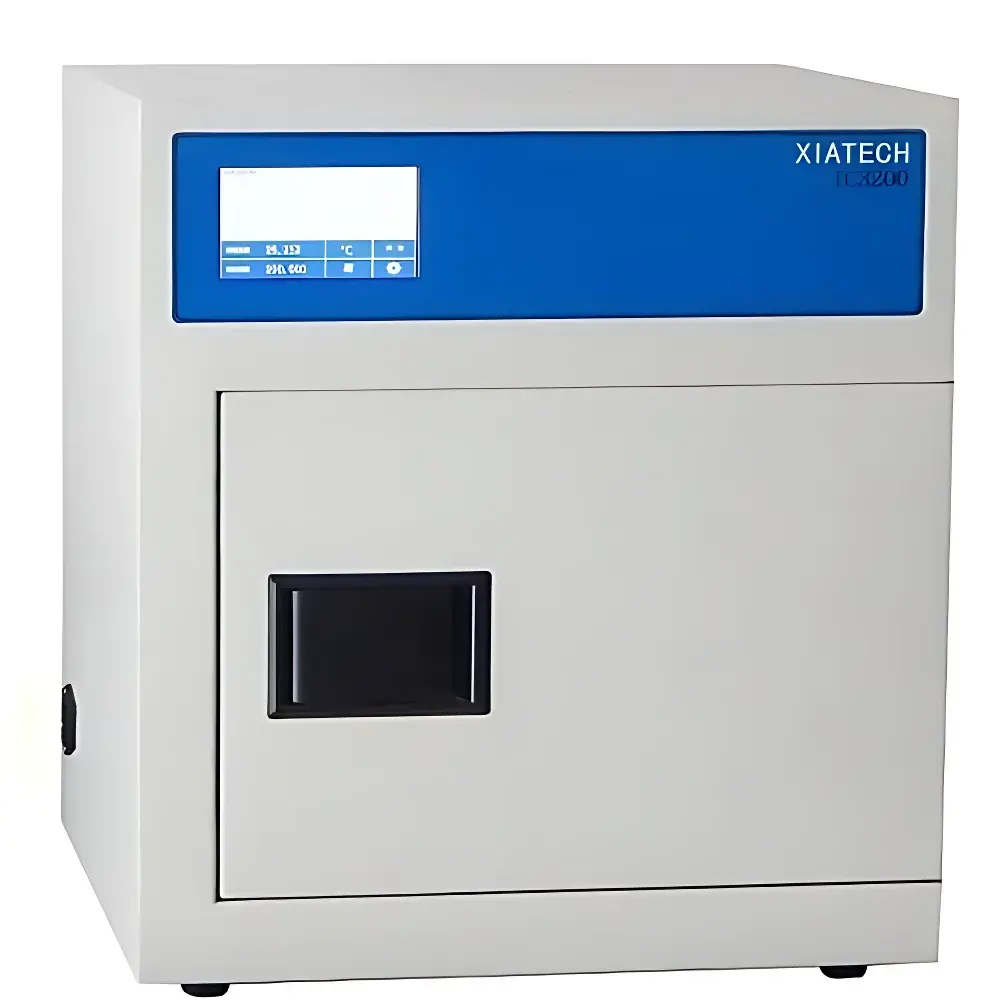
Xiatech TC5000-1 Transient Plane Source (TPS) Thermal Conductivity Analyzer
| Brand | Xiatech |
|---|---|
| Origin | Shaanxi, China |
| Model | TC5000-1 |
| Measurement Principle | Transient Plane Source (TPS) Method |
| Sample Configuration | Single sample per test |
| Test Environment | Ambient pressure, air atmosphere |
| Thermal Conductivity Range | 0.005–20 W/(m·K) |
| Accuracy | ±3% |
| Repeatability | ±3% |
| Minimum Sample Thickness | 0.1 mm |
| Minimum Lateral Dimension | 25 mm |
| Sample Forms | Solid blocks, sheets, pastes, powders, granules, gels — including irregular, circular, or square geometries |
| Data Acquisition Time | ≤5 minutes per measurement |
| Interface | USB 2.0 |
| Software | Windows-based native application with automated multi-cycle acquisition and optional temperature control integration |
Overview
The Xiatech TC5000-1 is a benchtop thermal conductivity analyzer engineered for precision measurement of thermal transport properties in heterogeneous and soft materials using the standardized Transient Plane Source (TPS) method—defined in ISO 22007-2 and ASTM D5930. Unlike steady-state techniques requiring extended equilibration, the TPS method employs a symmetric, double-sided sensor acting simultaneously as both heat source and temperature probe. A short-duration constant-power pulse is applied to the sensor embedded between or in contact with the sample; the resulting transient temperature rise is recorded and modeled using Fourier heat conduction theory. From a single measurement, the instrument directly calculates thermal conductivity (λ), thermal diffusivity (α), and—via λ/α—volumetric heat capacity (Cv). This dual-parameter extraction eliminates reliance on separate density or specific heat measurements, reducing cumulative uncertainty and experimental overhead. The TC5000-1 is particularly suited for quality control laboratories, R&D centers, and academic groups working with insulation foams, phase-change composites, geotechnical specimens, biomass, polymer blends, and thermally sensitive formulations where minimal sample preparation and non-destructive evaluation are critical.
Key Features
- Single-measurement dual-property output: Simultaneous determination of thermal conductivity and thermal diffusivity without calibration transfer or iterative modeling.
- Minimal sample requirements: Accepts specimens as thin as 0.1 mm and as small as 25 mm × 25 mm—ideal for scarce or high-value samples such as battery electrode coatings or thin-film composites.
- Universal sample compatibility: No sensor swapping required across solid blocks, flexible sheets, loose powders, viscoelastic pastes, or hydrated gels—even irregularly shaped or anisotropic specimens yield reproducible results due to the self-compensating nature of TPS geometry.
- Contact resistance immunity: The symmetrical sensor configuration and transient analysis algorithm inherently compensate for interfacial thermal resistance, eliminating the need for thermal interface compounds or surface polishing.
- Automated workflow: Integrated software supports scheduled multi-cycle acquisition, real-time curve fitting, and optional external temperature chamber synchronization—enabling unattended operation during long-term thermal stability studies.
- Regulatory-ready data handling: Audit-trail-enabled software logs operator ID, timestamp, environmental conditions, raw voltage-time traces, and fitted parameters—supporting GLP-compliant documentation per FDA 21 CFR Part 11 when configured with user authentication and electronic signature modules.
Sample Compatibility & Compliance
The TC5000-1 accommodates a broad spectrum of physical states and morphologies without mechanical modification: rigid solids (e.g., aerogels, ceramics), compliant sheets (e.g., graphite films, elastomeric TIMs), granular media (e.g., metal powders, mineral aggregates), semi-solids (e.g., thermal greases, hydrogels), and low-viscosity liquids. All tests are conducted under ambient atmospheric conditions (air, ~25 °C, 40–60% RH) unless interfaced with climate-controlled enclosures. The instrument complies with ISO 22007-2:2015 for transient plane source methodology and meets essential performance criteria outlined in ASTM D5930-21 for thermal conductivity measurement of plastics. While not certified for IEC 61000-4 electromagnetic immunity, its shielded analog front-end and opto-isolated USB interface ensure stable operation in typical laboratory environments.
Software & Data Management
The native TC5000 Control Suite (v3.2+) runs on Windows 10/11 and provides full parameter configuration, real-time signal visualization, automatic baseline correction, and nonlinear least-squares fitting of the TPS analytical solution. Raw data files (.tdf) store unprocessed thermoelectric voltage vs. time, along with metadata (sample ID, operator, date/time, ambient T/P). Export options include CSV, Excel (.xlsx), and PDF reports with embedded uncertainty budgets. Version-controlled firmware updates are delivered via secure HTTPS portal. For regulated environments, optional modules enable role-based access control, electronic signatures, and 21 CFR Part 11 audit trails—including immutable records of all parameter changes, result overrides, and report generation events.
Applications
- Quality assurance of thermal interface materials (TIMs) in electronics packaging
- Thermal characterization of building insulation products (aerogels, vacuum panels, cork composites)
- R&D of phase-change materials (PCMs) for thermal energy storage systems
- Geotechnical assessment of soil thermal resistivity for underground cable rating
- Characterization of biomaterials (wood, peat, food matrices) under variable moisture content
- Screening of nanocomposite polymers and additive-manufactured parts for anisotropic conduction
FAQ
Does the TC5000-1 require calibration standards for routine operation?
No—TPS is an absolute method traceable to SI units via electrical resistance and time measurement. Certified reference materials (e.g., NIST SRM 1450c) may be used for verification but are not mandatory for daily use.
Can the instrument measure anisotropic materials?
Yes—by orienting the sensor normal to the suspected direction of maximum conduction and comparing results across orthogonal placements, directional dependence can be empirically assessed.
Is vacuum or inert gas testing possible?
The base configuration operates in ambient air. Optional vacuum-compatible sample holders and purge ports are available for controlled-atmosphere testing (N2, Ar, He).
What is the minimum detectable thermal conductivity?
The lower limit of 0.005 W/(m·K) applies to homogeneous, low-density materials such as silica aerogels; accuracy degrades near this limit if sample thickness or lateral dimensions fall below recommended minima.
How does the TC5000-1 handle highly reflective or transparent samples?
Since TPS relies on bulk resistive heating—not optical absorption—it is unaffected by surface reflectivity or transparency, making it suitable for metals, glasses, and crystalline oxides alike.



