
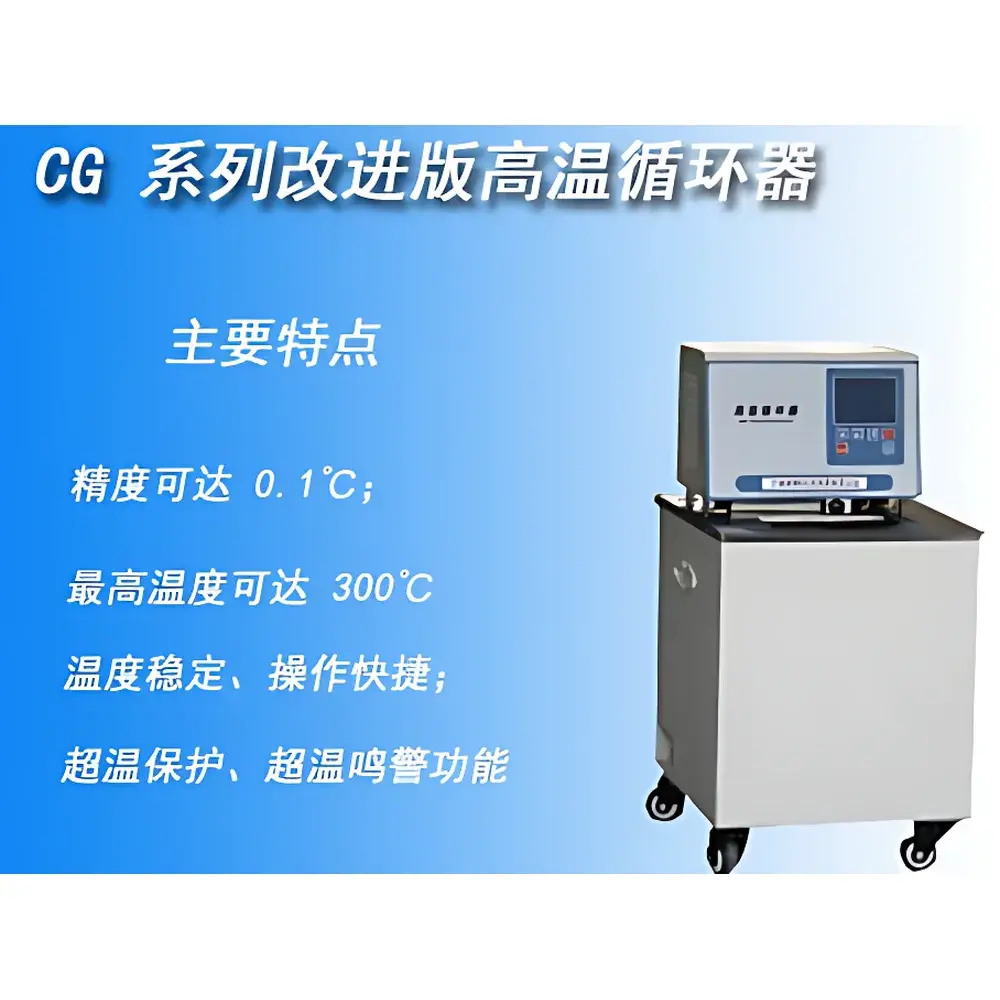
Xiatech CG Series Upgraded High-Temperature Circulating Bath
| Brand | Xiatech |
|---|---|
| Model | CG Series |
| Origin | Shaanxi, China |
| Equipment Type | Constant-Temperature Circulating Bath |
| Temperature Range | RT to 300 °C |
| Temperature Stability | ±0.1 °C |
| Bath Volume | 5 L |
| Circulation Mode | Internal & External |
| External Pump Flow Rate | Up to 15 L/min |
| Safety Features | Overtemperature Cut-off & Audible Alarm |
| Optional Feature | Integrated Tap-Water Cooling Module for Rapid Exothermic Reaction Quenching |
Overview
The Xiatech CG Series Upgraded High-Temperature Circulating Bath is an engineered thermal management system designed for precise, stable, and safe temperature control in demanding laboratory applications requiring sustained operation up to 300 °C. Based on resistive heating and forced liquid circulation principles, it delivers uniform thermal energy transfer via a closed-loop fluid circuit—typically using silicone oil or high-temperature heat-transfer fluids—to external devices such as glass reaction vessels, jacketed bioreactors, chemical synthesis reactors, and fermentation systems. Unlike ambient-referenced chillers or basic immersion heaters, this unit integrates real-time PID-controlled heating with dual-path circulation architecture (internal bath recirculation + externally routed flow), enabling consistent thermal loading across complex reactor geometries while maintaining ±0.1 °C stability under steady-state conditions. Its robust stainless-steel construction, sealed heating elements, and pressure-relief–equipped expansion tank comply with standard mechanical safety requirements for high-temperature fluid handling in Class II laboratory environments.
Key Features
- High-temperature capability: Continuous operation from ambient (RT) to 300 °C, validated per IEC 61000-4-30 for thermal stress endurance.
- Precision temperature regulation: Digital PID algorithm with auto-tuning; user-accessible offset correction for sensor calibration traceability.
- Dual-mode circulation: Independent internal recirculation ensures bath homogeneity; external loop supports flow rates up to 15 L/min (adjustable via calibrated bypass valve) for optimal heat exchange with jacketed reactors.
- Integrated safety architecture: Dual-stage overtemperature protection—electronic limit cutoff at 310 °C and mechanical thermal fuse at 320 °C—plus audible alarm and visual fault indication per EN 61000-6-2 EMC immunity standards.
- Human-centered interface: Backlit LCD display with intuitive menu navigation; real-time logging of setpoint, PV, pump status, and alarm history.
- Modular cooling compatibility: Optional tap-water–based auxiliary cooling module enables controlled ramp-down during exothermic processes without requiring external chiller infrastructure.
Sample Compatibility & Compliance
The CG Series is compatible with standard laboratory reactor configurations including 1–20 L glass-jacketed vessels (e.g., Chemglass, Ace Glass), stainless-steel bioreactor jackets (e.g., Sartorius BIOSTAT®), and custom-engineered reaction manifolds. Fluid compatibility includes silicone oils (e.g., Dow Corning 200 Fluid, viscosity grade 50–100 cSt), glycol–water blends (up to 200 °C), and specialized synthetic heat-transfer fluids meeting ASTM D6722 specifications. The unit conforms to CE marking requirements (2014/30/EU EMC Directive and 2014/35/EU LVD), carries RoHS 2011/65/EU compliance documentation, and supports GLP-aligned operational records when paired with optional RS485/Modbus RTU output for integration into centralized lab data acquisition systems.
Software & Data Management
While the base model operates via standalone front-panel control, optional communication modules enable bidirectional integration with third-party SCADA or LIMS platforms. The RS485 interface supports Modbus RTU protocol (function codes 03h/06h) for remote setpoint adjustment, real-time PV readout, and status flag monitoring (e.g., “Heating Active”, “Alarm Triggered”, “Pump Fault”). Audit-trail–capable data logging (timestamped every 10 s) is available through Xiatech’s optional PC-based XIAControl Suite v3.2, which complies with FDA 21 CFR Part 11 requirements for electronic records—including user authentication, immutable log files, and change-history tracking—making it suitable for regulated QC/QA workflows in pharmaceutical and biotech development labs.
Applications
- Controlled-temperature synthesis of metal-organic frameworks (MOFs) and nanomaterials requiring extended dwell at >250 °C.
- Enzymatic and microbial fermentation studies where precise thermal ramping (e.g., 0.5 °C/min) mimics physiological transition profiles.
- Accelerated stability testing per ICH Q1A(R3) guidelines using elevated-temperature storage protocols.
- In-process temperature control during hydrogenation, esterification, and polymerization reactions conducted in jacketed batch reactors.
- Calibration support for high-temperature reference sensors (e.g., Pt100 Class A probes) in metrology labs accredited to ISO/IEC 17025.
FAQ
Is the CG Series suitable for use with flammable heat-transfer fluids?
No. The unit is certified for use only with non-flammable, thermally stable fluids meeting flash point >250 °C (e.g., silicone oils). Flammable solvents such as toluene or xylene are strictly prohibited.
Can the external circulation loop be pressurized?
The standard configuration operates at atmospheric pressure. For pressurized jacket systems, users must install an external expansion tank and pressure-regulating valve compliant with ASME B31.9 process piping standards.
What maintenance intervals are recommended for long-term reliability?
Oil level and clarity should be verified monthly; full fluid replacement is advised every 12 months or after 2000 operating hours, whichever occurs first. Pump impeller inspection is recommended annually.
Does the unit meet requirements for GMP-compliant manufacturing environments?
Yes—when equipped with the optional audit-trail software package and operated under documented SOPs, it satisfies Annex 11 and EU GMP Chapter 4 expectations for critical utility equipment used in API synthesis and sterile processing support.
Related Products



