
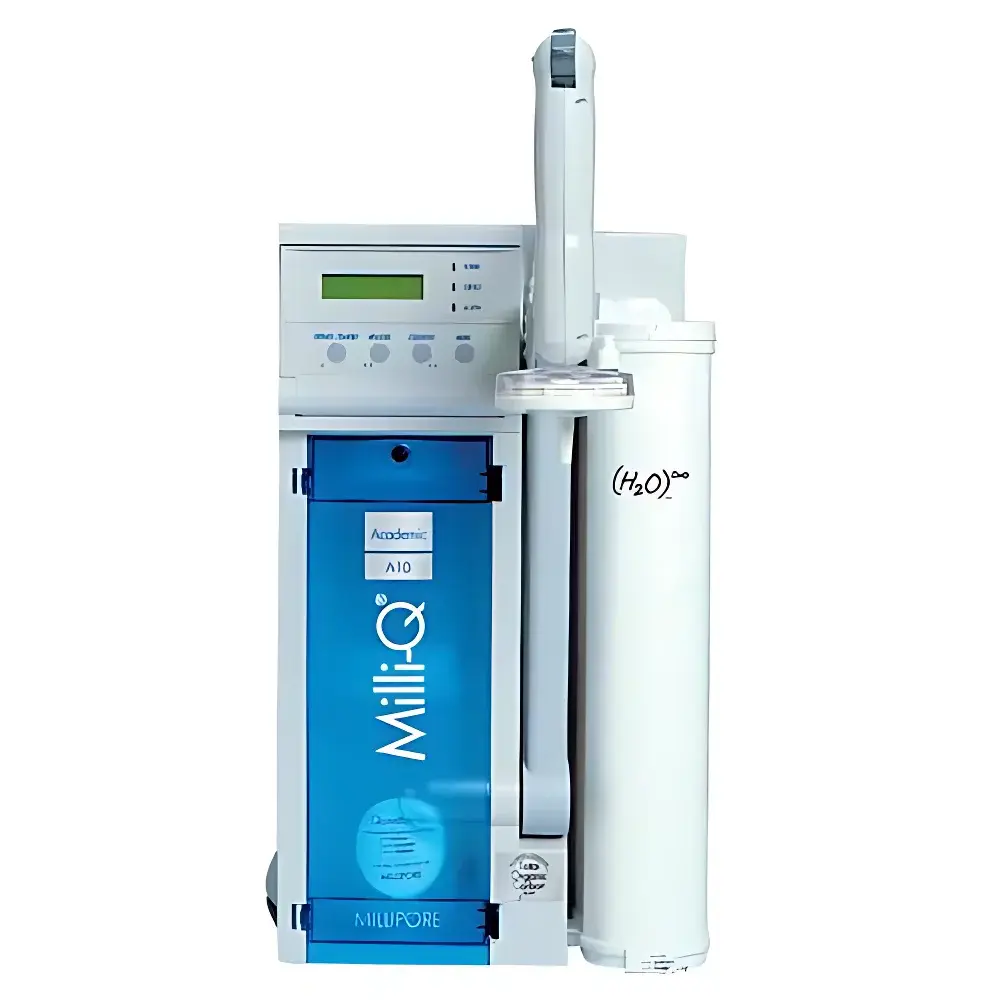
Millipore Milli-Q Academic Ultra-Pure Water System
| Brand | Millipore |
|---|---|
| Origin | France |
| Model | Milli-Q Academic |
| Production Flow Rate | 1.5 L/min |
| Resistivity | 18.2 MΩ·cm @ 25 °C |
| TOC | <10 ppb |
| Particles | <1/mL (>0.2 µm) |
| Microbial Count | <1 CFU/mL |
| Feed Water Requirement | Pre-treated water (RO, distillation, deionization, or Elix system) |
| Operating Pressure | 0.1–0.3 bar |
| Inlet Temperature | 5–35 °C |
| Dimensions (L×W×H) | 255 × 315 × 455 mm |
| Weight | 16.6 kg |
| Power Consumption | 70 VA |
| Voltage/Frequency | 230 V / 50 Hz |
| Conductivity Sensor Electrode Constant | 0.01 cm⁻¹ |
| Temperature Sensitivity | 0.1 °C |
| Volumetric Dispensing Accuracy | ±3% |
| Certifications | ISO 9001, ISO 14001, NIST-traceable calibration documentation available |
Overview
The Millipore Milli-Q Academic Ultra-Pure Water System is a benchtop-grade, GLP-compliant water purification platform engineered for laboratories requiring consistent Type I ultrapure water per ISO 3696 and ASTM D1193 specifications. It employs a multi-stage purification architecture—comprising integrated pre-treatment monitoring, dual-wavelength UV oxidation (185/254 nm), sequential ion exchange, and 0.22 µm final filtration—to deliver water with resistivity ≥18.2 MΩ·cm at 25 °C, total organic carbon (TOC) <10 ppb, and microbial levels <1 CFU/mL. Unlike modular or centralized systems, the Milli-Q Academic integrates real-time electrochemical resistivity measurement with temperature compensation (±0.1 °C sensitivity) and optional online TOC monitoring compliant with USP and EP 2.2.44. Its compact footprint (255 × 315 × 455 mm) and flexible mounting options—including under-bench, countertop, or wall-mount configurations—support space-constrained analytical environments without compromising hydraulic integrity or service accessibility.
Key Features
- Real-time, temperature-compensated resistivity monitoring using a 0.01 cm⁻¹ electrode constant sensor, enabling trace-level ionic contamination detection in continuous operation.
- Optional integrated TOC analyzer (1–999 ppb range) with UV/persulfate oxidation and NDIR detection, validated against USP Chapter for pharmaceutical and biotechnology applications.
- Intelligent dispensing interface supporting time-based, volume-based, or manual activation modes; volumetric accuracy maintained at ±3% across 10 mL to 5 L dispense ranges after field calibration.
- Modular cartridge architecture: QG pre-purification cartridges (for RO or distilled feed), QU ultra-purification cartridges (mixed-bed ion exchange + activated carbon), and Pyrogard D endotoxin/RNase-removing ultrafiltration modules for sensitive molecular biology workflows.
- Full-system GLP compliance: RS232 serial port for direct thermal printer integration; Explore Data software compatibility enables secure data export (CSV/PDF), audit trail generation, and long-term trend analysis of resistivity, TOC, flow history, and consumable lifetime metrics.
- Embedded safety logic including low-feed-pressure shutdown, leak-detection-triggered pump cutoff, visual/audible alarm escalation, and automatic recirculation cycles to maintain microbial control during idle periods.
Sample Compatibility & Compliance
The Milli-Q Academic delivers water suitable for critical analytical instrumentation requiring stringent purity thresholds—including HPLC mobile phase preparation, ICP-MS and AAS nebulizer feeds, LC-MS solvent blanks, PCR reagent formulation, and optical component rinsing. All internal wetted materials comply with USP Class VI biocompatibility standards. The system supports full traceability per FDA 21 CFR Part 11 when used with Explore Data software configured for electronic signatures and immutable audit logs. Calibration certificates are NIST-traceable and include uncertainty budgets aligned with ISO/IEC 17025 requirements. Electrical safety conforms to IEC 61010-1; environmental management follows ISO 14001 principles, and quality processes are certified to ISO 9001:2015.
Software & Data Management
Explore Data software provides a secure, Windows-based interface for remote system interrogation, historical data retrieval (up to 12 months), and customizable report generation—including daily water quality summaries, consumable usage forecasts, and deviation alerts. Data exports support CSV and PDF formats with embedded metadata (timestamp, operator ID, instrument serial number). When deployed in regulated environments, the software supports role-based access control, electronic signature capture, and ALCOA+ compliant audit trails—ensuring adherence to GxP, GLP, and ISO 17025 documentation requirements. No cloud dependency: all data resides locally unless explicitly exported via encrypted USB or network transfer.
Applications
- HPLC and UHPLC mobile phase and blank preparation
- ICP-OES and ICP-MS sample dilution and standard calibration
- AAS and AES nebulizer and graphite furnace rinse solutions
- LC-MS and GC-MS solvent blanks and system suitability testing
- PCR master mix formulation and nucleic acid handling
- High-precision optical lens and sensor cleaning
- Pharmaceutical excipient dilution per USP
- Cell culture media supplementation where endotoxin-free water is not required
- Preparation of reference standards for clinical chemistry analyzers
FAQ
What feed water quality is required to operate the Milli-Q Academic?
The system requires pre-treated feed water meeting Type II specifications (e.g., from an Elix, RO, or distillation unit) with conductivity ≤5 µS/cm and silica <50 ppb. Direct tap water or unconditioned municipal supply is incompatible.
Can the Milli-Q Academic be integrated into a laboratory information management system (LIMS)?
Yes—via RS232 output or Explore Data software’s export functionality, raw water quality logs and event timestamps can be parsed into LIMS-compatible formats using custom scripts or middleware adapters.
Is TOC monitoring mandatory for GLP compliance?
No—resistivity remains the primary release parameter per ISO 3696—but TOC measurement is strongly recommended for applications involving LC-MS, enzymatic assays, or trace metal analysis where non-ionic organics may compromise results.
How often must consumables be replaced?
QG pre-cartridges typically last 6–12 months depending on feed quality; QU ultra-purification cartridges require replacement every 6–9 months under normal use; Pyrogard D filters are single-use and must be discarded after each application cycle.
Does the system support password-protected user access levels?
Not natively—the front-panel interface lacks multi-user authentication; however, Explore Data software supports Windows-native user accounts and permission tiers when deployed on domain-joined workstations.



