
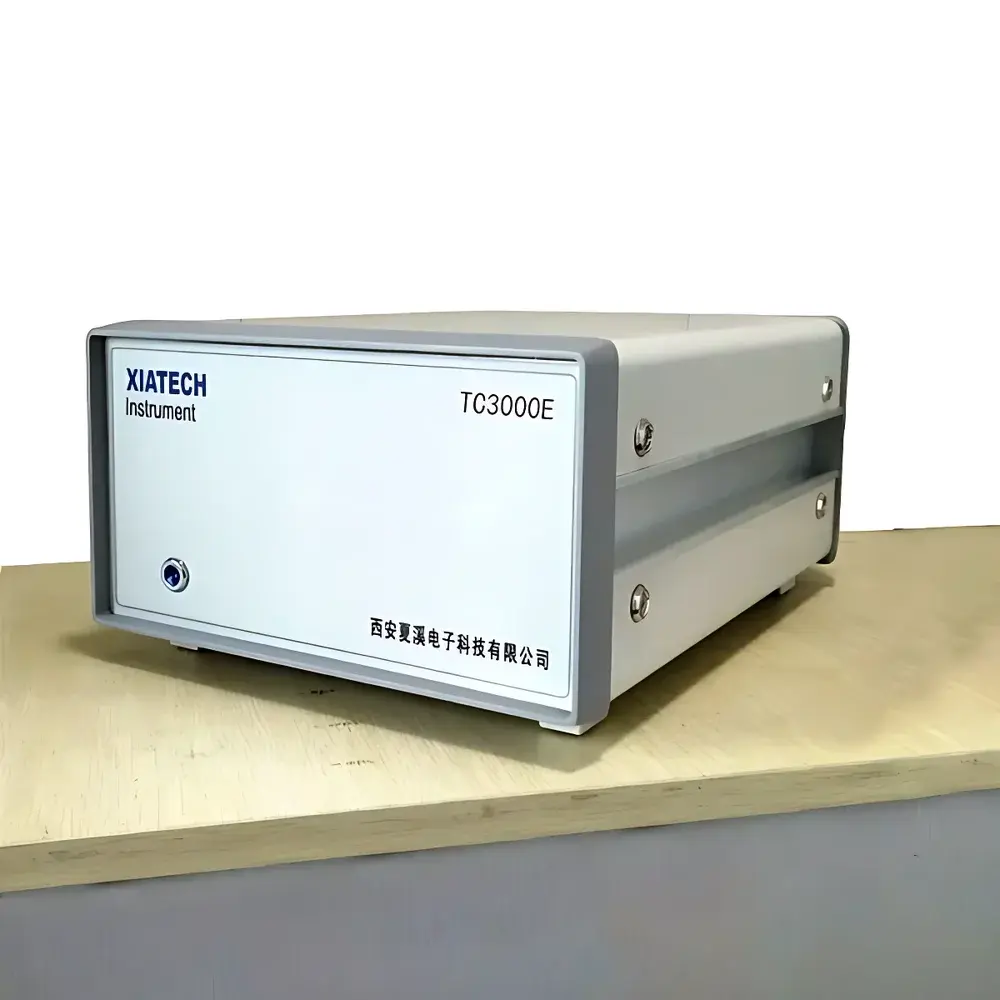
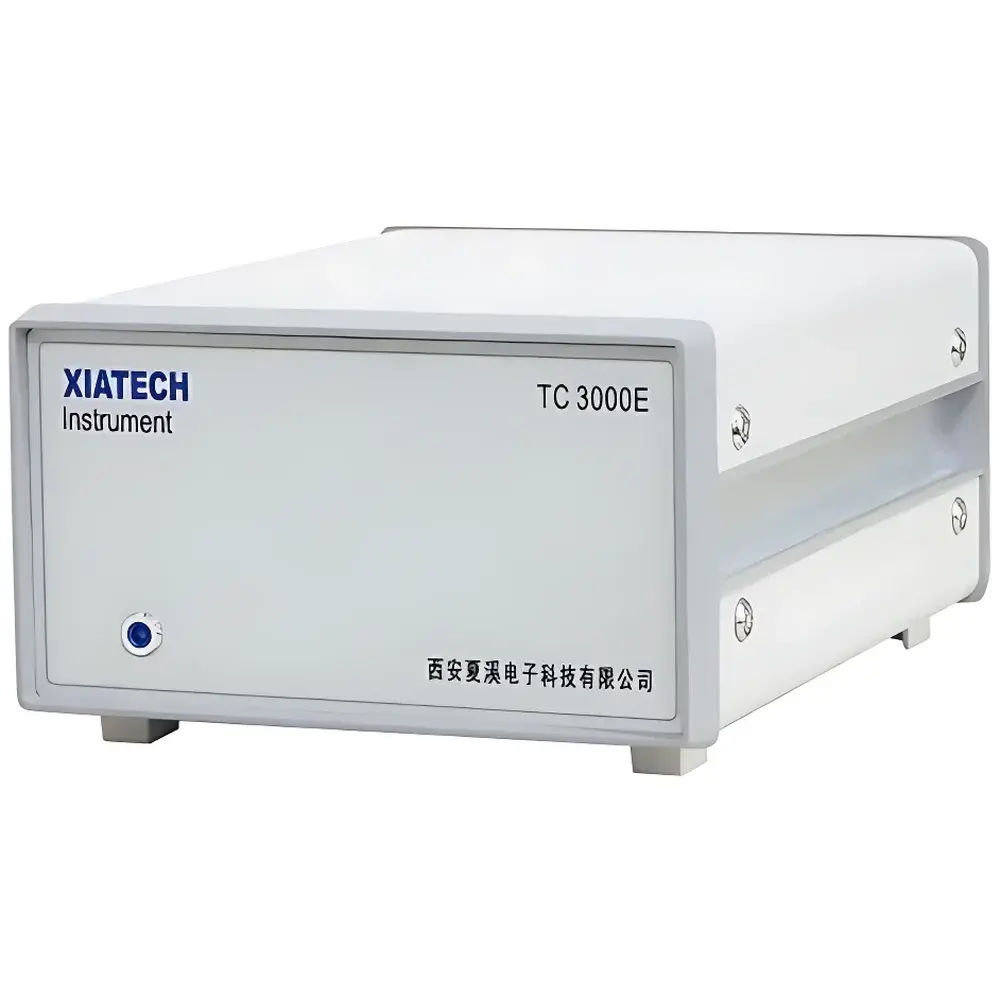
Xiatech TC3000E Portable Transient Hot Wire Thermal Conductivity Analyzer
| Brand | Xiatech |
|---|---|
| Origin | Shaanxi, China |
| Model | TC3000E-04 |
| Measurement Principle | Transient Hot Wire Method |
| Thermal Conductivity Range | 0.001–50 W/(m·K) (extendable to 100 W/(m·K)) |
| Accuracy | ±3% |
| Repeatability | ±3% |
| Resolution | 0.0005 W/(m·K) |
| Sample Forms | Solid, Liquid, Paste, Gel, Powder |
| Test Atmosphere | Air or Vacuum |
| Operating Temperature | 10–40 °C |
| Dimensions (L×W×H) | 350×250×150 mm |
| Power Supply | 220 V, 50 Hz |
| Data Interface | USB |
| Measurement Time | 1–20 s |
| Minimum Sample Thickness | 0.1 mm |
| Minimum Sample Lateral Dimension | 25 mm (circular or square) |
Overview
The Xiatech TC3000E Portable Transient Hot Wire Thermal Conductivity Analyzer is an engineered solution for high-accuracy, field-deployable thermal property characterization. Based on the internationally standardized transient hot wire (THW) method—defined in ASTM C1113, ASTM D5930, and GB/T 10297—the instrument determines thermal conductivity by measuring the temperature rise of a thin, electrically heated platinum wire embedded in or inserted into the sample. The underlying physics relies on the linear relationship between the natural logarithm of time and the temperature response of the wire during the early-time transient phase, enabling direct calculation of thermal conductivity without requiring prior knowledge of specific heat or density. Unlike steady-state methods, THW eliminates convective interference and offers intrinsic insensitivity to contact resistance, making it especially suitable for heterogeneous, soft, moist, or low-conductivity materials such as soils, biomass, gels, and thermal interface materials. Designed for mobility without compromising metrological integrity, the TC3000E delivers laboratory-grade accuracy (±3% against certified reference materials) in a compact, battery-compatible chassis weighing under 4.5 kg—enabling measurements at the point of interest: construction sites, geological survey zones, production lines, or classroom demonstrations.
Key Features
- Portable architecture with integrated power management and ruggedized enclosure—optimized for operation in non-laboratory environments including outdoor fieldwork, factory floors, and mobile labs.
- Transient hot wire sensor with surface-insulated platinum filament—enables safe, reliable measurement of both electrically conductive (e.g., metal-filled thermal greases) and insulating materials (e.g., aerogels, foams).
- Sub-3-second acquisition window per test cycle, with full data capture and real-time curve fitting performed onboard; typical total workflow (sample placement to exported result) completes in ≤120 seconds.
- Minimal sample requirements: accommodates specimens as thin as 0.1 mm and as small as 25 mm in lateral dimension—eliminating need for extensive machining or molding.
- Multi-environment compatibility: supports testing under ambient air or vacuum conditions (with optional vacuum chamber accessory), critical for eliminating convection artifacts in low-density or porous media.
- Calibration traceability: factory-calibrated using NIST-traceable reference materials (e.g., polymethyl methacrylate, borosilicate glass); calibration verification protocols align with ISO/IEC 17025 documentation requirements.
Sample Compatibility & Compliance
The TC3000E accepts diverse physical states—including rigid solids (ceramics, rocks, composites), deformable solids (rubber, elastomers), semi-solids (thermal pastes, adhesives), liquids (coolants, oils), powders (with optional powder holder kit), and hydrated matrices (soils, wood, biological tissues). Its non-destructive, insertion-based methodology avoids surface preparation, pressure application, or thermal interface compounds—preserving native microstructure and moisture content. Regulatory alignment includes conformance with ASTM C1113 (refractories), ASTM D5930 (plastics), and Chinese national standards GB/T 10297 and GB/T 11205. For quality-critical applications, the system supports audit-ready data logging compliant with GLP and GMP principles, including user authentication, electronic signatures, and immutable timestamped records exportable in CSV and XML formats.
Software & Data Management
The TC3000E operates via Windows-compatible control software featuring automated sequence programming, multi-point spatial mapping (for anisotropy assessment), and statistical batch analysis. Raw voltage-vs.-time datasets are processed using robust numerical algorithms that apply baseline correction, noise filtering, and dynamic time-window optimization to extract the linear ln(t)-ΔT region. All measurement parameters—including excitation current, integration duration, and thermal diffusivity assumptions—are fully configurable and stored with each dataset. Software outputs include thermal conductivity (W/(m·K)), estimated thermal diffusivity (mm²/s), and goodness-of-fit metrics (R² > 0.999 typical). Data exports support LIMS integration and comply with FDA 21 CFR Part 11 requirements when used with validated system configurations and access-controlled user roles.
Applications
- On-site validation of building insulation performance per ISO 6946 and EN 12667—reducing reliance on off-site lab submissions.
- Rapid screening of thermal interface materials (TIMs) in electronics manufacturing—quantifying batch-to-batch consistency of thermal greases, gap fillers, and phase-change pads.
- Geotechnical characterization: in-situ estimation of soil thermal resistivity for underground cable rating and geothermal system design.
- Materials R&D: iterative optimization of polymer composites, aerogel formulations, and nano-enhanced ceramics where thermal transport anisotropy must be resolved across multiple orientations.
- Educational use: hands-on demonstration of Fourier’s law, transient conduction theory, and metrological uncertainty propagation in undergraduate thermophysics laboratories.
- Process QA/QC: real-time monitoring of curing state in thermosetting resins or moisture-driven conductivity shifts in hygroscopic insulation boards.
FAQ
What standards does the TC3000E comply with?
ASTM C1113, ASTM D5930, GB/T 10297-1998, and GB/T 11205-2009—covering refractories, plastics, non-metallic solids, and rubber.
Can the TC3000E measure anisotropic materials?
Yes—by performing orthogonal insertions or surface-contact measurements at defined angles, users can derive directional thermal conductivity tensors with appropriate post-processing.
Is vacuum operation required for low-conductivity measurements?
Not mandatory, but recommended for samples with κ < 0.1 W/(m·K) to suppress convective heat loss and improve signal-to-noise ratio.
How is calibration maintained over time?
Annual recalibration using certified reference materials is advised; drift verification can be performed daily using a supplied PMMA standard block with documented κ = 0.192 W/(m·K) at 25 °C.
Does the system support automated reporting for regulatory submissions?
Yes—PDF and Excel reports include instrument ID, operator ID, environmental conditions, raw curves, fit residuals, and uncertainty budgets calculated per GUM (JCGM 100:2008).
Related Products



