
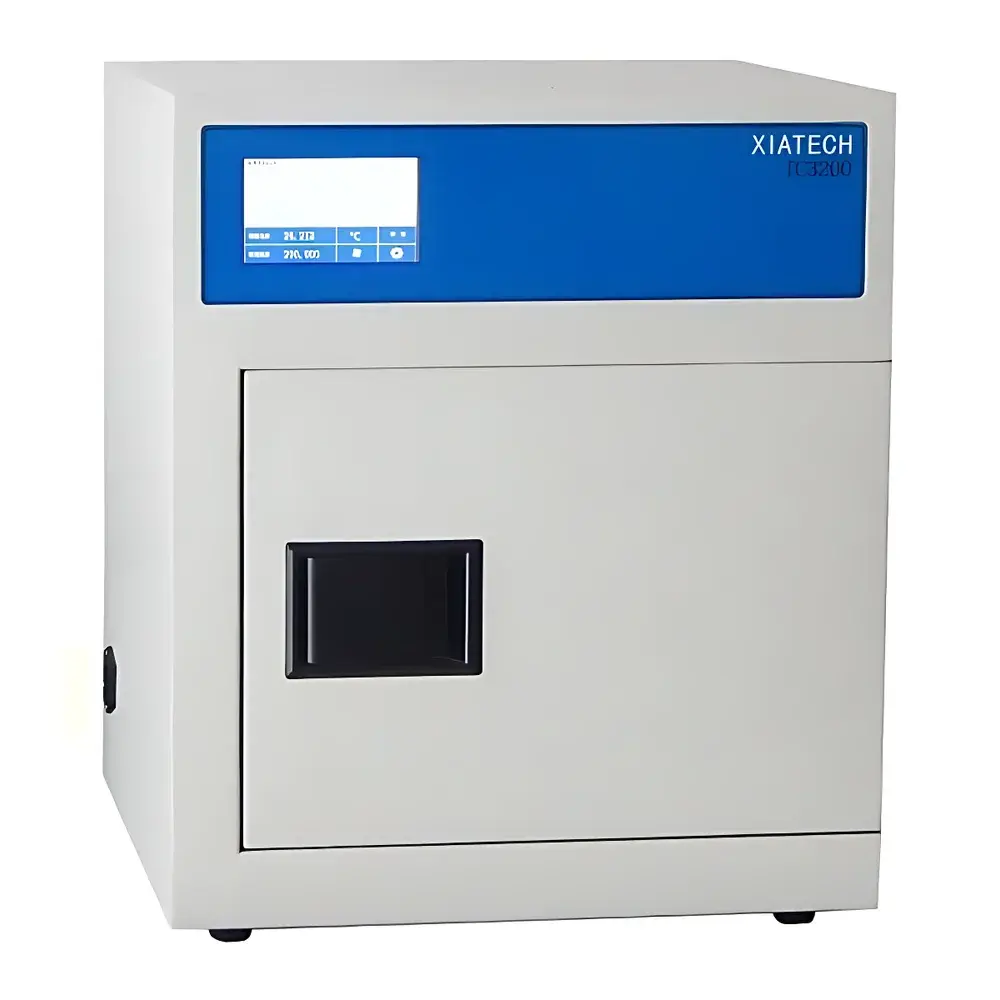
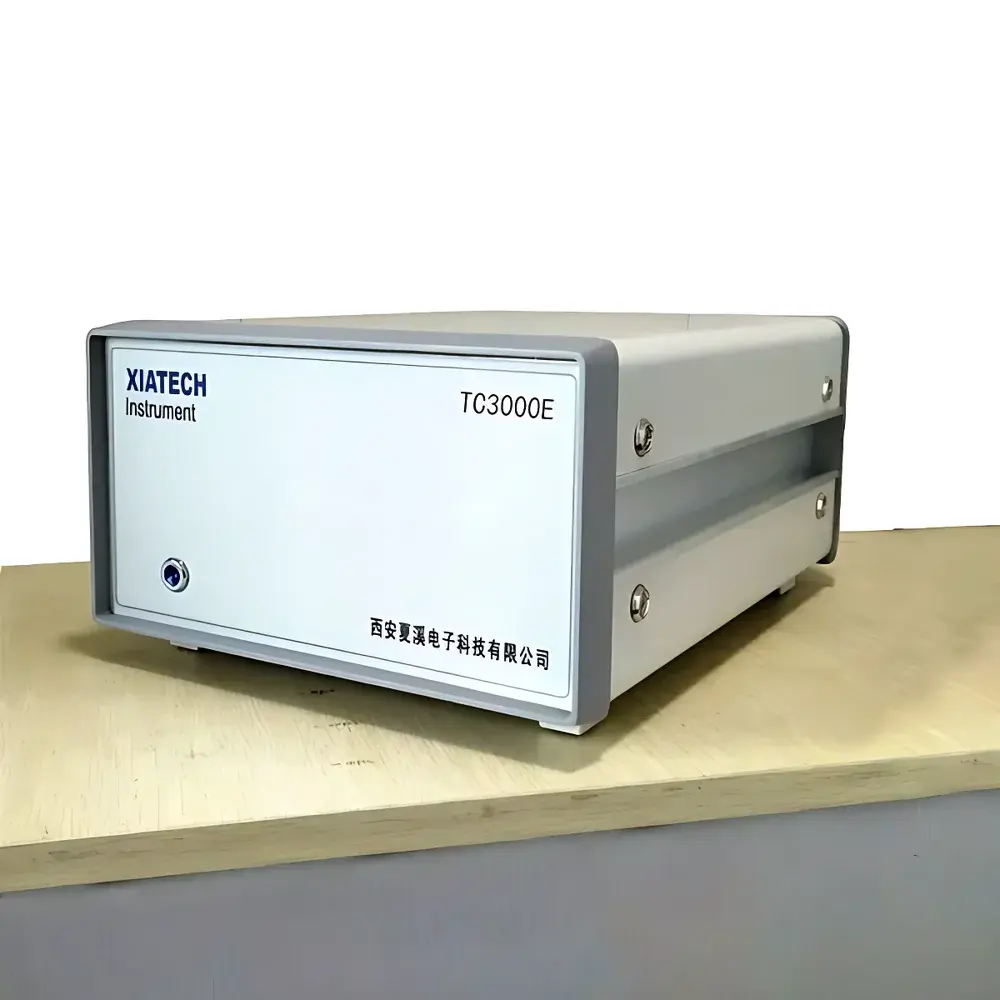
Xiatech TC3000 Series Hot Wire Method Thermal Conductivity Analyzer
| Brand | Xiatech |
|---|---|
| Origin | Shaanxi, China |
| Model | TC3000 Series |
| Measurement Principle | Transient Hot Wire (THW) |
| Thermal Conductivity Range | 0.001–50 W/(m·K), extendable to 100 W/(m·K) |
| Accuracy | ±3% |
| Repeatability | ±3% |
| Sample Form Compatibility | Solid blocks, sheets, powders, granules, pastes, gels, liquids (no geometric constraints) |
| Test Atmosphere | Ambient air |
| Operating Temperature | High-temperature capable (ambient to ≥200 °C, system-dependent) |
| Dimensions (L×W×H) | 550 × 500 × 650 mm |
| Compliance | ASTM C1113, ASTM D5930, GB/T 10297, GB/T 11205 |
Overview
The Xiatech TC3000 Series is a transient hot wire (THW) thermal conductivity analyzer engineered for precision, speed, and versatility in both laboratory research and industrial quality control environments. Based on the well-established THW principle—where a thin metallic wire acts simultaneously as heater and resistance thermometer—the instrument measures the rate of temperature rise in response to a constant-step electrical current input. This transient response is directly related to the thermal conductivity of the surrounding medium via Fourier’s law and the solution to the radial heat conduction equation in an infinite medium. The TC3000 Series delivers high reproducibility across diverse material classes without requiring sample shape standardization or extensive preparation, making it especially suitable for heterogeneous, temperature-sensitive, or compositionally unstable materials where contact-based steady-state methods may introduce artifacts or degradation.
Key Features
- High-accuracy measurement with ±3% accuracy over the full range (0.001–50 W/(m·K)), validated against NIST-traceable reference materials; optional calibration kits available for extended range up to 100 W/(m·K)
- Rapid single-point acquisition: stable thermal conductivity values obtained within 1–20 seconds per test, enabling high-throughput screening and real-time process monitoring
- Minimal sample requirement: no minimum mass or dimensional constraints—irregular, anisotropic, or fragile samples (e.g., aerogels, biological tissues, uncured pastes) can be measured in situ
- Non-destructive operation: low-power heating pulses (<100 mW) and short duration ensure negligible thermal perturbation, preserving sample integrity during repeated measurements
- Universal probe design: one integrated platinum-wire sensor accommodates solids, powders, gels, liquids, and suspensions—eliminating probe swaps, cross-contamination risks, and setup delays
- Robust mechanical architecture: rigid aluminum frame with thermal isolation mounts minimizes ambient drift; built-in temperature stabilization supports high-temperature testing up to 200 °C (with optional furnace module)
Sample Compatibility & Compliance
The TC3000 Series accepts samples in all common physical states—including rigid blocks, flexible sheets, loose granules, cohesive pastes, viscoelastic gels, and Newtonian/non-Newtonian liquids—without preprocessing or molding. Circular or square cross-sections are not required; irregular geometries (e.g., rock fragments, plant stems, composite cutouts) are routinely analyzed. Testing occurs under ambient atmospheric conditions unless paired with optional inert-gas purge or vacuum chamber accessories. The system complies with internationally recognized standards for transient thermal conductivity measurement: ASTM C1113 (standard test method for thermal conductivity of refractory materials by the hot-wire method), ASTM D5930 (standard test method for thermal conductivity of plastics), GB/T 10297 (Chinese national standard for thermal conductivity of nonmetallic solids), and GB/T 11205 (rubber and rubber products). Data traceability meets GLP and GMP documentation requirements, including timestamped raw voltage/time logs and operator ID tagging.
Software & Data Management
The TC3000 Series runs on Xiatech’s proprietary ThermalLab™ software (Windows 10/11 compatible), offering intuitive workflow-driven operation from sample loading to report export. Real-time visualization includes voltage decay curves, temperature rise profiles, and automatic curve-fitting using least-squares regression on the log(t)-ΔT domain. All raw data files (.tdf) are stored with embedded metadata (instrument ID, calibration date, environmental conditions, user notes). Export formats include CSV, Excel, PDF reports (with customizable templates), and XML for LIMS integration. Audit trail functionality records all parameter changes, measurement initiations, and calibration events—fully compliant with FDA 21 CFR Part 11 requirements when configured with electronic signature modules.
Applications
- Advanced Materials R&D: Characterization of thermal interface materials (TIMs), phase-change composites, ceramic matrix composites, and nanoparticle-enhanced polymers
- Geosciences & Building Materials: In-situ thermal profiling of soil cores, sediment layers, insulation foams, and fire-resistant cladding systems
- Life Sciences & Food Engineering: Quantifying thermal transport in biological tissues, hydrogels, pharmaceutical excipients, and food matrices (e.g., cheese, dough, frozen meals)
- Energy & Lubrication: Viscosity-independent thermal assessment of refrigerants, synthetic lubricants, battery electrolytes, and nanofluids under thermal cycling
- Quality Assurance: Batch-to-batch verification of thermal paste consistency, rubber compound homogeneity, and polymer extrusion uniformity in production lines
FAQ
What is the underlying measurement principle of the TC3000 Series?
It employs the transient hot wire (THW) method, where a fine platinum wire is embedded in the sample and subjected to a constant current pulse; thermal conductivity is derived from the time-dependent temperature rise recorded via the wire’s resistance change.
Can the TC3000 measure anisotropic materials?
Yes—by orienting the probe along different axes and performing directional measurements, effective thermal conductivity tensors can be approximated for layered or fiber-reinforced composites.
Is calibration required before each test?
No—factory calibration with certified reference oils and solids is performed prior to shipment; users may execute periodic verification using supplied glycerol or ethanol standards (traceable to NIST SRM 1451a).
Does the system support automated multi-sample testing?
The base TC3000 operates in single-sample mode; however, integration with robotic sample changers (e.g., XYZ stage + auto-loader) is supported via RS-232/Ethernet API for unattended batch analysis.
How does ambient temperature fluctuation affect measurement stability?
The instrument incorporates dual-stage thermal shielding and real-time ambient compensation algorithms; drift is typically <0.1% per °C deviation within the operating range of 15–35 °C.



