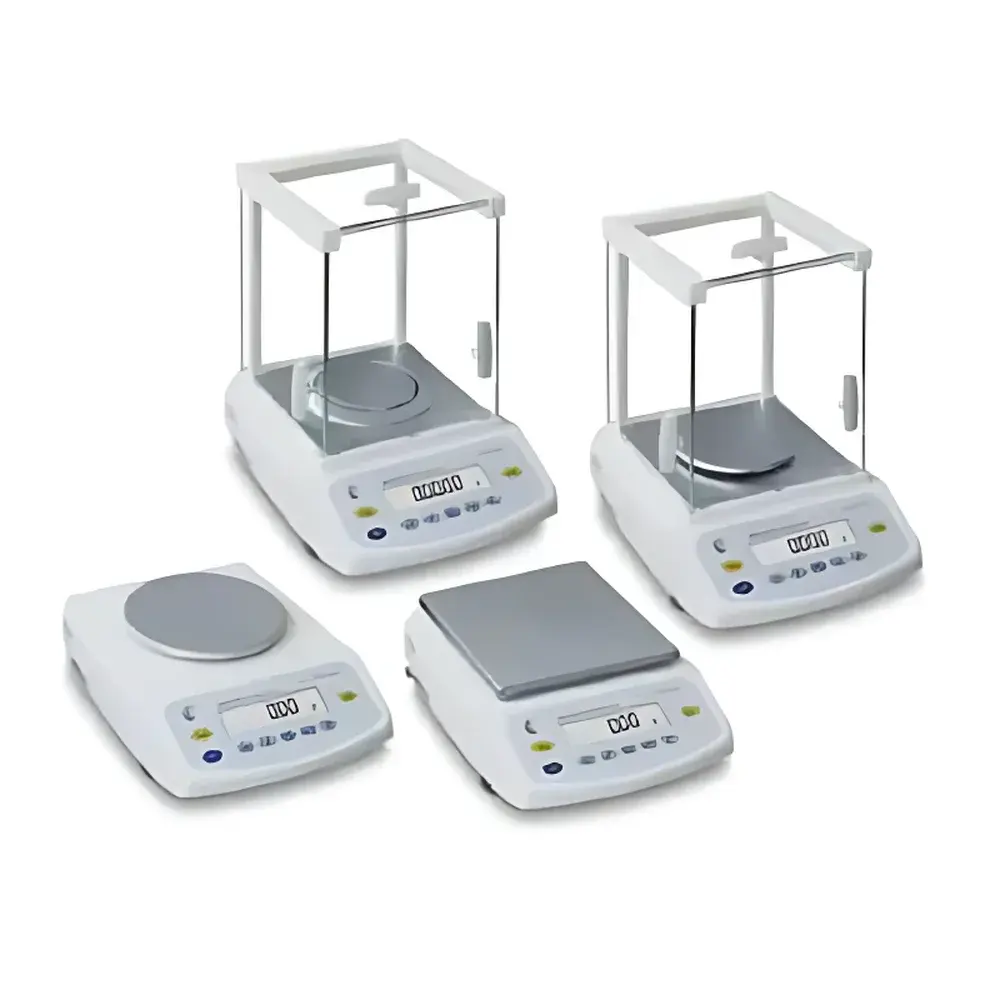
Sartorius CPA1003P Precision Balance
| Brand | Sartorius |
|---|---|
| Origin | Germany |
| Model | CPA1003P |
| Readability | 1 mg |
| Capacity | 1000 g |
| Repeatability | ±0.001 g |
| Linearity | ±0.002 g |
| Calibration | Internal, isoCAL® automatic adjustment |
| Display | Backlit LCD, 16 mm digit height |
| Pan Diameter | Ø110 mm |
| Interface | RS-232C |
| Compliance | ISO/IEC 17025, GLP, FDA 21 CFR Part 11 (with audit trail enabled via software) |
| Built-in Applications | Percentage weighing, net/gross summation, animal weighing, piece counting, unit conversion |
| Optional Accessories | YDP20-0CE printer, Sartorius LabX® software integration |
Overview
The Sartorius CPA1003P Precision Balance is an ISO/IEC 17025–aligned laboratory balance engineered for high-reproducibility mass measurement in regulated and non-regulated analytical environments. Operating on electromagnetic force compensation (EMFC) principle, it delivers stable, drift-resistant readings under variable ambient conditions—including minor air currents and temperature fluctuations common in shared lab spaces. With a 1000 g capacity and 1 mg readability, the CPA1003P bridges the performance gap between analytical and precision balances, making it suitable for quantitative sample preparation, reagent dispensing, formulation verification, and QC release testing where sub-milligram resolution is required but full analytical-grade draft housing is not mandated. Its monolithic weighing sensor—patented by Sartorius—minimizes mechanical hysteresis and thermal drift, ensuring long-term stability without recalibration dependency beyond scheduled isoCAL® routines.
Key Features
- isoCAL® integrated internal calibration and adjustment system: fully automated, motor-driven calibration using built-in reference weights; triggered manually or scheduled at user-defined intervals (e.g., after power-on, time-based, or temperature-triggered)
- Backlit LCD display with 16 mm high digits: optimized for legibility under low-light or high-glare conditions; supports multi-language UI (English, German, French, Spanish, Chinese, Japanese)
- RS-232C serial interface as standard: enables bidirectional communication with PCs, LIMS, ELN systems, or Sartorius YDP20-0CE thermal printers for GLP-compliant record generation
- Built-in application modes: percentage weighing (reference-based % deviation), net/gross accumulation, dynamic animal weighing (filtering motion-induced instability), piece counting (with sample weight input), and metric/imperial unit conversion
- Robust die-cast aluminum housing with chemically resistant pan support: designed for durability in high-throughput labs handling solvents, acids, or particulates
- GLP documentation readiness: timestamped, operator-ID–capable data export (when paired with LabX® or certified third-party software); supports 21 CFR Part 11 audit trails when configured with electronic signature and role-based access control
Sample Compatibility & Compliance
The CPA1003P accommodates samples up to Ø110 mm in diameter on its stainless-steel weighing pan, compatible with standard weigh boats, crucibles, beakers, and filtration assemblies. Its open-frame design permits easy cleaning and minimizes static buildup—critical for low-mass powders or hygroscopic materials. The balance conforms to ISO 9001:2015 quality management requirements and meets metrological criteria outlined in OIML R 76-1 (Class II). For regulated pharmaceutical or clinical labs, it supports traceable calibration via accredited external weights (optional external calibration mode) and satisfies documentation requirements of USP , EP 2.1.6, and ISO/IEC 17025 clause 6.5.2 for equipment verification. All firmware updates are version-controlled and validated per Sartorius’s internal GxP-aligned change control process.
Software & Data Management
Data output from the CPA1003P is ASCII-formatted and protocol-compatible with industry-standard serial communication standards (e.g., Modbus RTU, Sartorius SICS). When connected to Sartorius LabX® software (v3.10+), the balance integrates into centralized instrument management workflows—enabling remote configuration, real-time data capture, automated report generation, and electronic signature enforcement. Raw weight values include metadata: date/time stamp, operator ID (if entered), balance ID, stability flag, and unit identifier. Printer outputs (via YDP20-0CE) include configurable headers, GLP footer lines (e.g., “Calibrated per SOP-WEIGH-007”), and checksum validation for data integrity assurance.
Applications
- Pharmaceutical: Excipient and API weighing for tablet batch formulation; filter membrane gravimetric analysis per USP <>1251
- Academic Research: Sample mass verification prior to ICP-MS digestion; catalyst loading in heterogeneous catalysis studies
- Food & Beverage QA: Moisture loss determination via gravimetric drying; ingredient proportioning in R&D pilot batches
- Materials Science: Powder density determination (tap density, bulk density); electrode coating mass uniformity checks
- Environmental Labs: Filter weight gain measurement for PM2.5/PM10 particulate quantification per EPA Method 201A
FAQ
Does the CPA1003P support external calibration with NIST-traceable weights?
Yes—external calibration mode is accessible via menu navigation and supports user-provided Class E2 or better reference masses.
Can the balance store multiple user profiles locally?
No—the CPA1003P does not feature onboard user account storage; operator identification is entered manually per session or enforced externally via LabX®.
Is isoCAL® compliant with ISO/IEC 17025 clause 6.4.10 regarding calibration frequency justification?
Yes—isoCAL® logs all calibration events with environmental parameters (temperature, time since last calibration), enabling objective, risk-based justification of recalibration intervals per ISO/IEC 17025 Annex A.
What is the warm-up time required to achieve specified repeatability?
Minimum 30 minutes after power-on at stable ambient temperature (20–25 °C); full specification compliance achieved after 60 minutes.
Does the RS-232C interface support plug-and-play USB adapters?
Yes—standard FTDI-based USB-to-RS232 adapters are fully compatible; driver installation required on host PC.