
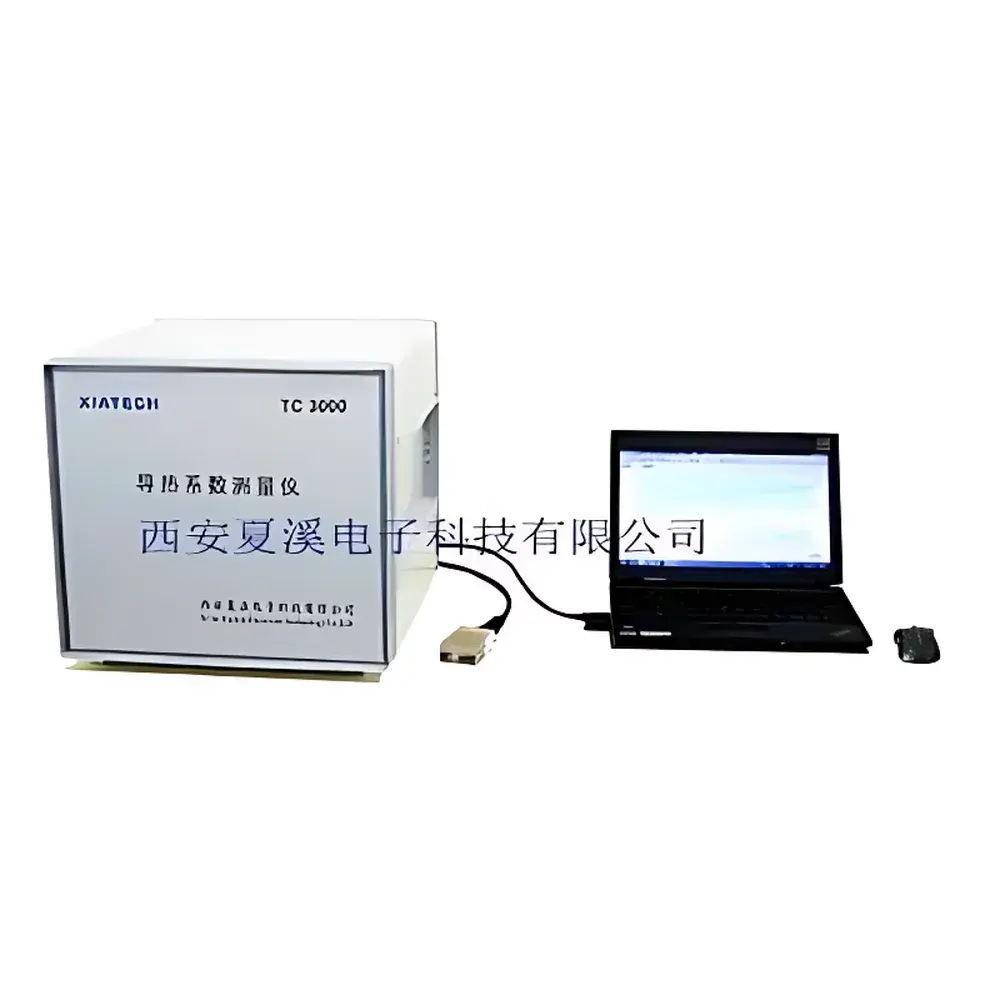
Xiatech TC3200 High-Temperature Transient Hot Wire Thermal Conductivity Analyzer
| Brand | Xiatech |
|---|---|
| Origin | Shaanxi, China |
| Model | TC3200 |
| Measurement Principle | Transient Hot Wire (THW) Method |
| Sample Form | Solid & Liquid |
| Test Atmosphere | Ambient Air |
| Temperature Capability | High-Temperature Operation |
| Dimensions (L×W×H) | 550 × 500 × 650 mm |
| Accuracy | ±3–5% |
| Thermal Conductivity Range | 0.001–50 W/(m·K), extendable to 100 W/(m·K) |
| Repeatability | ±3% |
| Sample Throughput | Single-sample sequential mode |
| Compliance | ASTM C1113, ASTM D5930, GB/T 10297, GB/T 11205 |
Overview
The Xiatech TC3200 is a high-temperature transient hot wire (THW) thermal conductivity analyzer engineered for precision measurement of thermal transport properties in both solid and liquid materials under elevated temperature conditions. Based on the internationally standardized transient hot wire method—defined in ASTM C1113 and ASTM D5930—the instrument determines thermal conductivity by monitoring the time-dependent temperature rise of a thin, electrically heated platinum wire embedded in or inserted into the sample. This principle enables direct, absolute measurement without calibration against reference standards, delivering high reproducibility and minimal dependence on sample geometry. The TC3200 is specifically designed for laboratories requiring reliable characterization of thermally stable and moderately unstable materials—including phase-change composites, high-viscosity fluids, and heterogeneous solids—across a broad thermal conductivity range (0.001–50 W/(m·K), extendable to 100 W/(m·K)) and elevated operational temperatures.
Key Features
- Transient hot wire methodology compliant with ASTM C1113 (for solids) and ASTM D5930 (for liquids), ensuring traceable, standard-aligned results
- High-temperature capable architecture supporting stable measurements under ambient air atmosphere up to specified thermal limits
- Rapid data acquisition: single measurement completed within 1–20 seconds, with automated multi-cycle averaging to enhance statistical robustness
- Geometry-insensitive operation—no requirement for machined discs, cylinders, or parallel surfaces; accommodates irregular, granular, paste-like, or bulk samples without probe replacement
- Low-power heating protocol minimizes thermal perturbation, enabling non-destructive evaluation of compositionally sensitive or thermally labile materials
- Integrated thermal shielding and environmental stabilization to mitigate convection and radiation artifacts during high-temperature testing
Sample Compatibility & Compliance
The TC3200 accepts a wide spectrum of physical forms: rigid and flexible solids (e.g., ceramics, polymers, metals, rocks, biological tissues), powders, granular media, gels, pastes, viscous liquids (e.g., thermal greases, lubricants, nanofluids), and low-melting-point alloys (e.g., NaK). Its design eliminates the need for sample encapsulation or surface polishing. All measurements are conducted in ambient air unless otherwise specified by user-defined thermal management protocols. The system meets the metrological requirements of ASTM C1113 (Standard Test Method for Thermal Conductivity of Refractory Materials by the Hot-Wire Method), ASTM D5930 (Standard Test Method for Thermal Conductivity of Plastics), GB/T 10297 (Chinese national standard for thermal conductivity of non-metallic solids), and GB/T 11205 (for rubber and elastomers). While not intrinsically certified for GLP/GMP environments, its measurement traceability, repeatability (±3%), and documented uncertainty budget support integration into quality-controlled workflows aligned with ISO/IEC 17025 principles.
Software & Data Management
Instrument control, real-time signal acquisition, and post-processing are executed via Xiatech’s proprietary THW analysis software suite. The interface provides full parameter logging—including voltage, current, resistance, and thermistor feedback—with timestamped metadata per test cycle. Raw thermal decay curves are exportable in CSV format for third-party analysis (e.g., MATLAB, Python SciPy). Software supports batch processing of multiple samples, automatic outlier rejection based on residual deviation thresholds, and generation of compliance-ready reports including uncertainty estimation per ISO/IEC Guide 98-3 (GUM). Audit trails record operator ID, session timestamps, and configuration changes—facilitating alignment with FDA 21 CFR Part 11 requirements when deployed with validated electronic signature modules and secure user access controls.
Applications
- Materials R&D: Characterization of thermal interface materials (TIMs), phase-change composites, aerogels, and ceramic matrix composites under thermal load
- Energy sector: Evaluation of molten salts, liquid metal coolants (e.g., NaK), and high-temperature heat transfer fluids for CSP and nuclear applications
- Geosciences: In-situ compatible thermal profiling of soil cores, rock specimens, and sediment analogues at controlled ambient-equivalent conditions
- Pharmaceutical & biotech: Thermal stability assessment of hydrogels, injectables, and lyophilized formulations across storage-relevant temperature ranges
- Automotive & electronics: QC verification of thermal greases, potting compounds, and encapsulants used in battery thermal management systems
- Academic research: Teaching and validation experiments in heat transfer, thermophysics, and soft matter physics laboratories
FAQ
What is the fundamental measurement principle employed by the TC3200?
The TC3200 utilizes the transient hot wire (THW) method, where a fine platinum wire serves as both heater and thermometer; thermal conductivity is derived from the slope of the natural logarithm of temperature versus time curve during constant-power heating.
Can the TC3200 measure liquid metals such as sodium-potassium (NaK) alloys?
Yes—provided the sample remains chemically compatible with the platinum wire and housing materials at operating temperature, and appropriate safety and containment protocols are followed per institutional EH&S guidelines.
Is vacuum or inert gas testing capability available?
The base configuration operates in ambient air; optional furnace-integrated vacuum or purge gas chambers (N₂, Ar) can be integrated upon request for specialized atmospheric control.
How is calibration verified on this instrument?
Calibration is performed using certified reference materials (CRMs) traceable to NIM (National Institute of Metrology, China) or NIST, with periodic verification recommended per ISO/IEC 17025 internal audit schedules.
Does the system support unattended overnight testing?
Yes—the software enables scheduled sequential runs with auto-shutdown and error logging; however, continuous high-temperature exposure requires thermal safety interlocks and environmental monitoring external to the unit.



