
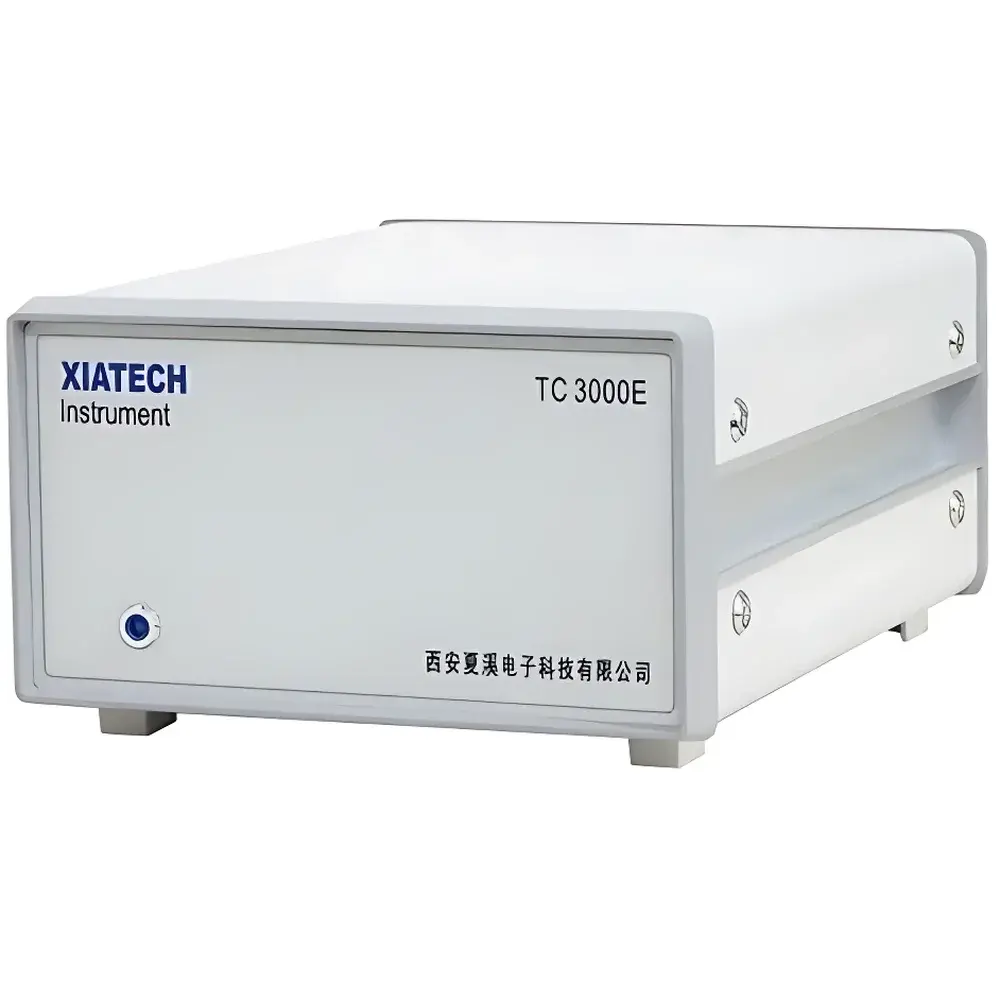
Xiatech TC3000E-1 Portable Thermal Conductivity Analyzer
| Brand | Xiatech |
|---|---|
| Origin | Shaanxi, China |
| Model | TC3000E-1 |
| Measurement Principle | Transient Hot Wire (THW) Method |
| Thermal Conductivity Range | 0.001–50 W/(m·K) |
| Repeatability | ±3% |
| Accuracy | ±3% |
| Sample Forms | Solid, Liquid |
| Test Atmosphere | Air or Vacuum |
| Operating Environment | Ambient Pressure |
| Temperature Range | Room Temperature (20–25 °C) |
| Sample Size Requirement | Minimum dimension >25 mm |
| Dimensions (L×W×H) | 350 × 250 × 150 mm |
| Sample Throughput | Single-sample sequential testing |
Overview
The Xiatech TC3000E-1 Portable Thermal Conductivity Analyzer is a compact, field-deployable instrument engineered for rapid and reliable thermal conductivity measurement using the transient hot wire (THW) method—a standardized technique defined in ASTM D7896-19 and ISO 22007-2. Unlike guarded-hot-plate or laser-flash methods, THW relies on measuring the temperature rise of a thin, electrically heated wire embedded in the sample over time; thermal conductivity is derived directly from the slope of the ln(t)-T curve, eliminating dependency on sample density, specific heat, or thermal diffusivity inputs. This direct physical principle ensures traceable, first-principle-based results with minimal calibration drift. Designed for both laboratory benchtop use and on-site deployment—including construction sites, geological survey vehicles, and manufacturing QA labs—the TC3000E-1 maintains metrological integrity without requiring environmental enclosures or active temperature control beyond ambient stability.
Key Features
- Transient Hot Wire (THW) Core Architecture: Utilizes a precision platinum wire sensor with controlled current pulse and high-resolution thermometry to capture thermal response within milliseconds—enabling measurements in under 60 seconds per sample.
- Direct Parameter Output: Reports thermal conductivity (W/(m·K)) natively; no secondary property inputs (e.g., density, Cp) are required, reducing operator error and simplifying SOP execution.
- Broad Material Compatibility: Validated for solids (rigid, porous, anisotropic), liquids (Newtonian and non-Newtonian), gels, pastes, and heterogeneous media—including moist soils, biological tissues, and phase-change composites—without sensor replacement or hardware modification.
- Field-Ready Portability: Weighing under 4.2 kg and housed in an IP54-rated enclosure, the unit operates on internal Li-ion battery (optional AC adapter) and features integrated shock-absorbing feet and ergonomic carry handle.
- Robust Metrological Performance: Achieves ±3% accuracy and repeatability across its full 0.001–50 W/(m·K) range, verified against NIST-traceable reference materials (e.g., glycerol, Pyrex glass, copper) per ISO/IEC 17025-compliant validation protocols.
- Minimal Sample Demand: Accepts irregularly shaped specimens with any one dimension ≥25 mm; no machining, polishing, or vacuum drying is mandatory—even for hygroscopic or volatile samples tested under inert or vacuum conditions.
Sample Compatibility & Compliance
The TC3000E-1 accommodates diverse physical states and industrial material classes: rigid polymers (e.g., polyimide foams), elastomers (silicone rubber, EPDM), thermal interface materials (TIMs), mineral aggregates (sandstone, basalt), metallic alloys (Al 6061, Cu C11000), biological matrices (wood, muscle tissue), and colloidal systems (lithium grease, hydrogels, nanofluids). Testing may be conducted under ambient air or low-pressure vacuum (down to 10 Pa), supporting ASTM C1113 (hot wire for refractories) and ISO 22007-2 Annex A (liquid and soft solid protocols). While not certified for GLP or FDA 21 CFR Part 11 out-of-the-box, the instrument’s deterministic algorithm, timestamped raw data export (CSV), and audit-ready test logs enable integration into validated QA/QC workflows compliant with ISO 9001, IATF 16949, and ASTM E2500-18 system lifecycle requirements.
Software & Data Management
The TC3000E-1 runs embedded firmware v3.2 with a touchscreen GUI supporting multilingual UI (English, German, Japanese, Chinese). All measurements are stored locally with metadata (date/time, operator ID, ambient T/P, atmosphere mode, sample ID). Data export occurs via USB-C to CSV or Excel-compatible formats, including raw voltage-time arrays, fitted ln(t)-T plots, and uncertainty estimates per GUM (JCGM 100:2019). Optional PC software (TCSoft v4.1) provides batch analysis, statistical trending (X̄-R charts), report generation (PDF/HTML), and configurable pass/fail thresholds aligned with internal spec limits or industry standards (e.g., MIL-STD-810G thermal specs).
Applications
- Building Science: On-site verification of insulation board R-values, aerogel performance, and moisture-induced conductivity shifts in wall assemblies.
- Electronics Thermal Management: Screening of thermal greases, gap fillers, and underfill materials prior to reflow soldering process qualification.
- Geotechnical Engineering: In-field characterization of soil thermal resistivity for underground cable ampacity modeling (IEC 60287-3-2).
- Materials R&D: High-throughput screening of polymer nanocomposites, PCM microencapsulates, and bio-based foams during formulation development.
- Pharmaceutical & Food: Stability assessment of lyophilized cakes, emulsion-based delivery systems, and frozen food thermal history profiling.
FAQ
Does the TC3000E-1 require calibration with certified reference materials before each use?
No—factory calibration is stable for 12 months under normal operating conditions. Annual recalibration against NIST-traceable standards (e.g., distilled water at 25 °C, k = 0.606 W/(m·K)) is recommended per ISO/IEC 17025.
Can it measure anisotropic materials such as layered composites or wood?
Yes—orientation-dependent measurements are possible by aligning the hot wire parallel or perpendicular to structural axes; directional thermal conductivity ratios can be reported with appropriate sample mounting fixtures.
Is vacuum operation compatible with liquid samples?
Vacuum mode is intended for degassing viscous liquids or eliminating convection artifacts in low-k materials; volatile solvents must be pre-stabilized or measured under inert gas purge to prevent boiling or sensor contamination.
What is the minimum detectable thermal conductivity, and how is noise managed at the lower limit?
At 0.001 W/(m·K), signal-to-noise ratio is maintained via adaptive current pulsing, 24-bit delta-sigma ADC sampling, and real-time outlier rejection in the linear regression domain.
Does the instrument support automated sequence testing for quality control lines?
Not natively—but external PLC triggering via TTL I/O port enables integration into semi-automated test cells with barcode-linked sample ID logging via optional RS-485 module.
Related Products



