
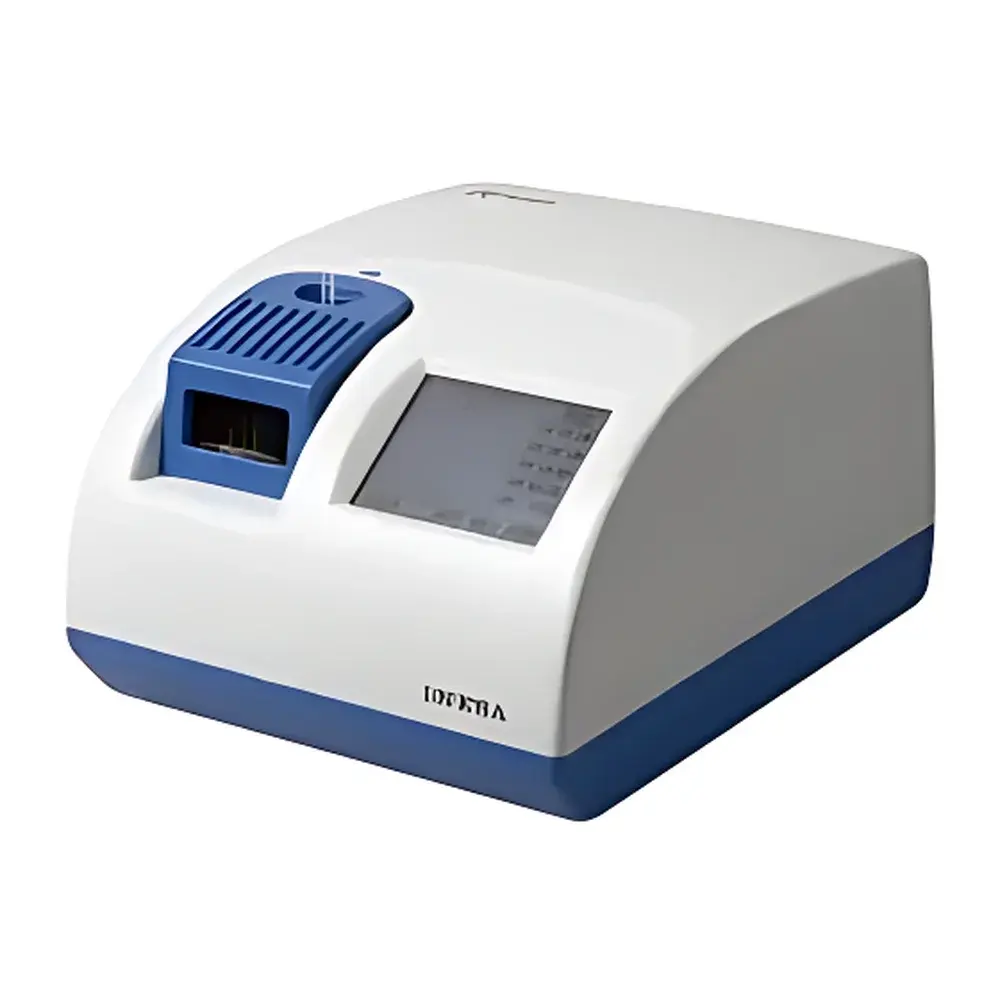
Jihepu WRS-3 Dual-Mode Visual and Photometric Melting Point Apparatus
| Brand | Jihepu |
|---|---|
| Model | WRS-3 |
| Temperature Range | Ambient to 320 °C |
| Heating Rate Options | 0.2, 1.0, 1.5, 3.0 °C/min |
| Temperature Resolution | ±0.5 °C |
| Temperature Accuracy | ±0.5 °C (≤200 °C), ±0.8 °C (200–300 °C) |
| Temperature Repeatability | 0.3 °C at 1.0 °C/min |
| Capillary Dimensions | OD 1.2 mm, ID 1.0 mm, Length 120 mm |
| Sample Capacity | 3 positions |
| Power Supply | AC 220 V ±10%, 50 Hz, 100 W |
| Interfaces | RS232, USB |
| Display | Touchscreen LCD |
Overview
The Jihepu WRS-3 Dual-Mode Visual and Photometric Melting Point Apparatus is a precision thermal analysis instrument engineered for reliable, traceable determination of solid-phase transition temperatures in pharmaceuticals, fine chemicals, polymers, and organic compounds. It operates on the principle of controlled linear heating combined with simultaneous optical detection and human-aided visual observation—enabling unambiguous identification of onset, clear point, and complete melt stages. Unlike single-mode instruments, the WRS-3 integrates both photometric (light-transmittance-based) detection and direct capillary viewing through an integrated optical path and magnified eyepiece, ensuring robust performance across diverse sample types—including highly pigmented, opaque, or low-contrast substances where conventional photometric sensors may yield ambiguous endpoints. Its PID-controlled heating system delivers stable thermal ramping with minimal overshoot, supporting compliance-critical workflows in QC laboratories operating under GLP or GMP frameworks.
Key Features
- Dual-mode measurement architecture: Independent yet synchronized visual observation and photometric detection—eliminating reliance on a single endpoint criterion
- Three-sample parallel analysis capability with independent thermal zones, improving throughput without cross-contamination risk
- Programmable linear heating rates (0.2, 1.0, 1.5, 3.0 °C/min) calibrated per ASTM E324 and ISO 6179 standards
- High-contrast touchscreen interface with real-time temperature curve display, adjustable brightness, and intuitive parameter entry
- Thermal accuracy validated across full range: ±0.5 °C below 200 °C and ±0.8 °C up to 300 °C (traceable to NIST-certified reference materials)
- Integrated RS232 and USB interfaces support bidirectional data exchange with LIMS or electronic lab notebooks (ELN), enabling audit-ready record generation
Sample Compatibility & Compliance
The WRS-3 accepts standard thin-walled glass capillaries (OD 1.2 mm, ID 1.0 mm, length 120 mm) filled to ≥3 mm height—compatible with USP , Ph. Eur. 2.2.17, and JP 17 methodologies. Its dual-mode design ensures consistent performance with crystalline APIs, dyes, metal-organic frameworks (MOFs), and thermally sensitive intermediates that exhibit gradual opacity changes rather than sharp transmittance shifts. The instrument meets mechanical and electrical safety requirements per IEC 61010-1 and supports documentation protocols aligned with FDA 21 CFR Part 11 when paired with compliant software—providing electronic signature capability, user access control, and immutable audit trails for temperature calibration logs and test reports.
Software & Data Management
While the WRS-3 operates autonomously via embedded firmware, its RS232 and USB ports enable seamless integration with third-party laboratory software platforms. Raw temperature/time datasets are exportable in CSV format for post-acquisition analysis in MATLAB, Origin, or Python-based QA tools. Timestamped measurement records include operator ID, capillary position, heating rate, observed onset/clear points, and photometric threshold crossings—facilitating retrospective review during regulatory inspections. Firmware updates preserve backward compatibility and incorporate corrections validated against certified reference standards (e.g., indium, caffeine, phenacetin).
Applications
- Pharmaceutical QC: Identity confirmation and purity assessment of active pharmaceutical ingredients (APIs) per USP monographs
- Chemical synthesis validation: Monitoring reaction completion and intermediate isolation purity in R&D labs
- Polymorph screening: Differentiating thermally distinct crystalline forms where subtle melting behavior informs formulation stability
- Educational laboratories: Teaching fundamental principles of phase transitions, thermal kinetics, and analytical method validation
- Regulatory submissions: Generating GLP-compliant melting data packages for ANDA, DMF, or CMC sections
FAQ
Does the WRS-3 comply with pharmacopeial requirements for melting point determination?
Yes—the instrument’s thermal accuracy, repeatability, and dual-mode verification protocol align with USP , EP 2.2.17, and JP 17 specifications for manual and automated methods.
Can the WRS-3 be used for samples with very dark coloration or low optical contrast?
Yes—its integrated visual observation mode allows trained analysts to manually identify melt onset independently of photometric signal, making it suitable for carbon-black-loaded polymers, metal complexes, and heavily substituted aromatics.
Is calibration traceable to national standards?
Calibration is performed using NIST-traceable reference materials (e.g., indium, 113.1 °C; tin, 231.9 °C), and certificate documentation follows ISO/IEC 17025 guidelines.
What maintenance is required for long-term accuracy?
Annual verification of heating block uniformity and photodetector linearity is recommended; capillary holder alignment checks should be conducted quarterly per internal SOPs.



