
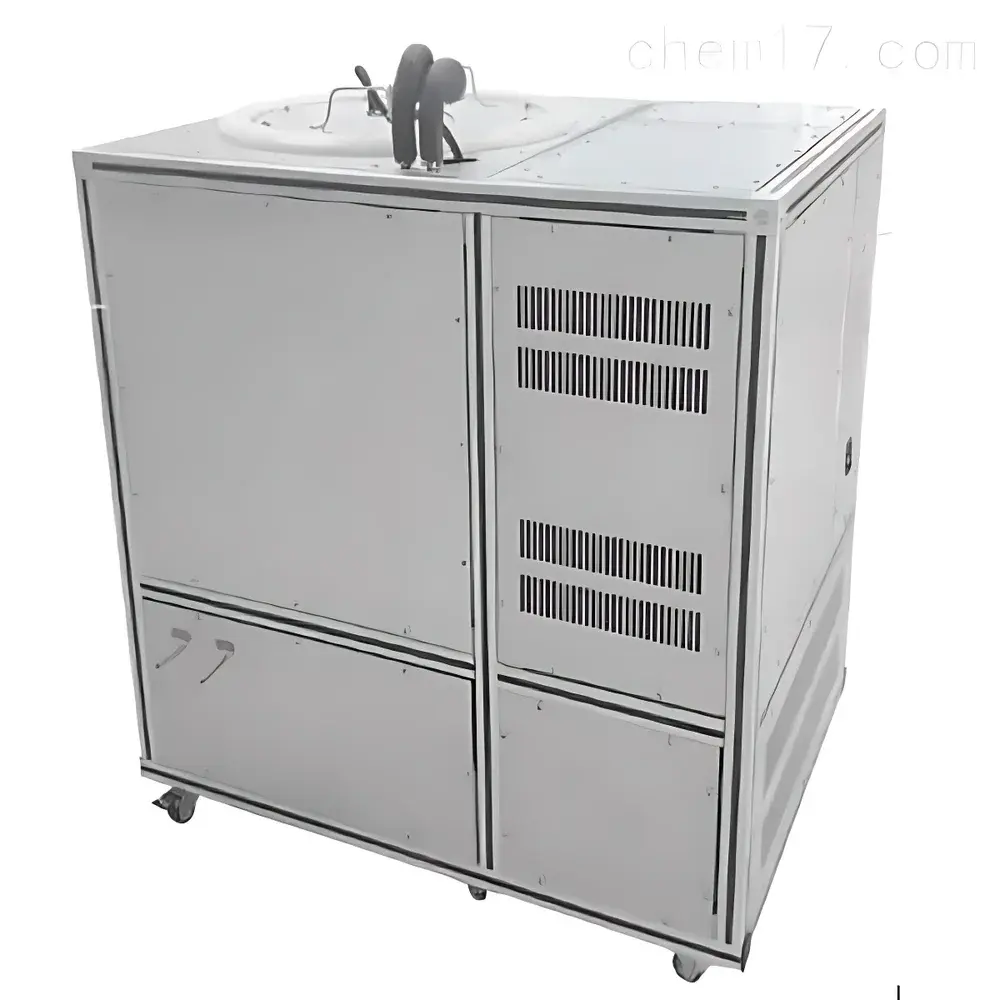
Xiatech TC1000 Series Axial/Radial Heat Pipe Method Thermal Conductivity Analyzer
| Brand | Xiatech |
|---|---|
| Model | TC1000 Series (Customizable) |
| Origin | Shaanxi, China |
| Thermal Conductivity Range | 0.05–50 W/(m·K) |
| Axial Range | 0.2–50 W/(m·K) |
| Radial Range | 0.05–5 W/(m·K) |
| Sample OD | 150 mm |
| Wall Thickness | 1–200 mm |
| Length | 100–1500 mm |
| Temperature Range | −30 to 100 °C |
| Temperature Control Accuracy | ±0.05 °C |
| Accuracy | ±3 % to ±8 % |
| Repeatability | ±3 % |
| Test Atmosphere | Air |
| Dimensions (L×W×H) | 1100×800×1500 mm |
| Data Interface | USB |
| Operating System | Windows |
| Ambient Conditions | 0–40 °C, ≤65 % RH |
| Power Supply | 220 V, 50 Hz |
Overview
The Xiatech TC1000 Series Axial/Radial Heat Pipe Method Thermal Conductivity Analyzer is an engineered solution for the precise determination of anisotropic thermal transport properties in cylindrical tubular materials—particularly fiber-reinforced polymer composites, ceramic matrix composites, and multilayered metal-polymer hybrids with thin-walled geometries. Unlike steady-state guarded-hot-plate or transient plane source methods, this instrument implements the heat pipe principle: a sealed, thermally conductive capillary structure establishes a stable, one-dimensional axial temperature gradient across the sample wall while minimizing parasitic radial conduction and convective losses. By simultaneously monitoring high-resolution surface temperatures on both inner and outer cylindrical surfaces via calibrated thermocouple arrays, the system solves the inverse heat conduction problem under cylindrical coordinates, enabling independent quantification of axial (longitudinal) and radial (transverse) thermal conductivity components. This dual-direction capability is critical for validating finite-element models used in aerospace pressure vessel design, nuclear fuel cladding qualification, and thermal interface material integration in rotating machinery.
Key Features
- Dual-axis thermal conductivity measurement: Independent determination of axial (0.2–50 W/(m·K)) and radial (0.05–5 W/(m·K)) conductivity coefficients under identical thermal boundary conditions
- Customizable sample chamber geometry: Accommodates tubular specimens with outer diameter up to 150 mm, wall thickness from 1 mm to 200 mm, and length up to 1500 mm; modular fixtures support non-standard dimensions upon request
- High-stability temperature control: PID-regulated heating/cooling system maintains setpoint accuracy within ±0.05 °C across the full operating range (−30 to 100 °C)
- Multi-point real-time thermal mapping: 16-channel thermocouple acquisition synchronously records inner/outer surface temperatures at discrete angular and axial positions, supporting spatially resolved conductivity profiling
- Integrated vacuum-compatible test environment: Optional vacuum enclosure (≤10⁻² mbar) enables testing under controlled atmospheres—including inert gas purging—to eliminate oxidative degradation during high-temperature measurements
- USB-based data acquisition with deterministic timing: Sub-second sampling resolution ensures accurate capture of thermal transients during ramp-and-soak protocols
Sample Compatibility & Compliance
The TC1000 is optimized for rigid, non-porous cylindrical samples exhibiting minimal interfacial thermal resistance between layers. It supports ASTM C1113 (Standard Test Method for Thermal Conductivity of Refractory Materials by Hot Wire Method) as a comparative reference, and its cylindrical coordinate modeling framework aligns with ISO 22007-2 Annex B guidelines for anisotropic thermal property evaluation. While not certified to GLP or FDA 21 CFR Part 11 out-of-the-box, the system’s audit-ready data logs—including timestamped raw thermocouple voltages, environmental chamber status, and user-initiated parameter changes—support internal validation for ISO/IEC 17025-accredited laboratories. All firmware and software binaries are digitally signed, and configuration files are stored with SHA-256 checksums to ensure traceability.
Software & Data Management
The proprietary TC-Control Suite runs natively on Windows 10/11 (64-bit) and provides a role-based interface for operator, technician, and administrator users. Measurement workflows are defined via XML-based protocol templates that enforce parameter constraints (e.g., maximum ramp rate, dwell time, tolerance bands). During acquisition, live thermal contour plots update in real time, overlaid with analytical solutions derived from Fourier’s law in cylindrical coordinates. Post-test, the software exports results in HDF5 format—including raw voltage traces, calibrated temperature fields, computed kaxial and kradial values with expanded uncertainty budgets (k=2), and metadata compliant with NIEM 4.2 schema. Export modules generate PDF reports conforming to ASTM E2916 (Standard Guide for Validation of Software Used in Computational Solid Mechanics) requirements.
Applications
- Qualification of carbon-fiber-reinforced polymer (CFRP) piping for cryogenic fluid transport in space launch systems
- Thermal performance benchmarking of SiC/SiC composite tubes in next-generation nuclear reactor fuel assemblies
- Validation of thermal contact resistance models at metal-polymer interfaces in electric motor stator cooling jackets
- Material screening for additively manufactured heat exchanger manifolds where directional thermal expansion mismatches induce delamination
- Research into phonon scattering mechanisms in functionally graded ceramic-metal laminates subjected to thermal cycling
FAQ
Can the TC1000 measure anisotropic conductivity in non-cylindrical samples?
No—the instrument’s physical design and mathematical inversion algorithm are intrinsically tied to axisymmetric geometry. Flat plates or irregular solids require alternative methods such as laser flash analysis (ASTM E1461) or guarded hot plate (ASTM C177).
Is vacuum operation standard or optional?
Vacuum capability is optional. The base configuration operates in ambient air; vacuum-rated versions include stainless-steel test chamber, pneumatic gate valve, and turbomolecular pumping station (base pressure ≤1×10⁻² mbar).
How is calibration traceability established?
Each unit ships with NIST-traceable thermocouple calibrations (per ASTM E230) and a certificate of conformance referencing SRM 1470a (thermally stable glass) and SRM 1471a (alumina) reference standards tested under identical boundary conditions.
Does the software support automated compliance reporting for ISO 17025 audits?
Yes—TC-Control Suite includes configurable report templates that auto-populate uncertainty budgets, equipment calibration status, environmental logs, and operator authentication records required for Clause 7.7 and Annex A.3 documentation.



