
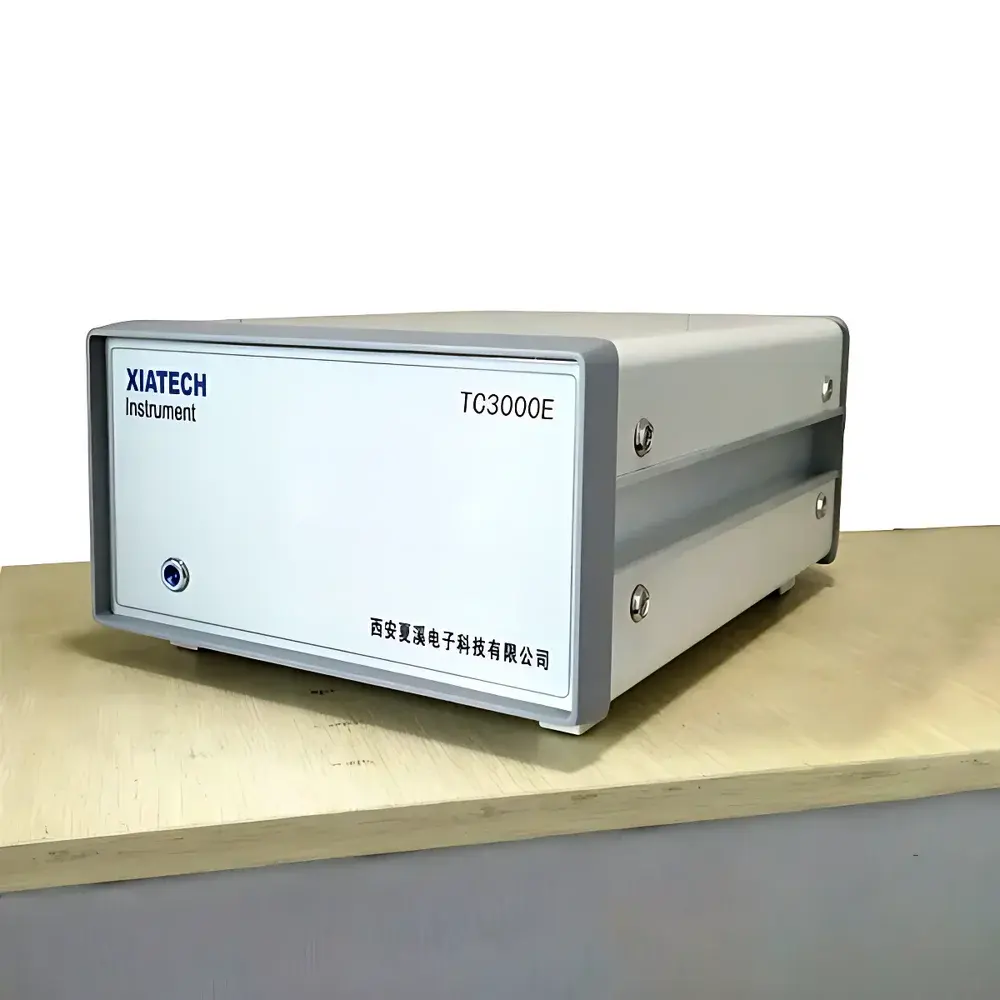

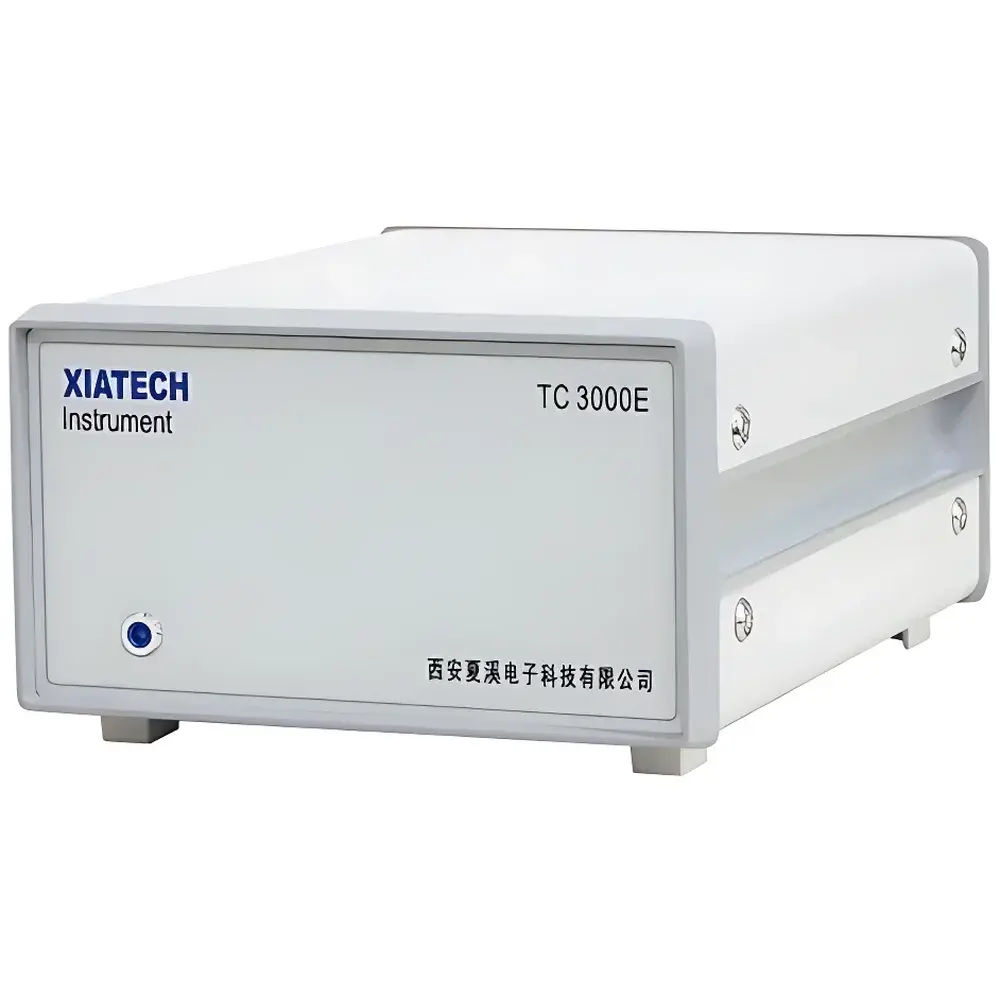
Xiatech TC3000E Portable Transient Hot Wire Thermal Conductivity Analyzer
| Brand | Xiatech |
|---|---|
| Origin | Shaanxi, China |
| Model | TC3000E-03 |
| Measurement Principle | Transient Hot Wire Method |
| Thermal Conductivity Range | 0.001–50 W/(m·K) (extendable to 100 W/(m·K)) |
| Accuracy | ±3% |
| Repeatability | ±3% |
| Resolution | 0.0005 W/(m·K) |
| Sample Form Compatibility | Solid (block, sheet), powder, paste, gel, liquid |
| Sample Geometry | Unrestricted (circular or square |
| Test Environment | Ambient air or vacuum |
| Operating Temperature Range | 10–40 °C |
| Measurement Duration | 1–20 s per test |
| Dimensions (L×W×H) | 350 × 250 × 150 mm |
| Power Supply | 220 V, 50 Hz |
| Data Interface | USB |
| Software Platform | Windows-based acquisition and analysis suite |
| Compliance Standards | ASTM C1113, ASTM D5930, GB/T 10297-1998, GB/T 11205-2009 |
Overview
The Xiatech TC3000E Portable Transient Hot Wire Thermal Conductivity Analyzer is an engineered solution for high-accuracy, field-deployable thermal property characterization. It operates on the internationally standardized transient hot wire (THW) method—defined in ASTM C1113 and ASTM D5930—where a thin, electrically heated platinum wire serves simultaneously as heater and temperature sensor embedded within the sample. The time-dependent temperature rise is recorded during a short-duration constant-power pulse, and thermal conductivity is derived from the slope of the ln(t)-T curve in the linear regime, independent of heat capacity and density. This principle ensures rapid, absolute measurement without calibration against reference standards for most homogeneous or semi-homogeneous materials. Designed explicitly for mobility, the TC3000E eliminates logistical constraints associated with laboratory-bound instrumentation, enabling direct on-site measurement at construction sites, geological survey locations, manufacturing floors, or R&D pilot lines—without compromising metrological integrity.
Key Features
- True portability: Compact footprint (350 × 250 × 150 mm) and integrated power management enable battery-independent operation in diverse environments—from outdoor soil profiling to cleanroom QC stations.
- Universal sample adaptability: Accepts solids (blocks, sheets), powders, pastes, gels, liquids, and heterogeneous composites without shape restriction—no machining or dimensional standardization required.
- High-speed transient acquisition: Single-point measurement completed in 1–20 seconds, supporting up to 100 sequential automated acquisitions via Windows software with timestamped metadata logging.
- Robust probe architecture: Platinum wire sensor with dielectric coating ensures electrical insulation—critical for safe, accurate measurement of conductive or semi-conductive materials including thermal interface materials (TIMs), graphite composites, and metal-filled pastes.
- Metrological traceability: Validated accuracy of ±3% and repeatability of ±3% against certified reference materials (e.g., PMMA, borosilicate glass); resolution of 0.0005 W/(m·K) supports detection of subtle formulation changes in R&D workflows.
Sample Compatibility & Compliance
The TC3000E accommodates a broad spectrum of industrial and academic sample classes—including insulating foams, ceramic tiles, polymer composites, geological cores, hydrated soils, food matrices, and phase-change materials—regardless of physical state or geometry. Its non-destructive, minimally invasive probing strategy is especially suited for moisture-sensitive or structurally fragile specimens (e.g., aerogels, biomass, wood). The instrument complies with key international thermal transport testing standards: ASTM C1113 (refractories), ASTM D5930 (plastics), GB/T 10297-1998 (non-metallic solids), and GB/T 11205-2009 (rubber). While not inherently 21 CFR Part 11 compliant, audit-trail-enabled data export (CSV, TXT, XML) and user-access-controlled software support GLP/GMP-aligned documentation practices when deployed in regulated QA/QC environments.
Software & Data Management
The TC3000E is operated via a dedicated Windows application providing real-time signal visualization, multi-curve overlay, automatic baseline correction, and configurable acquisition parameters (pulse duration, power level, sampling rate). All raw voltage-time datasets are stored with full metadata—including ambient temperature, operator ID, sample ID, and probe insertion depth—to ensure analytical reproducibility. Export formats include tab-delimited ASCII for integration into LIMS or statistical analysis platforms (e.g., JMP, MATLAB, Python pandas). The software supports batch processing of repeated measurements, statistical summary (mean, SD, CV%), and pass/fail thresholding against internal specifications—enabling automated go/no-go decisions in production line settings.
Applications
- Building materials R&D: Rapid screening of novel aerogel composites, vacuum-insulated panels (VIPs), and bio-based insulators under ambient or controlled-atmosphere conditions.
- Electronics thermal management: In-process verification of thermal interface material (TIM) uniformity, curing consistency, and batch-to-batch equivalence across silicone greases, phase-change pads, and metal-filled adhesives.
- Geotechnical & environmental science: Field-deployable assessment of soil thermal resistivity for ground-source heat pump design, permafrost monitoring, and landfill cover performance evaluation.
- Quality assurance in manufacturing: On-line spot-checking of extruded polymer profiles, sintered ceramics, or cast metal-matrix composites without interrupting production flow.
- Academic teaching & research: Hands-on demonstration of Fourier’s law, transient conduction theory, and structure-property relationships in materials science laboratories.
FAQ
What sample preparation is required prior to measurement?
No machining, polishing, or dimensional standardization is needed. Samples must simply accommodate probe insertion (minimum thickness 0.1 mm; minimum lateral dimension 25 mm). Loose powders require light compaction into a cylindrical holder; liquids and gels are measured in standard cuvettes.
Can the TC3000E measure anisotropic materials?
Yes—by performing orthogonal measurements (in-plane vs. through-thickness) using repositionable probe orientation, users can empirically assess directional dependence in layered composites or fiber-reinforced polymers.
Is vacuum operation supported?
Yes—the instrument includes a sealed sample chamber port compatible with standard vacuum pumps (≤10⁻¹ mbar), enabling thermal conductivity measurement under reduced pressure to isolate solid-phase conduction in porous media.
How is calibration maintained over time?
The THW method is inherently absolute and does not rely on reference standards for routine use. However, periodic verification using certified reference materials (e.g., NIST SRM 1470a) is recommended every 6 months or after mechanical shock events.
Does the system support automated reporting for regulatory submissions?
While the base software does not provide electronic signatures or audit trails per 21 CFR Part 11, all measurement data—including raw signals, processed results, and operator logs—can be exported in machine-readable formats suitable for inclusion in validated report templates used in ISO/IEC 17025-accredited labs.



