
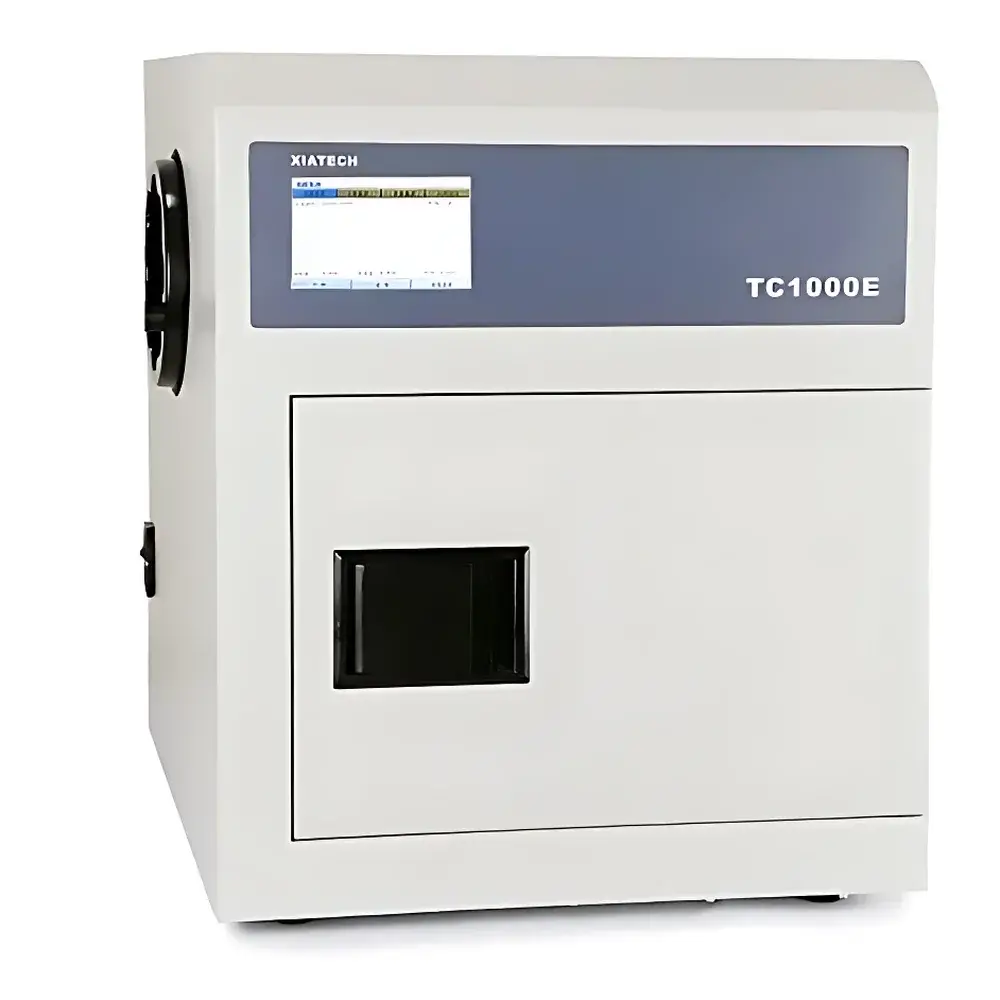
Xiatech TC1000 Series Guarded Hot Plate Thermal Conductivity Analyzer
| Brand | Xiatech |
|---|---|
| Origin | Shaanxi, China |
| Manufacturer Type | Authorized Distributor |
| Country of Origin | China |
| Model | TC1000 Series |
| Instrument Type | Guarded Hot Plate Method |
| Sample Capacity | Single specimen per test |
| Test Environment | High-Temperature & Ambient-Pressure (standard configuration) |
| Dimensions (L×W×H) | 550 × 500 × 650 mm |
| Accuracy | ±3–5% (full scale) |
| Thermal Conductivity Range | 0.002–2.0 W/(m·K) |
| Repeatability | ≤1% RSD |
| Test Atmosphere | Air (standard) |
| Sample Form | Solid blocks (rigid or semi-rigid), thickness 10–50 mm, minimum face area 150 × 150 mm |
Overview
The Xiatech TC1000 Series Guarded Hot Plate Thermal Conductivity Analyzer is a precision instrument engineered for steady-state measurement of thermal conductivity in low-conductivity solid materials. It operates on the guarded hot plate principle—defined in ISO 8302, ASTM C177, and GB/T 10294—as a primary reference method for absolute thermal transport characterization. The system establishes a controlled one-dimensional heat flux across two identical test specimens sandwiched between a centrally heated main plate and symmetrically cooled cold plates. A surrounding guard ring, actively temperature-controlled to match the main heater, eliminates lateral heat loss and ensures strict adherence to the ideal one-dimensional conduction model. This architecture enables traceable, NIST-aligned measurements with minimal boundary effect interference—making the TC1000 suitable not only for routine quality control but also for calibration reference material (CRM) validation and interlaboratory round-robin studies.
Key Features
- Guarded hot plate architecture with independent active guard ring control, maintaining thermal uniformity within ±0.05 °C across all heated surfaces
- Automated specimen compression system applying programmable axial load (0–5 kPa range) to minimize interfacial contact resistance without deforming soft or compressible samples
- Integrated digital micrometer-based thickness measurement (resolution: 1 µm) synchronized with thermal equilibrium detection, eliminating manual caliper error
- High-stability PID-controlled heating/cooling modules with dual-channel temperature monitoring (PT100 sensors, Class A tolerance) at both hot and cold plates
- Full automation via embedded controller and PC-based software: automatic thermal equilibration detection, data logging, uncertainty calculation per ISO/IEC 17025 guidelines, and report generation compliant with GLP documentation requirements
- Modular design supporting optional upgrades: inert gas purge manifold (for oxidation-sensitive or hygroscopic samples), high-temperature extension (up to 200 °C), and vacuum enclosure integration
Sample Compatibility & Compliance
The TC1000 accommodates rigid and semi-rigid block specimens with nominal dimensions ≥150 mm × 150 mm and thickness between 10 mm and 50 mm. Compatible material classes include cellular polymers (e.g., PU, EPS, XPS, phenolic foams), fibrous insulations (glass wool, rock wool, ceramic fiber boards), aerogel composites (silica aerogel blankets, nanoporous hybrid panels), refractory ceramics (lightweight alumina, fireclay bricks), and multi-layer laminates (aluminum foil–polymer–foam sandwiches). All measurements comply with the metrological requirements of ISO 8302:2014 (Determination of steady-state thermal resistance — Guarded hot plate method), ASTM C177-22 (Standard Test Method for Steady-State Thermal Transmission Properties by Means of the Guarded-Hot-Plate Apparatus), and GB/T 10294–2008 (Thermal insulation — Determination of steady-state thermal resistance — Guarded hot plate method). System validation includes annual calibration against certified reference materials (e.g., NIST SRM 1450c Fibrous Glass Board) and full uncertainty budget documentation per GUM (JCGM 100:2008).
Software & Data Management
The TC1000 is operated through Xiatech’s proprietary THERMO-ANALYZER v4.x software suite, designed for ISO/IEC 17025 and FDA 21 CFR Part 11 compliance. Key capabilities include real-time thermal gradient visualization, automated equilibrium verification using slope-threshold algorithms (dT/dt < 0.001 °C/min over 30 min), built-in uncertainty propagation engine accounting for thickness, temperature, and power measurement uncertainties, and audit-trail-enabled user access control (role-based permissions, electronic signatures, immutable log files). Export formats include CSV, PDF (with embedded metadata), and XML for LIMS integration. Raw data archives are stored with SHA-256 hash integrity verification and support automated backup to network drives or cloud storage (AWS S3, Azure Blob) via configurable protocols.
Applications
The TC1000 serves as a core metrology platform in R&D laboratories and QC departments across building science, aerospace thermal management, energy-efficient appliance development, and advanced materials manufacturing. Typical use cases include: certification testing of commercial insulation products against EN 12667 and ASTM C518; thermal performance benchmarking of next-generation aerogels and vacuum insulation panels (VIPs); formulation optimization of fire-retardant polymer composites; validation of thermal models for building energy simulation tools (e.g., EnergyPlus, TRNSYS); and regulatory submission support for CE marking, UL 723, and China’s GB 8624 fire safety classification. Its accuracy and repeatability meet the stringent requirements of third-party certification bodies (e.g., TÜV Rheinland, SGS, CNAS-accredited labs).
FAQ
What standards does the TC1000 comply with?
ISO 8302:2014, ASTM C177-22, GB/T 10294–2008, and EN 12667 (when used with certified reference materials and documented uncertainty budgets).
Can the TC1000 measure anisotropic materials?
Yes—by orienting the sample to align the principal thermal axis perpendicular to the heat flow direction; however, directional anisotropy requires supplementary measurements using alternative methods (e.g., laser flash analysis) for full tensor characterization.
Is vacuum operation supported?
Standard configuration operates under ambient air; vacuum-compatible variants (≤10⁻² mbar) are available as factory-installed options with stainless-steel chamber and feedthrough-rated sensors.
How is calibration traceability maintained?
Annual recalibration is performed using NIST-traceable reference materials (SRM 1450c, SRM 1450d) and documented in accordance with ISO/IEC 17025 Clause 6.6; calibration certificates include measurement uncertainty statements and GUM-compliant sensitivity coefficients.
Does the system support GLP/GMP workflows?
Yes—the software enforces electronic signature capture, change control logs, versioned method templates, and 21 CFR Part 11–compliant audit trails for all critical operations including calibration, testing, and report generation.



