
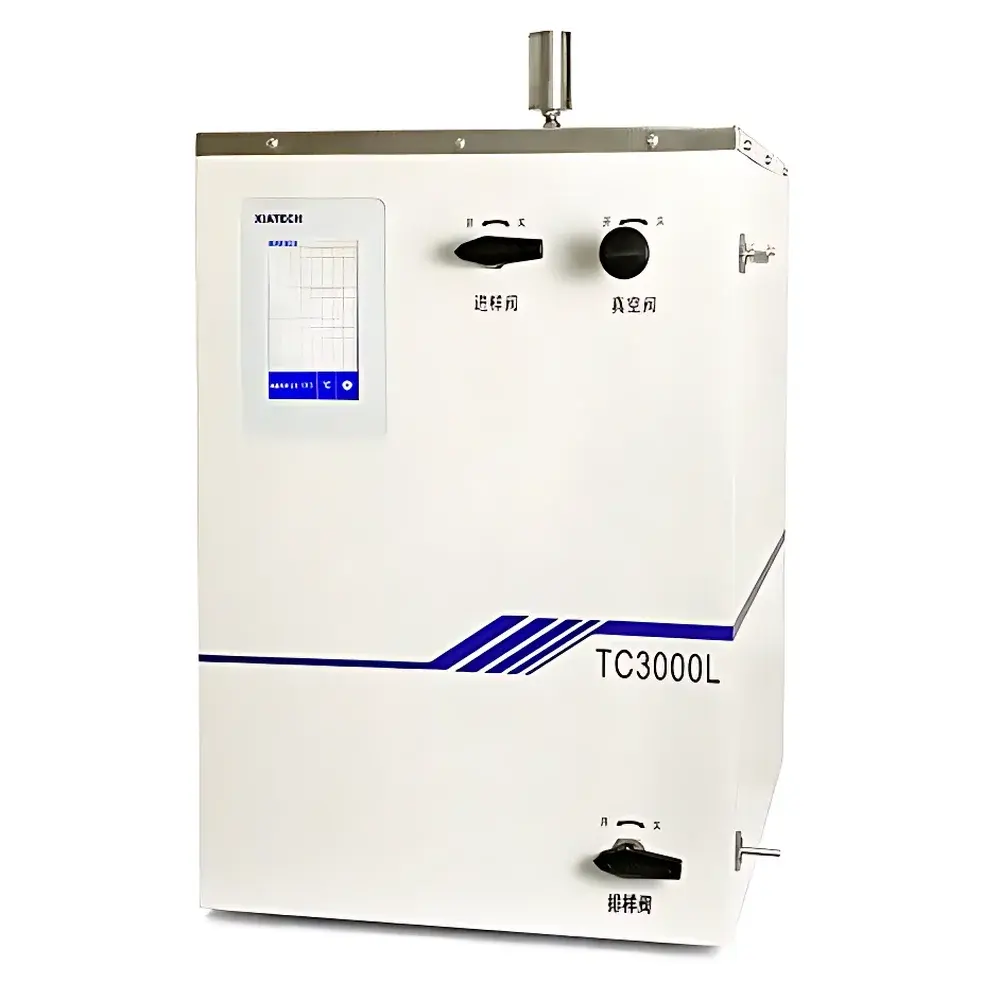
Xiatech TC3000L-1 Transient Hot-Wire Thermal Conductivity Analyzer for Liquids
| Brand | Xiatech |
|---|---|
| Origin | Shaanxi, China |
| Model | TC3000L-1 |
| Measurement Principle | Transient Hot-Wire Method |
| Thermal Conductivity Range | 0.0005–5 W/(m·K) |
| Accuracy | ±2% |
| Repeatability | ±2% |
| Sample Volume Required | 30 mL |
| Test Duration | ≤2 s per measurement |
| Temperature Range | −30 to 200 °C |
| Pressure Range | 0.1–15 MPa |
| Test Atmosphere | Vacuum-compatible |
| Sample Form | Liquid only |
| Compliance | ASTM D2717, ASTM D7896 |
| Dimensions (L×W×H) | Not specified |
Overview
The Xiatech TC3000L-1 is a high-precision transient hot-wire (THW) thermal conductivity analyzer engineered specifically for liquid-phase measurements under controlled temperature and pressure conditions. Based on the fundamental principle of transient linear heat source theory, the instrument measures thermal conductivity by monitoring the time-dependent temperature rise of a thin, electrically heated platinum wire immersed in the sample liquid. The THW method eliminates convective interference through ultra-short measurement duration (≤2 seconds), enabling high-fidelity data acquisition even in low-viscosity or thermally unstable fluids. Designed for rigorous laboratory and industrial R&D environments, the TC3000L-1 delivers traceable, reproducible results across a broad thermal conductivity range (0.0005–5 W/(m·K)) and accommodates demanding operational envelopes — from cryogenic −30 °C to elevated 200 °C, and from sub-atmospheric vacuum to supercritical 15 MPa pressures.
Key Features
- Transient Hot-Wire Core Technology: Utilizes a calibrated platinum micro-wire sensor with active current control and nanosecond-resolution thermal response capture to ensure adherence to ISO 22007-1 and ASTM D2717 physical modeling assumptions.
- High-Speed, Low-Interference Measurement: Completes each thermal conductivity determination in ≤2 seconds — significantly shorter than characteristic natural convection timescales — thereby suppressing buoyancy-driven artifacts without requiring flow suppression hardware.
- Minimal Sample Consumption: Requires only 30 mL of test liquid per measurement cycle, reducing material cost and enabling evaluation of scarce or synthetically complex samples such as functionalized nanofluids or custom ionic liquids.
- Extended Operational Envelope: Integrates pressure-rated sample cell and thermostatically controlled jacketing to support stable measurements across −30 °C to 200 °C and 0.1–15 MPa, including vacuum-compatible operation for degassed or volatile systems.
- Traceable Calibration & Validation: Factory-calibrated using certified reference materials (e.g., pure water and toluene) with documented uncertainty budgets; accuracy validated to ±0.5% against NIST-traceable standards within the mid-range and maintained at ±2% across full scale.
- Robust Mechanical Design: Features vibration-damped optical bench architecture and electromagnetic shielding to ensure signal integrity in shared instrumentation laboratories or pilot-scale process environments.
Sample Compatibility & Compliance
The TC3000L-1 is validated for polar and non-polar liquids exhibiting Newtonian or mildly shear-thinning behavior under static test conditions. Compatible sample classes include nanofluids (e.g., TiO₂, Al₂O₃, Fe₃O₄, and ZrO₂ dispersions in ethylene glycol/water base fluids), hydrocarbon fuels (gasoline, diesel, kerosene, oxygenated blends), refrigerants (R134a, R12, R22, R123, DME), lubricants, heat transfer oils, cryogenic coolants, and room-temperature ionic liquids (RTILs). All measurements comply with ASTM D2717 (Standard Test Method for Thermal Conductivity of Liquids) and ASTM D7896 (Standard Test Method for Thermal Conductivity of Refrigerants and Refrigerant Mixtures), supporting regulatory submissions and GLP-compliant reporting workflows. The system’s vacuum-capable cell design enables degassing prior to measurement — critical for eliminating nucleation-induced thermal resistance in nanofluid characterization.
Software & Data Management
Control and analysis are executed via Xiatech’s proprietary TCSoft v4.x platform, a Windows-based application supporting real-time sensor diagnostics, automated temperature/pressure ramping, and multi-point isothermal/isobaric mapping. Raw voltage-time datasets are stored in HDF5 format with embedded metadata (timestamp, ambient T/P, calibration ID, operator tag). Export options include CSV, Excel, and PDF reports compliant with 21 CFR Part 11 requirements — including electronic signatures, audit trails, and user-access-level permissions. Data processing applies standard THW inversion algorithms incorporating radial heat loss correction and finite-wire-length compensation per ISO 22007-1 Annex B. Optional API integration enables synchronization with LIMS or MES platforms for automated data ingestion into enterprise QA/QC databases.
Applications
- Thermal property benchmarking of nanofluid formulations for advanced heat exchanger and microchannel cooling applications
- Formulation development and batch release testing of next-generation refrigerant blends under ASHRAE Standard 34 conditions
- Viscosity-independent thermal conductivity validation for lubricant base stocks and additive packages per ASTM D7112
- Thermophysical database generation for computational fluid dynamics (CFD) model parameterization
- Stability assessment of colloidal nanofluids via time-resolved thermal conductivity monitoring during accelerated aging
- Support of DOE, EU Horizon, and national key R&D programs targeting high-efficiency thermal management systems
FAQ
What is the minimum required sample volume for a valid measurement?
A single measurement requires 30 mL of homogeneous, particle-free liquid. For statistical validation across multiple temperatures or pressures, a total volume of ≥120 mL is recommended.
Can the TC3000L-1 measure nanofluids containing sedimentation-prone nanoparticles?
Yes — provided the sample is homogenized immediately prior to loading and measured within the specified 2-second window before significant settling occurs. Optional ultrasonic dispersion integration is available upon request.
Is vacuum operation mandatory, or can measurements be performed under inert gas?
The system supports both vacuum (<10⁻² mbar) and inert gas (N₂, Ar) backfilling up to 15 MPa; gas composition and partial pressure are programmable via integrated mass flow controllers.
How is traceability to international standards ensured?
Each unit ships with a factory calibration certificate referencing NIST SRM 742 (water) and NIST SRM 1493 (toluene), with uncertainty statements fully aligned with ISO/IEC 17025:2017 requirements.
Does the system support unattended overnight operation?
Yes — TCSoft includes scheduler functionality for sequential isothermal sweeps, pressure ramps, and auto-recovery protocols following power interruption or sensor fault events.



