
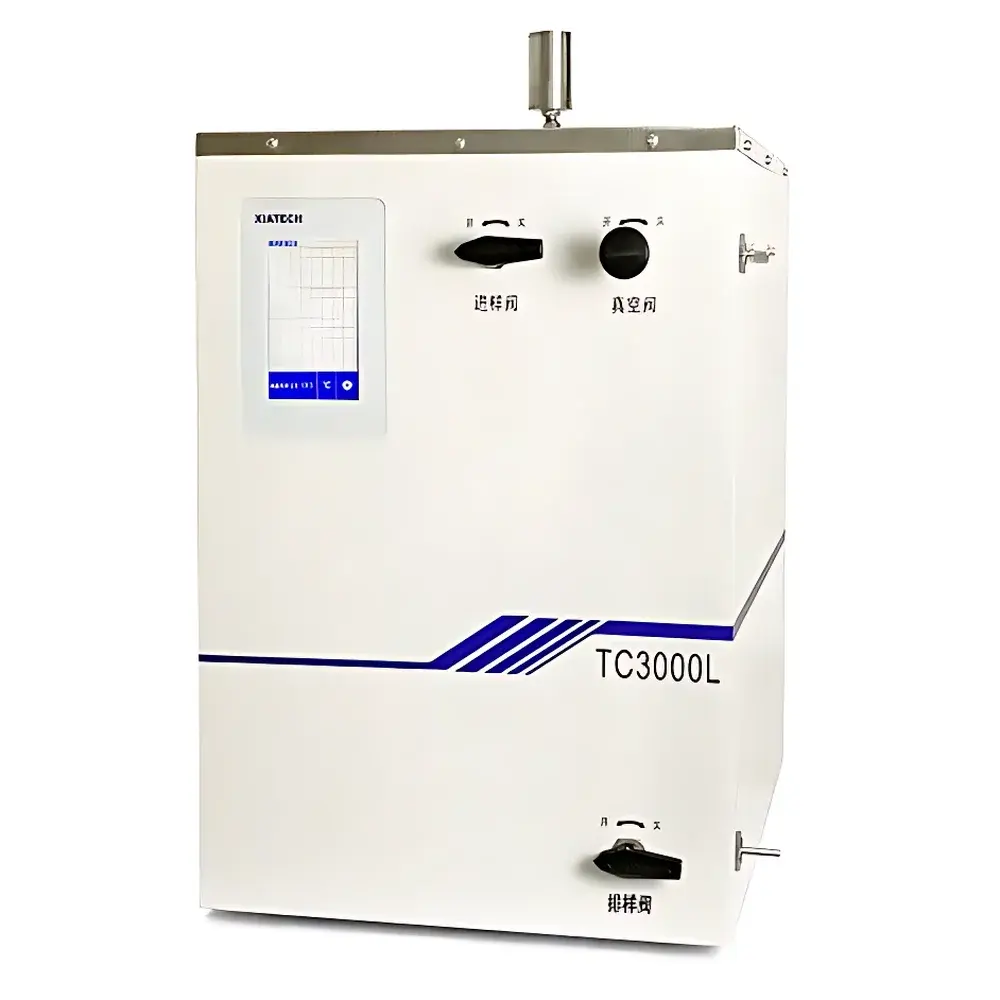
XIATECH TC3000L Series Liquid Thermal Conductivity Analyzer
| Brand | XIATECH |
|---|---|
| Model | TC3000L Series |
| Measurement Principle | Transient Hot Wire (THW) Method |
| Origin | Shaanxi, China |
| Instrument Type | Liquid & Gas Thermal Conductivity Analyzer |
| Thermal Conductivity Range | 0.0005–5 W/(m·K) |
| Accuracy | ±2% |
| Repeatability | ±2% |
| Sample Volume Required | 40 mL |
| Test Duration | ≤2 s per measurement |
| Temperature Range | −30 to 250 °C |
| Pressure Range | 0.1–15 MPa |
| Test Atmosphere | Vacuum or Controlled Gas Environment |
| Sample States | Liquid and Gaseous Fluids |
| Compliance Standards | ASTM D2717, ASTM D7896 |
| Power Supply | 220 V AC, 50/60 Hz |
Overview
The XIATECH TC3000L Series Liquid Thermal Conductivity Analyzer is a precision instrument engineered for rapid, high-accuracy thermal conductivity measurements of liquids and gases using the transient hot wire (THW) method. This technique relies on monitoring the time-dependent temperature rise of a thin, electrically heated platinum wire immersed in the sample fluid—enabling direct determination of thermal conductivity from the slope of the ln(t)–T curve. The THW principle ensures minimal influence from natural convection, particularly critical for low-viscosity or low-conductivity fluids operating under static conditions. Designed for laboratory and industrial R&D environments, the TC3000L series delivers reliable data across extreme thermodynamic conditions—from cryogenic liquids at −30 °C to high-temperature heat-transfer fluids up to 250 °C, and pressures up to 15 MPa. Its compact, vibration-damped mechanical architecture supports stable operation in shared lab spaces without dedicated isolation tables.
Key Features
- Rapid measurement cycle: Full thermal conductivity result generated within ≤2 seconds—significantly reducing test time and mitigating buoyancy-driven convection artifacts.
- High metrological confidence: Validated against certified reference materials including toluene and deionized water; achieves ≤0.5% deviation on standard samples and maintains <3% uncertainty across the full 0.0005–5 W/(m·K) range.
- Minimal sample consumption: Requires only 40 mL of fluid per test—critical for expensive or hazardous samples such as ionic liquids, nanofluids, or novel refrigerant blends.
- Broad operational envelope: Compatible with temperature control from −30 °C to 250 °C and pressure regulation from vacuum to 15 MPa, enabling characterization under realistic process conditions.
- Robust mechanical design: Engineered with reinforced thermal shielding and passive damping to ensure long-term stability and resistance to ambient vibrations common in multi-instrument laboratories.
- Automated workflow integration: Fully programmable temperature/pressure ramps, auto-zeroing, and real-time signal validation reduce operator dependency and support unattended overnight testing.
Sample Compatibility & Compliance
The TC3000L series accommodates a wide spectrum of thermophysical fluid classes—including polar and non-polar liquids, supercritical fluids, and low-density gases—provided they remain chemically inert toward platinum and fused silica cell components. Verified applications include nanofluids (e.g., TiO₂, Al₂O₃, Fe₃O₄, ZrO₂ dispersions), hydrocarbon fuels (gasoline, diesel, kerosene), oxygenated additives, synthetic refrigerants (R134a, R123, DME), lubricant-refrigerant mixtures, heat transfer oils, cryogenic coolants, and room-temperature ionic liquids (RTILs). All measurements adhere to internationally recognized protocols: ASTM D2717 (Standard Test Method for Thermal Conductivity of Liquids) and ASTM D7896 (Standard Test Method for Thermal Conductivity of Refrigerants). The system architecture supports GLP-compliant audit trails when integrated with validated data acquisition software, and its sealed vacuum chamber design facilitates ISO/IEC 17025-aligned calibration traceability.
Software & Data Management
The TC3000L operates via XIATECH’s proprietary ThermalStudio™ control and analysis suite, running on Windows-based host PCs. The software provides real-time visualization of voltage decay curves, automatic baseline correction, THW model fitting (including radial heat loss compensation), and uncertainty propagation reporting per ISO/IEC Guide 98-3 (GUM). Raw data files are stored in HDF5 format with embedded metadata (timestamp, T/P setpoints, sensor IDs, calibration coefficients), ensuring FAIR (Findable, Accessible, Interoperable, Reusable) data principles. Export options include CSV, Excel, and XML for integration into LIMS or statistical analysis platforms (e.g., JMP, MATLAB). Optional 21 CFR Part 11 compliance packages include electronic signatures, role-based access control, and immutable audit logs for regulated environments.
Applications
This analyzer serves core functions in thermal fluid formulation, energy systems development, and advanced material qualification. In academic and industrial labs, it supports thermophysical property databases for equation-of-state modeling (e.g., REFPROP, CoolProp), optimization of heat exchanger working fluids, safety assessment of alternative refrigerants under ASHRAE Standard 34, and thermal stability evaluation of next-generation battery electrolytes. It is routinely deployed in national metrology institutes for inter-laboratory comparison studies and in OEM R&D centers validating thermal performance of dielectric coolants for high-power electronics and EV traction inverters.
FAQ
What measurement principle does the TC3000L employ?
It uses the transient hot wire (THW) method, based on solving the one-dimensional radial heat conduction equation around an infinitely thin line source.
Can the TC3000L measure gases?
Yes—it is validated for low-density gases and vapors under controlled vacuum or pressurized inert atmospheres, provided thermal contact and electrical insulation requirements are met.
Is calibration traceable to NIST or other NMIs?
Instrument calibration utilizes NIST-traceable reference fluids (e.g., toluene SRM 1492); users may perform in-house verification using certified standards per ASTM D2717 Annex A1.
Does the system support automated temperature and pressure sweeps?
Yes—integrated PID-controlled heating/cooling and pressure regulation modules enable programmable isobaric, isothermal, or combined T–P mapping sequences.
How is data integrity ensured during long-term testing?
ThermalStudio™ implements cyclic redundancy checks (CRC) on all acquired signals, automatic file versioning, and timestamp-synchronized hardware logging to prevent data corruption or misattribution.



