
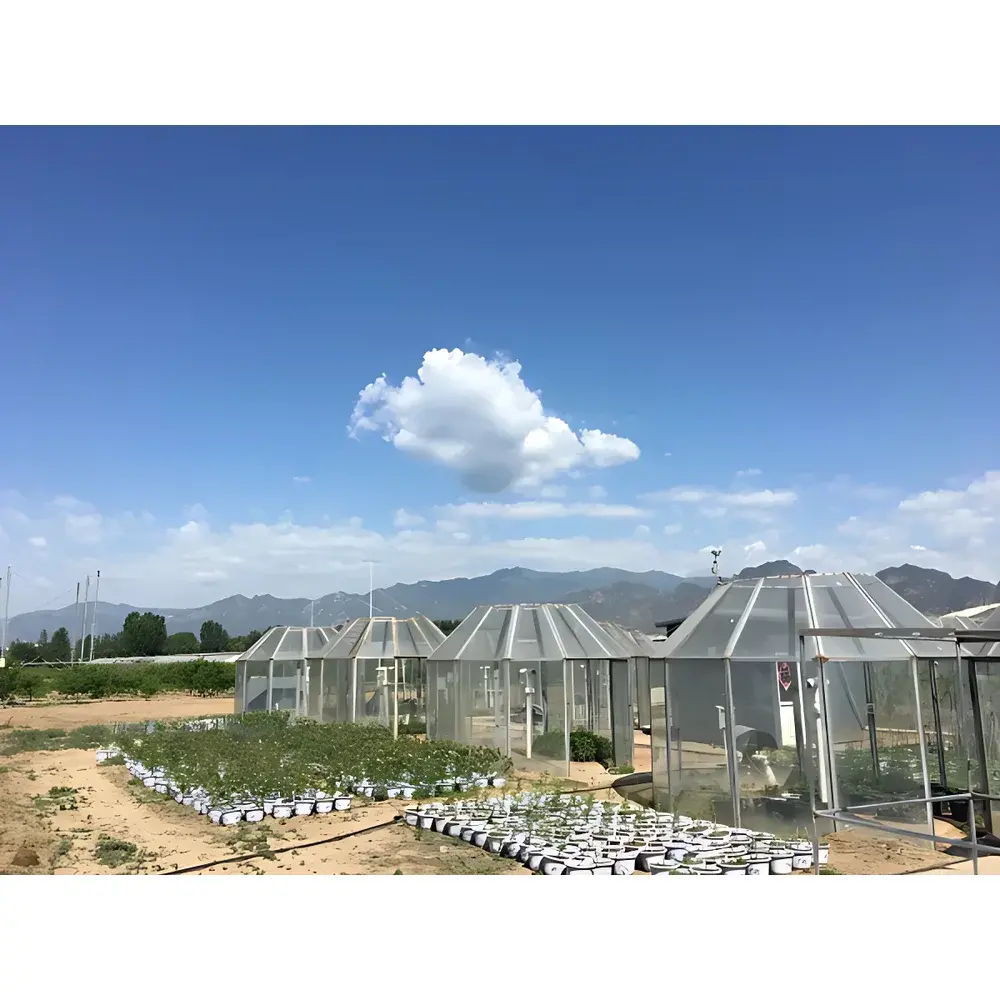
AERODYNE EcoCosm Ozone Control Experimental System
| Brand | AERODYNE |
|---|---|
| Origin | Beijing, China |
| Model | EcoCosm |
| Instrument Type | Online Fixed-Station System |
| Measurement Range | O₃: 0–200 nmol·mol⁻¹ (ppb) |
| CO₂ | 0–1000 ppm |
| Co-measured Gases | CO, CH₄, N₂O, NO, NO₂ |
| OTC Capacity | Up to 15 Open-Top Chambers (OTCs) |
| Control Resolution | < ±2 nmol·mol⁻¹ O₃ |
| Sampling Interval | Configurable (default 10 min) |
| Imaging Frequency | 1 image per OTC per hour |
| Compliance | Designed for GLP-aligned environmental exposure studies |
Overview
The AERODYNE EcoCosm Ozone Control Experimental System is an integrated, online environmental simulation platform engineered for controlled atmospheric exposure studies in terrestrial ecology and climate change research. It operates on the principle of dynamic gas blending and real-time feedback control within open-top chamber (OTC) enclosures, enabling precise, programmable regulation of ozone (O₃) and carbon dioxide (CO₂) concentrations—while simultaneously monitoring a comprehensive suite of atmospheric precursor gases. Unlike conventional static O₃ fumigation setups, EcoCosm implements closed-loop concentration control using high-stability electrochemical and tunable diode laser absorption (TDLAS)-based gas analyzers, ensuring traceable, reproducible exposure gradients across multiple parallel OTCs. The system is explicitly designed to address critical knowledge gaps in plant–atmosphere interaction science: namely, the interactive effects of elevated O₃ and CO₂ under ecologically relevant background atmospheric composition—including co-varying levels of NO, NO₂, CO, CH₄, and N₂O. Its architecture supports long-term, multi-season experiments compliant with international protocols for ambient air quality impact assessment (e.g., ISO 16000-29, ASTM D6196-22) and ecological risk evaluation frameworks.
Key Features
- Modular multi-OTC control architecture supporting up to 15 independent chambers via time-multiplexed gas sampling and actuation
- Dual-gas precision generation: O₃ via high-purity oxygen-fed corona discharge; CO₂ via mass flow-controlled cylinder delivery with optional scrubbing
- Multi-species gas analysis module measuring O₃, CO₂, CO, CH₄, N₂O, NO, and NO₂ in a single analytical stream—calibrated against NIST-traceable standards
- Real-time, user-programmable concentration profiles: O₃ gradients from 0–200 nmol·mol⁻¹ (0–200 ppb); CO₂ from 0–1000 ppm, with ramp, step, or sinusoidal temporal functions
- Integrated environmental monitoring: PAR (photosynthetically active radiation), air temperature & relative humidity, soil moisture & temperature, all sampled at 10-minute intervals
- Automated phenotyping: Hourly RGB imaging per OTC with timestamped georeferenced storage and optional AI-assisted growth metric extraction
- Centralized control software with audit-trail logging, configurable alarm thresholds, and 21 CFR Part 11-compliant user access management (optional)
Sample Compatibility & Compliance
EcoCosm accommodates herbaceous and woody plant species grown in field-simulated soil columns or pots within its 5 m base-diameter, 3 m top-opening OTCs. The system is compatible with standard agronomic practices including irrigation scheduling, fertilization, and manual phenotyping. All gas handling components comply with ISO 8573-1:2010 Class 2 purity requirements for compressed gases. O₃ generation uses medical-grade oxygen (≥99.5% purity) to eliminate nitrogen oxide byproducts. Data acquisition and control firmware adhere to IEC 61508 SIL 2 functional safety principles. The platform meets technical prerequisites for studies submitted to journals requiring adherence to the European Monitoring and Evaluation Programme (EMEP) exposure guidelines and supports documentation required for GLP audits per OECD Series on Testing and Assessment No. 124.
Software & Data Management
The EcoCosm Central Monitoring Software (v4.x) provides a browser-based interface for configuration, visualization, and export. All sensor data are stored in a relational PostgreSQL database with automatic daily backups and SHA-256 integrity hashing. Historical trends are rendered using D3.js with zoomable, overlay-capable time-series plots. Users define control setpoints via intuitive graphical curve editors, with version-controlled script deployment. Raw images are archived in lossless PNG format with EXIF metadata (GPS, UTC timestamp, OTC ID, environmental conditions). Export formats include CSV (time-series), NetCDF4 (climate-ready multidimensional arrays), and PDF reports with embedded QC metrics. Audit logs record every parameter change, user login/logout, alarm event, and calibration action—with immutable timestamps signed by an onboard hardware security module.
Applications
- Quantifying species-specific O₃ dose–response relationships under ambient and future-climate CO₂ scenarios
- Evaluating stomatal conductance modulation and photosynthetic acclimation across developmental stages
- Assessing synergistic oxidative stress from O₃ + NO₂ co-exposure in sensitive crop cultivars (e.g., wheat, soybean, rice)
- Validating regional air quality models by comparing measured O₃ fluxes with simulated deposition velocities
- Supporting regulatory submissions for national ozone vegetation protection standards (e.g., EU Directive 2008/50/EC Annex III)
- Long-term ecosystem monitoring in FACE (Free-Air CO₂ Enrichment) and OTCE (Open-Top Chamber Exposure) networks
FAQ
What is the minimum detectable ozone concentration and its measurement uncertainty?
The system achieves a lower detection limit of 0.5 nmol·mol⁻¹ (0.5 ppb) for O₃ with a stated expanded uncertainty (k=2) of ±1.2 nmol·mol⁻¹ across the 0–200 nmol·mol⁻¹ range, verified annually per ISO/IEC 17025 accredited procedures.
Can the system operate without CO₂ enrichment capability?
Yes—CO₂ generation and control modules are fully decoupled and may be omitted during installation; O₃-only operation maintains full functionality and metrological integrity.
Is remote access and troubleshooting supported?
Standard configuration includes TLS-encrypted SSH and HTTPS access; optional VPN tunneling and remote desktop support (via vendor-managed jump host) are available under service-level agreements.
How frequently must gas analyzers be calibrated?
Zero/span calibration is recommended every 7 days using certified gas standards; full multi-point linearity verification is required quarterly, with certificates traceable to NIST SRM 2692c (O₃) and SRM 1662a (CO₂).
Does the system meet electromagnetic compatibility (EMC) requirements for field deployment?
Yes—certified to EN 61326-1:2013 (industrial environment) and EN 55011:2016 Class B emission limits, with IP55-rated outdoor enclosures for control electronics.







