
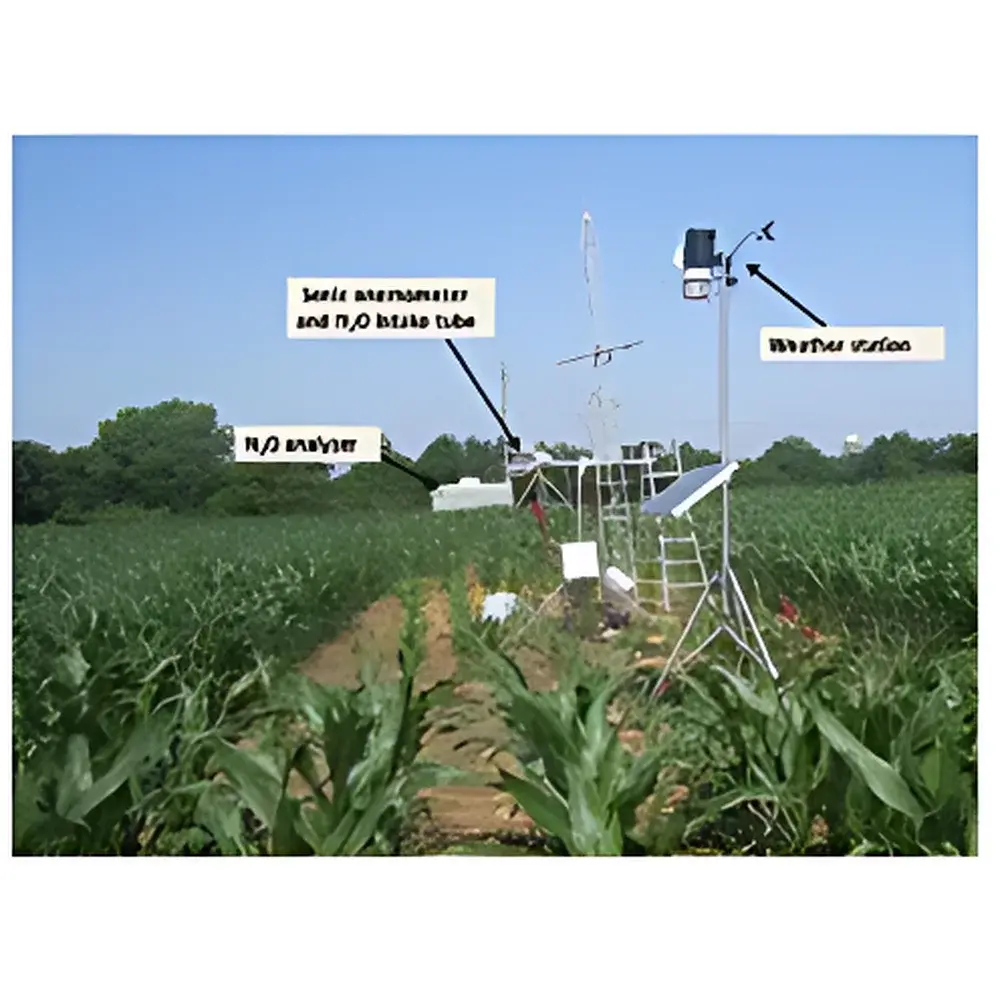
Aerodyne TILDAS-CO2/CH4/N2O Dual-Laser Tunable Infrared Laser Direct Absorption Spectrometer for Simultaneous Carbon & Nitrogen Stable Isotope Monitoring
| Brand | Aerodyne |
|---|---|
| Origin | USA |
| Model | TILDAS-CO2/CH4/N2O |
| Detection Principle | Tunable Infrared Laser Direct Absorption Spectroscopy (TILDAS) |
| Configuration | Online, Closed-Path |
| Response Time | ≤1 s (selectable 1–10 Hz) |
| Precision (1 s) | CO₂: 100 ppb, CH₄: 0.1 ppb, N₂O: 0.03 ppb, H₂O: 10 ppm, δ¹³C-CO₂: 0.1‰, δ¹⁸O-CO₂: 0.03‰ |
| Measurement Range | CO₂: 0–5000 ppm, CH₄/N₂O: 0–10 000 ppb, H₂O: 0–5000 ppm, δ¹³C/δ¹⁸O: ±0.5‰ |
| Effective Optical Path Length | 210 m (Astigmatic Multipass Cell) |
| Detection Limit | Sub-ppt for key trace gases |
| Compliance | Designed for GLP/GMP-aligned operation |
Overview
The Aerodyne TILDAS-CO2/CH4/N2O is a high-precision, online, closed-path tunable infrared laser direct absorption spectrometer engineered for simultaneous, real-time quantification of greenhouse gas concentrations and their stable isotopic ratios in ambient air and ecosystem flux studies. Based on quantum cascade laser (QCL) technology operating in the mid-infrared fingerprint region (2.7–12 µm), the system exploits fundamental vibrational-rotational absorption lines of CO₂, CH₄, N₂O, and H₂O — as well as isotopologue-specific transitions for δ¹³C-CO₂ and δ¹⁸O-CO₂ — enabling unambiguous molecular identification and sub-ppt sensitivity without chemical conversion or pre-concentration. Its core innovation lies in dual-laser architecture: two independently tunable QCLs operate in parallel within a single astigmatic multipass absorption cell (210 m effective path length), allowing concurrent detection of multiple target species and isotopologues with zero cross-interference. This eliminates inter-instrument variability inherent in multi-analyzer setups and ensures long-term stability essential for eddy covariance (EC) and chamber-based flux measurements over seasonal to multi-year timescales.
Key Features
- Dual-QCL architecture enables fully synchronous measurement of CO₂, CH₄, N₂O, H₂O, δ¹³C-CO₂, and δ¹⁸O-CO₂ at up to 10 Hz — critical for resolving turbulent flux structures in EC applications.
- Astigmatic multipass cell delivers 210 m optical path length in a compact footprint, enhancing signal-to-noise ratio and achieving sub-ppt detection limits for N₂O and CH₄.
- Zero-calibration operation: each measurement cycle includes a true “zero” spectrum acquired with laser off and purge gas (99.9992% N₂) flowing — eliminating reliance on frequent span gas injections and drift-induced bias.
- TDLWINTEL software provides full spectral replay functionality, permitting post-acquisition re-fitting against HITRAN reference spectra to diagnose contamination, verify calibration gas purity, and validate line shape integrity — a capability absent in competing platforms.
- Patented active surface passivation coating minimizes adsorption/desorption hysteresis for sticky molecules (e.g., NH₃), enabling co-quantification of reactive and non-reactive gases without cross-talk or memory effects.
- Inertial particle removal interface prevents particulate carryover during high-humidity or soil-derived sampling, ensuring long-term optical cleanliness and measurement fidelity.
- Integrated laser frequency stabilization cavity enables real-time correction of laser wavelength drift, maintaining spectral alignment to within <0.001 cm⁻¹ over weeks of continuous operation.
Sample Compatibility & Compliance
The TILDAS-CO2/CH4/N2O is validated for continuous, unattended operation in diverse environmental matrices: ambient air (urban, rural, marine boundary layer), eddy covariance towers, soil chambers, forest canopies, and enclosed mesocosms. Its closed-path design accommodates sample flows from 0.5–2 L/min and tolerates water vapor mixing ratios up to 5000 ppm without condensation or optical degradation. The system meets the physical and metrological requirements of ISO 13864:2020 (ambient air quality — performance criteria for automated measuring systems), ASTM D6348-18 (standard test method for determination of gaseous compounds by GC), and US EPA Method TO-14A (determination of volatile organic compounds in ambient air). When configured with time-stamped data logging, user access controls, and electronic signature support, the instrument complies with FDA 21 CFR Part 11 for regulated environmental monitoring under GLP or GMP frameworks.
Software & Data Management
TDLWINTEL v5.x serves as the embedded acquisition, control, and analysis environment. It provides real-time spectral visualization, automated baseline correction, least-squares spectral fitting using Voigt line profiles, and export of calibrated concentration and isotopic ratio time series in netCDF-4 or CSV formats. The software implements configurable audit trails compliant with 21 CFR Part 11, including operator login history, parameter change logs, and raw spectral archive retention. All calibration events — including zero checks, reference gas injections, and laser frequency recalibrations — are timestamped and linked to spectral metadata. Data streams integrate natively with EddyPro®, TK3, and FluxNet-compatible post-processing pipelines via TCP/IP or RS-232 interfaces.
Applications
- Ecosystem carbon and nitrogen cycling studies: partitioning net ecosystem exchange (NEE) into gross primary production (GPP) and ecosystem respiration (Reco) via δ¹³C-CO₂ isotopic disequilibrium analysis.
- Soil-atmosphere N₂O flux quantification with isotopic source apportionment (δ¹⁵N, δ¹⁸O, site preference) — enabled by integration with optional isotopomer modules.
- Urban methane leak detection and attribution using δ¹³C-CH₄ signatures to distinguish biogenic vs. thermogenic sources.
- Long-term atmospheric monitoring networks (e.g., ICOS, NOAA GML) requiring high-precision, low-drift, autonomous operation under variable temperature and humidity.
- Controlled-environment experiments: real-time tracking of isotopic fractionation during photosynthesis, respiration, nitrification, and denitrification under manipulated CO₂, O₂, or nutrient regimes.
FAQ
Does the system require daily calibration with certified standard gases?
No. The TILDAS-CO2/CH4/N2O operates in zero-reference mode with periodic N₂ purges. Certified standards are only required for initial factory calibration and annual verification — not routine operation.
Can it measure δ¹⁵N-N₂O or site-preference (SP) of N₂O?
The base configuration measures δ¹⁸O-CO₂ and δ¹³C-CO₂. Optional isotopomer expansion modules enable δ¹⁵N-N₂O and SP quantification; contact technical support for integration pathways.
What is the minimum detectable flux for CO₂ using eddy covariance?
At 10 Hz sampling and 40 s integration, typical instrumental noise is σ(δ¹³C) = 0.02‰ and σ(CO₂) = 18 ppb — sufficient to resolve ecosystem-scale CO₂ fluxes ≥0.1 µmol m⁻² s⁻¹ with statistical confidence.
Is remote diagnostics and firmware updates supported?
Yes. Secure SSH and HTTPS interfaces allow encrypted remote access for log review, parameter adjustment, and over-the-air firmware upgrades without on-site service visits.
How is water vapor interference corrected for isotopic measurements?
H₂O absorption lines are explicitly fitted in every spectral scan using high-resolution HITRAN parameters. Measured H₂O concentration directly constrains its contribution to CO₂ isotopologue line broadening and shift — no empirical correction factors are applied.







