
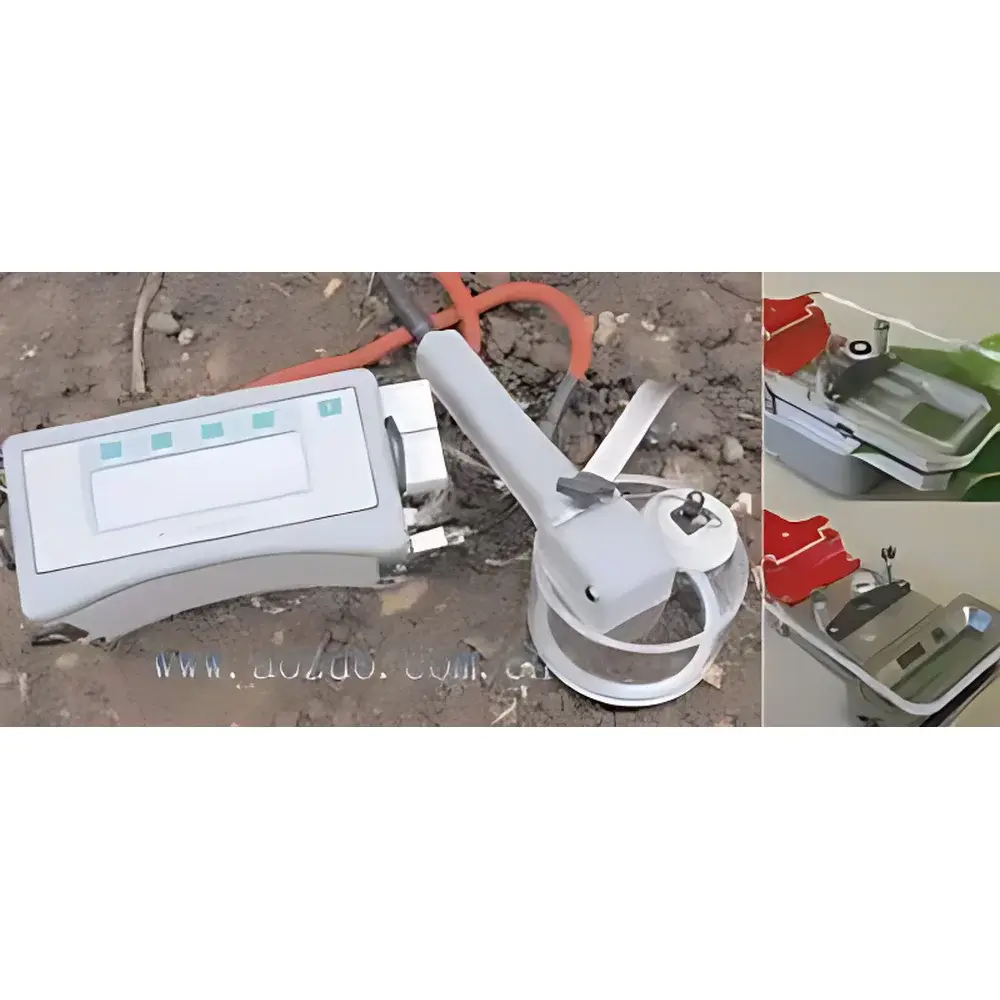
SRS-SD1000 Portable Soil Respiration Measurement System
| Origin | UK |
|---|---|
| Manufacturer Type | Distributor |
| Origin Category | Imported |
| Model | SRS-SD1000 |
| Price | Upon Request |
Overview
The SRS-SD1000 Portable Soil Respiration Measurement System is a field-deployable, battery-powered instrument engineered for high-temporal-resolution quantification of soil CO2 efflux—the primary indicator of heterotrophic and autotrophic respiration in terrestrial ecosystems. Operating on the open-system (flow-through) principle, the system maintains near-ambient CO2 partial pressure within the chamber, eliminating feedback inhibition of microbial and root metabolic activity commonly observed in closed-chamber configurations. Its integrated, miniaturized non-dispersive infrared gas analyzer (NDIR IRGA) is mounted directly inside the 1 L stainless-steel-and-polypropylene soil respiration chamber, minimizing gas transport delay and ensuring sub-second response to dynamic CO2 flux changes. With a total operational weight of just 4.4 kg—including console, chamber, sensors, and internal 12 V / 2.6 Ah lead-acid battery—the SRS-SD1000 enables rapid deployment across heterogeneous landscapes, from alpine meadows to agroecosystems and restored grasslands.
Key Features
- Integrated NDIR CO2 sensor with 1 ppm resolution and dual fast-response humidity sensors (0.1 mbar resolution) for real-time water vapor correction
- Open-system gas exchange architecture with programmable flow control (0–500 mL·min−1) to sustain stable boundary layer conditions
- Dual-temperature monitoring: chamber air temperature (0–50 °C), soil temperature (5–50 °C) via calibrated probe
- Photosynthetically active radiation (PAR) sensor (0–3000 μmol·m−2·s−1) for concurrent light-response analysis
- 240 × 64 pixel monochrome LCD display with intuitive menu navigation and on-device data review
- Non-volatile flash memory (2 GB internal) plus removable SD card supporting up to 16 million timestamped records
- Field-rugged mechanical design: stainless-steel base ring (Ø130 mm, 75 mm height, 325 g), polypropylene upper chamber (70 mm height, 320 g)
- Full USB 2.0 interface and SD card export for seamless integration with post-processing workflows in MATLAB, R, or Python
Sample Compatibility & Compliance
The SRS-SD1000 is validated for use across mineral and organic soils, turfgrass plots, small potted plants, and low-canopy vegetation systems. Its 1 L chamber volume conforms to ISO 16634-2:2016 guidelines for standardized soil respiration measurement geometry in field studies. All embedded sensors comply with IEC 60751 (Pt100 temperature probes) and ISO 8573-1 (compressed air purity class, adapted for ambient air sampling). Data logging firmware supports GLP-compliant metadata tagging—including operator ID, GPS coordinates (via optional external module), chamber insertion depth, and soil moisture context—and generates audit-ready CSV files traceable to UTC timestamps. While not FDA 21 CFR Part 11 certified (as it is a research-grade environmental instrument), its deterministic sampling logic, hardware-based clock synchronization, and write-once SD storage ensure reproducibility required for peer-reviewed ecological publications and long-term flux network contributions (e.g., ChinaFLUX, ICOS, AmeriFlux).
Software & Data Management
Data acquisition is managed by embedded firmware with user-configurable measurement protocols: fixed-duration cycles (e.g., 90 s chamber closure + 30 s purge), auto-triggered sequences based on soil temperature thresholds, or PAR-synchronized diurnal tracking. Raw sensor outputs (CO2, H2O, Tair, Tsoil, PAR) are recorded at 1 Hz with 16-bit ADC resolution. Post-acquisition, the included SRS-DataLink desktop application (Windows/macOS) performs automatic flux calculation using standard linear regression (slope-of-CO2-vs.-time) or nonlinear exponential fitting where appropriate. Export formats include NetCDF-4 (CF-1.8 compliant), CSV with ISO 8601 timestamps, and Excel-compatible .xlsx. All calibration coefficients—span gas slope, zero drift compensation, and humidity cross-sensitivity factors—are stored in device EEPROM and logged with each dataset to satisfy traceability requirements under ISO/IEC 17025:2017 Clause 7.7.
Applications
- Quantifying spatial heterogeneity of soil respiration across microtopographic gradients, land-use boundaries, or edaphic transitions
- Assessing short-term responses to rainfall pulses, freeze-thaw cycles, or nitrogen fertilization in controlled field experiments
- Validating ecosystem models (e.g., CENTURY, DAYCENT) through high-frequency in situ CO2 efflux time series
- Measuring rhizosphere respiration in grassland monocultures or mixed-species stands using repeated chamber placement
- Supporting carbon accounting frameworks aligned with IPCC Tier 2 methodologies for national GHG inventories
- Long-term monitoring in protected areas where minimal site disturbance and autonomous operation are mandatory
FAQ
What is the warm-up time required before accurate measurements?
At 20 °C ambient temperature, the IRGA achieves thermal equilibrium and baseline stability within 5 minutes after power-on.
Can the system operate unattended overnight?
Yes—using the internal 12 V / 2.6 Ah battery, continuous operation lasts up to 10 hours; external 12 V DC input enables indefinite deployment when paired with a solar charge controller.
Is the CO2 sensor factory-calibrated, and can users perform field recalibration?
Each IRGA is calibrated against NIST-traceable CO2 standards (0 ppm and 500 ppm) prior to shipment; zero calibration is supported in-field using ambient air scrubbed through soda lime, while span calibration requires certified gas cylinders.
How does the open-system design mitigate chamber-induced artifacts?
By maintaining constant airflow and near-ambient CO2 concentration, the open configuration prevents CO2 accumulation, pressure differentials, and O2 depletion that suppress biological activity in closed chambers—ensuring physiological fidelity in measured fluxes.
What data security and integrity measures are implemented?
All datasets are written sequentially to SD cards with cyclic redundancy check (CRC-32); file headers contain SHA-256 hashes of raw binary blocks, enabling forensic verification of data authenticity during third-party audit.
Related Products







