AZ ENVIdata-DT Rod-Type Soil Water Content, Temperature, Electrical Conductivity & Matric Potential Monitoring System
| Brand | AZ (Beijing AoZuo) |
|---|---|
| Origin | Beijing, China |
| Manufacturer Type | OEM Manufacturer |
| Product Category | Domestic |
| Model | ENVIdata-DT Rod-Type |
| Price | USD 140 (approx. ¥1000) |
Overview
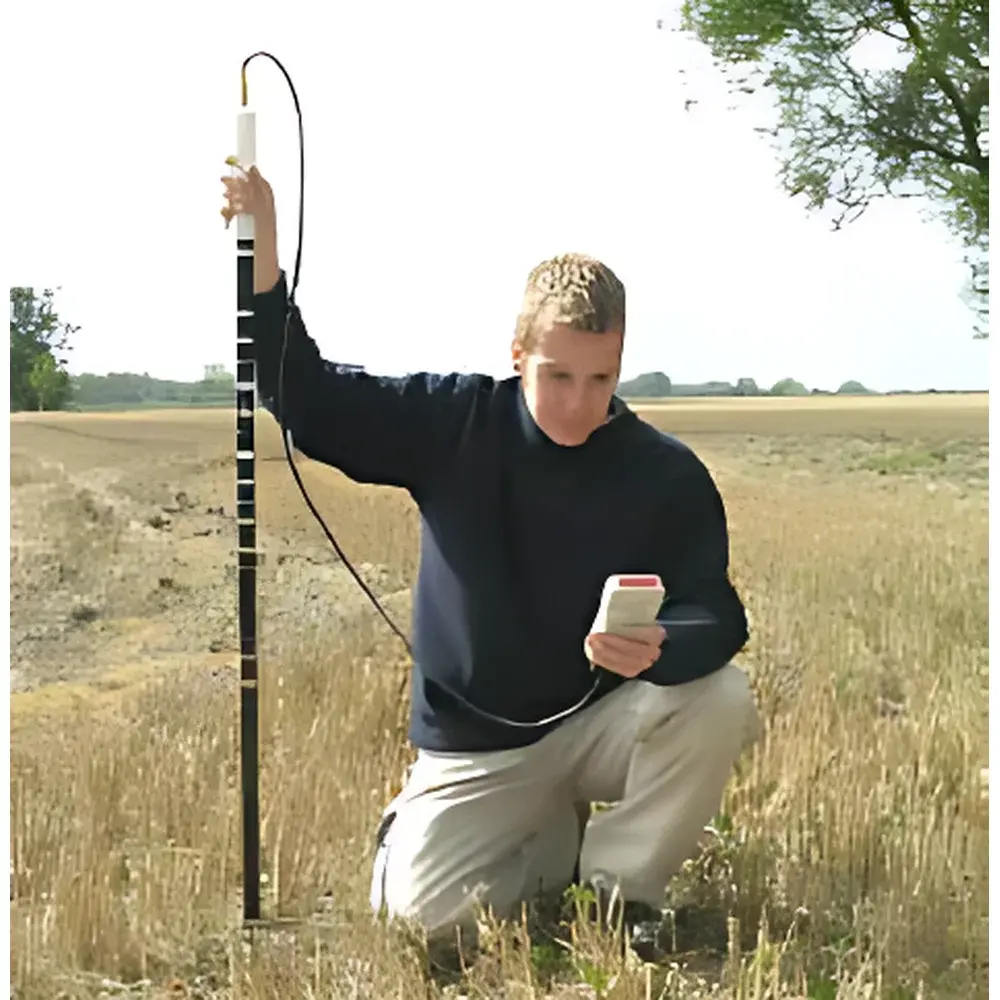
The AZ ENVIdata-DT Rod-Type Soil Water Content, Temperature, Electrical Conductivity & Matric Potential Monitoring System is an integrated, in-situ environmental monitoring platform engineered for high-fidelity, long-term characterization of soil hydro-physical dynamics. It combines multi-depth sensing of volumetric water content (θv), soil temperature (T), pore-water electrical conductivity (ECp), and matric potential (ψm) within a single mechanically robust rod configuration—minimizing soil disturbance during installation and enabling continuous, undisturbed profiling across heterogeneous field conditions. The system operates on three complementary physical principles: Time-Domain Reflectometry (TDR) for high-accuracy θv and ECp quantification; frequency-domain (FD) capacitance with dual-parameter compensation (temperature + EC) for extended-range profiling; and tensiometric vacuum measurement for direct ψm determination down to –1500 kPa. This multi-physics architecture ensures data integrity across diverse soil textures—from sandy loams to saline-clay profiles—and supports rigorous process-based modeling of unsaturated zone flow, root-zone water uptake, and solute transport.
Key Features
- Modular rod architecture with configurable lengths (0.6–3.0 m) and sensor layering (4–16 depth intervals at 10 cm spacing)
- TDR-based PICO-Profile and PICO-T3P probes delivering ±0.3% repeatability and immunity to temperature/EC interference via 1 GHz controlled-rise pulse generation
- PR2-series TDR sensors with IP67-rated stainless-steel housings, calibrated for absolute volumetric water content (0–0.4 m³·m⁻³) with ±0.04 m³·m⁻³ accuracy (0–40 °C)
- EnviroPro FD sensors featuring epoxy-encapsulated, corrosion-resistant electrodes and real-time EC/temperature compensation for θv
- T-series tensiometers (T4/T5/T8/EQ) with ceramic tips, stainless-steel bodies, and analog 100–800 mV output calibrated to ISO 2859–1 sampling standards
- DT-series data loggers (DT80/DT82E/DT85) with 18-bit A/D resolution, –45 °C to +70 °C operational range, SDI-12/Modbus/FTP/HTTP protocol support, and onboard LCD interface
- Integrated power management: 7–24 VDC input, <80 mA (PR2/4) or <120 mA (PR2/6) peak draw, compatible with solar-charged battery systems
Sample Compatibility & Compliance
The ENVIdata-DT system is validated for deployment in mineral soils, organic peats, volcanic ash, and moderately saline substrates (ECp ≤ 600 mS·m⁻¹). Its TDR probes are certified for operation under frozen conditions (–15 °C to +50 °C), enabling year-round monitoring in temperate and boreal climates. All sensors comply with IEC 60529 (IP67/IP68 ingress protection), ASTM D5084 (hydraulic conductivity correlation), and ISO 11277 (soil texture classification compatibility). Tensiometer calibration adheres to ISO 22043 (soil water retention curve standardization), while data acquisition firmware supports audit-trail logging per GLP/GMP requirements. The system architecture permits seamless integration into USDA ARS, FAO SWAP, and EU H2020 LUCAS-compatible workflows.
Software & Data Management
ENVIdata Server software provides secure, role-based access to time-series datasets through HTTPS-encrypted web interfaces. It supports automated ingestion from DT loggers via FTP, Modbus TCP, or direct Ethernet connection, with optional local storage on microSD or USB 2.0 drives (≥128 MB). Data processing includes configurable aggregation (mean/min/max/sample), unit conversion (e.g., dS·m⁻¹ ↔ ECp), and timestamp synchronization with NTP servers. The platform generates ISO-compliant CSV/NetCDF exports and enables multi-site spatiotemporal visualization—including GIS-integrated mapping, cross-parameter correlation heatmaps, and anomaly detection alerts based on user-defined thresholds. All data transactions are logged with immutable timestamps and operator IDs, satisfying FDA 21 CFR Part 11 electronic record requirements when deployed on validated infrastructure.
Applications
This system serves as a foundational tool for quantitative ecohydrology research and precision land management. Primary use cases include: evapotranspiration partitioning in agroecosystems; root-zone water stress assessment for irrigation scheduling; vadose zone contaminant transport modeling in brownfield remediation; permafrost thaw monitoring in alpine tundra; salinity intrusion tracking in coastal aquifers; and validation of satellite-derived soil moisture products (e.g., SMAP, Sentinel-1). Field deployments span experimental lysimeters (e.g., Beijing Normal University’s 6-column fertilizer leaching study), forest canopy interception experiments, grassland restoration trials, and wetland hydroperiod analysis—demonstrating reproducibility across >50 peer-reviewed publications since 2011.
FAQ
Can the system operate in frozen soil?
Yes. TDR-based PICO and PR2 sensors maintain measurement capability below 0 °C, with specified performance down to –15 °C. Ice formation does not impair signal propagation due to the guided-wave geometry of the waveguide structure.
How is sensor calibration handled for non-mineral soils?
Factory calibration follows ISO 11277 mineral soil protocols. Users may perform site-specific recalibration using TrimeTool software, storing up to 15 custom curves per probe. EnviroPro units allow field-adjustable EC/temperature compensation coefficients.
What communication protocols does the DT logger support?
RS232, RS485, Ethernet (TCP/IP), USB 2.0, and SDI-12. Optional Modbus RTU/TCP and FTP server modes enable SCADA interoperability and cloud-based telemetry.
Is the system compliant with international data integrity standards?
Yes. Firmware supports audit trails, electronic signatures, and data immutability features required under FDA 21 CFR Part 11 and EU Annex 11 when configured on validated hardware and network infrastructure.
What is the maximum cable length for tensiometer extension?
Standard cables are 5 m; extensions up to 100 m are supported without signal degradation, provided shielded twisted-pair cabling (AWG22) and proper grounding are implemented.