
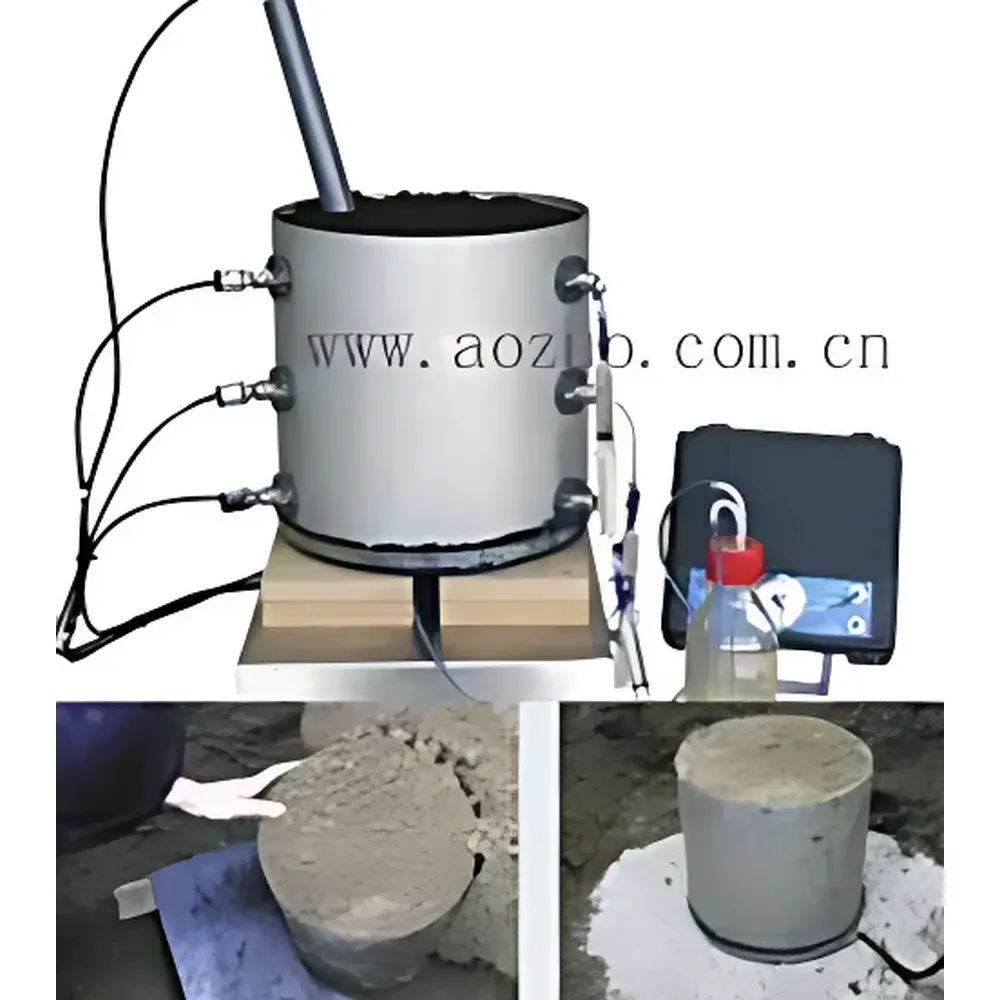
AZ-ES100 Vadose Zone Contaminant Transport Monitoring System
| Brand | AZ (Beijing Aozuo) |
|---|---|
| Origin | Germany |
| Manufacturer | AZ Instrument GmbH |
| Product Type | Vadose Zone Contaminant Transport Simulation & Monitoring System |
| Model | AZ-ES100 |
| Instrument Category | Contaminant Detection System |
| Compliance | Designed for ASTM D4220, ISO 11274, US EPA Method 9060A, and GLP-compliant soil–water–contaminant interaction studies |
Overview
The AZ-ES100 Vadose Zone Contaminant Transport Monitoring System is an engineered laboratory-scale simulation platform designed to quantify dynamic solute transport, water flux, and biogeochemical interactions within the unsaturated (vadose) zone. It operates on the physical principles of coupled water flow and reactive solute migration in porous media—governed by Richards’ equation for variably saturated flow and the advection–dispersion–sorption–degradation (ADSD) equation for contaminant fate. The system enables controlled, high-temporal-resolution observation of vertical contaminant breakthrough under realistic matric potential gradients, supporting mechanistic validation of numerical models used in environmental risk assessment, landfill leachate management, agricultural nitrate leaching prediction, and contaminated site remediation design.
Key Features
- Modular micro-column architecture: Supports standardized soil columns of 300 mm, 600 mm, or 1200 mm height with 300 mm internal diameter—compatible with undisturbed field cores or reconstituted soils.
- Multi-depth, co-located sensor integration: Simultaneous measurement of volumetric water content (θ, via TDR/FDR), soil water matric potential (ψ, via tensiometers or gypsum-based sensors), and solution chemistry at up to five discrete depth intervals.
- Controlled drainage boundary condition: Ceramic disc base (15-bar air-entry value) maintains defined bottom matric potential while enabling precise gravimetric or volumetric drainage quantification.
- Automated pore-water sampling: Stainless-steel suction lysimeters installed at each sensor depth provide time-resolved, low-disturbance aqueous phase extraction for offline or inline analysis.
- Flexible data acquisition: Programmable interval logging (1 s to 24 h per channel) with independent scheduling per sensor or sampler—enabling transient response capture during infiltration pulses or drying cycles.
- Interchangeable analytical modules: Integration-ready interface for either automated ion chromatography (for anions: NO₃⁻, Cl⁻, SO₄²⁻, PO₄³⁻; cations: NH₄⁺, Fe²⁺/³⁺, Cr⁶⁺) or portable ICP-OES/HR-CS-AAS (for trace metals: Cr, Cu, Zn, Pb, Ni, Cd, As).
Sample Compatibility & Compliance
The AZ-ES100 accommodates both intact soil monoliths and repacked samples—including loam, clay, sandy loam, and anthropogenically altered substrates (e.g., landfill cover soils, phytoremediation amendments). Sensor placement protocols align with ISO 11274 (soil water retention characterization) and ASTM D4220 (in-situ vadose zone monitoring). All materials contacting soil or leachate comply with USP Class VI biocompatibility and EPA SW-846 compatibility requirements. Data acquisition firmware supports audit trails, electronic signatures, and 21 CFR Part 11–compliant metadata tagging—ensuring traceability for regulatory submissions and GLP/GMP-aligned research workflows.
Software & Data Management
The system includes AZ-VZMonitor™ v3.2 software—a Python-based desktop application with real-time visualization, multi-parameter correlation tools, and export to common modeling formats (e.g., CSV, HDF5, MODFLOW-NWT input templates). Raw sensor data are timestamped with NTP-synchronized precision (<±50 ms). All calibration coefficients, sensor metadata, and sampling event logs are embedded in structured JSON headers. Batch processing scripts enable automated calculation of hydraulic conductivity (K(ψ)), dispersion coefficient (D), retardation factor (R), and first-order degradation rate constants (k) directly from concentration–depth–time matrices.
Applications
- Quantifying nitrate leaching thresholds under variable irrigation/fertilization regimes.
- Evaluating sorption isotherms and redox-driven speciation shifts (e.g., Cr(VI) → Cr(III)) across moisture-controlled soil profiles.
- Validating reactive transport codes (e.g., HYDRUS-1D, PFLOTRAN, MIN3P) using high-fidelity breakthrough curve datasets.
- Assessing attenuation capacity of engineered barrier systems (e.g., zeolite-amended soils, biochar filters) against organic micropollutants (e.g., phenols, pharmaceuticals).
- Supporting site-specific risk assessment under EU Soil Thematic Strategy and US RCRA Subpart F monitoring requirements.
FAQ
What soil types are compatible with the AZ-ES100 column configuration?
The system accepts undisturbed cores (300 mm diameter × up to 1200 mm height) or reconstituted soils with particle sizes ≤ 2 mm. Gravelly or highly macroporous soils require pre-screening or structural support layers to ensure uniform flow paths.
Can the system operate under transient saturation conditions?
Yes—the ceramic base disc allows continuous matric potential control from −10 kPa to −80 kPa, and optional pressure-controlled top boundary enables infiltration–redistribution experiments mimicking rainfall events.
Is calibration traceable to national standards?
All included soil water potential sensors are factory-calibrated against NIST-traceable tensiometric references; moisture sensors are certified per ISO/IEC 17025 by an accredited third-party lab (certificate provided with shipment).
How is data integrity ensured during long-term runs (e.g., >30 days)?
The data logger features dual SD card redundancy, battery-backed real-time clock, and automatic checksum verification on every write cycle—validated per IEC 62443-3-3 security level 1 requirements.
Does the system support custom sensor integration?
Yes—open RS-485 and analog (0–5 V / 4–20 mA) ports allow connection of third-party CO₂, O₂, pH, or Eh probes; SDK documentation and Modbus RTU register maps are supplied with hardware.







