
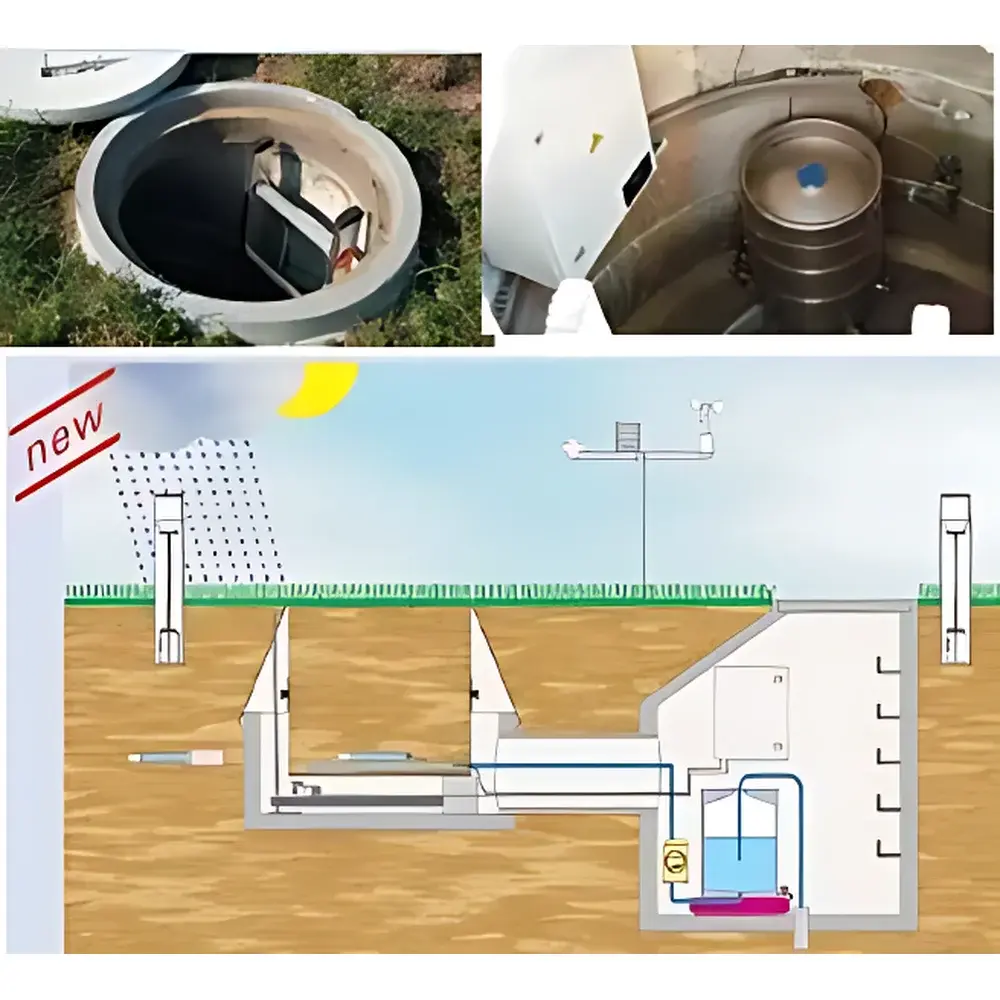
AZ FR102 Miniature Lysimeter System
| Brand | AZ (Beijing Aozuo) |
|---|---|
| Origin | Beijing, China |
| Manufacturer | AZ Instrument Co., Ltd. |
| Type | Weighing Lysimeter System |
| Model | FR102 |
| Application | Soil Water Balance, Solute Transport, Evapotranspiration Quantification |
| Measurement Principle | High-precision gravimetric weighing combined with tensiometric soil water potential control and suction-cup-based pore water sampling |
| Column Surface Area | 1 m² |
| Column Height Options | 1 m or 2 m (stainless steel) |
| Total System Height | 1.35 m (1-m version) or 2.35 m (2-m version) |
| Outer Diameter | 1.65 m |
| Gravimetric Resolution | 0.01 mm water equivalent |
| Drainage/Leachate Resolution | 0.01 mm (standard), 0.001 mm (soil solution sampling mode) |
| Sampling Cup Surface Area | 3600 cm² |
| Compliance | Designed for GLP-aligned long-term field deployment |
Overview
The AZ FR102 Miniature Lysimeter System is a modular, field-deployable gravimetric lysimeter engineered for high-fidelity quantification of soil water balance, vertical solute transport, and evapotranspiration (ET) under natural or managed conditions. Unlike passive or non-weighing lysimeters, the FR102 integrates a precision load-cell-based weighing subsystem with integrated tensiometric feedback, vacuum-controlled pore-water extraction, and multi-depth sensor arrays—enabling simultaneous measurement of infiltration, drainage, capillary rise, root-zone water uptake, and leachate chemistry. Its core architecture follows the principle of controlled boundary conditions: the stainless-steel column isolates a representative soil monolith (1 m² surface area, 1–2 m depth), while its base incorporates a tension-controlled drainage zone that replicates in-situ matric potential gradients. This design ensures measured fluxes reflect actual field-scale hydrodynamic behavior—not laboratory artifacts. The system is explicitly intended for long-term, unattended operation in agricultural, ecological, and contaminated-site monitoring applications where regulatory-grade data integrity and traceable mass balance closure are required.
Key Features
- Modular configuration supporting four research-specific variants: Hydrological, Meteorological, Soil Scientific, and Agronomic lysimetry—each with standardized column geometry (1 m² cross-section) and calibrated instrumentation interfaces.
- High-resolution gravimetric measurement with ≤0.01 mm water-equivalent resolution, validated per ISO 27668 Annex B for soil water content determination accuracy.
- Tensiometric drainage control via FR1022 water potential controller, enabling dynamic regulation of outflow based on real-time matric potential at the column base (T84 tensiometers).
- Multi-depth monitoring: Up to 8 FDR-2 dielectric moisture sensors and 6 SiC ceramic suction cups (FR5014) installed at customizable depths (30–195 cm) for concurrent volumetric water content, temperature, and pore-water sampling.
- Integrated leachate collection with dual-resolution capability: standard 0.01 mm drainage quantification via load cell; sub-millimeter precision (0.001 mm) achieved during active vacuum-assisted soil solution extraction using FR1023 controller and SF1000 fraction collectors.
- Robust mechanical design: 304 stainless-steel column (1.65 m outer diameter), reinforced concrete base, and patented non-cutting excavation tooling to minimize soil structural disturbance during installation—critical for preserving undisturbed hydraulic continuity between column and surrounding field soil.
Sample Compatibility & Compliance
The FR102 accommodates intact soil monoliths from diverse textures—including clay loam, sandy loam, and gravelly alluvium—provided the site meets minimum hydrogeological criteria: a minimum 2.5 m separation from the regional groundwater table and absence of steep slope (>5%) or dense tree root interference. It complies with internationally recognized protocols for lysimeter validation: ASTM D4959-22 (Standard Practice for Performance Evaluation of Lysimeters), ISO 27668:2021 (Soil quality — Determination of water content), and the European COST Action ES1303 framework for harmonized hydrological monitoring. For regulated environmental studies, the system supports audit-ready data provenance when paired with FR220 dataloggers configured for timestamped, tamper-evident storage compliant with ALCOA+ principles (Attributable, Legible, Contemporaneous, Original, Accurate, Complete, Consistent, Enduring, Available). While not intrinsically certified to FDA 21 CFR Part 11, its architecture permits integration with Part 11–compliant software platforms for electronic records and signatures.
Software & Data Management
Data acquisition is managed by the FR220 universal datalogger, supporting programmable sampling intervals from 1 second to 24 hours and synchronized logging across all analog (tensiometer voltage, load cell mV), digital (RS-485 sensor outputs), and pulse-count (leachate tipping bucket) channels. Raw sensor outputs are converted in real time using embedded calibration coefficients traceable to NIST-standard reference materials. Export formats include CSV, NetCDF, and CF-compliant HDF5—ensuring compatibility with hydrological modeling environments (e.g., HYDRUS-1D, SWAP, PRMS). Optional cloud telemetry modules enable remote diagnostics, alarm notifications (e.g., power failure, vacuum loss, overflow), and secure HTTPS-based data push to institutional servers or third-party platforms such as EDI-ORNL or ICOS. All firmware updates and configuration files are digitally signed to prevent unauthorized modification.
Applications
The FR102 serves as a foundational instrument in process-level hydrological research and environmental compliance monitoring. Documented deployments include: (1) Alpine hydrology—1830 m elevation lysimeter station in the Austrian Alps, quantifying snowmelt-driven recharge and nitrate leaching dynamics in drinking water catchments; (2) Agricultural nutrient management—long-term monitoring of fertilizer-derived nitrogen and phosphorus leaching under conventional tillage vs. no-till regimes in Central Europe; (3) Contaminant fate studies—eight-column lysimeter array (Wielenbach, Germany) tracking arsenic, cadmium, and PAH migration through unsaturated zones into shallow aquifers; (4) Climate-resilience trials—48-column facility (GSF Neuherberg) evaluating drought-stress responses and volatile organic compound (VOC) volatilization using gas-tight canopy enclosures. Its ability to resolve sub-daily ET fluctuations, quantify preferential flow paths via depth-resolved sampling, and maintain mass balance closure over multi-year campaigns makes it particularly suited for validating land-surface models used in IPCC AR6 assessments and EU Green Deal monitoring frameworks.
FAQ
What is the minimum required separation distance between the lysimeter base and the groundwater table?
A minimum vertical separation of 2.5 meters is mandatory to prevent upward capillary influence and ensure unidirectional drainage measurement.
Can the FR102 be installed on sloped terrain?
No. Slopes exceeding 5% introduce lateral flow components that violate the vertical-flux assumption inherent to lysimeter mass balance calculations.
Is frost heave mitigation addressed in the design?
Yes. Pre-winter maintenance requires removal of snow from the annular gap between column and native soil to prevent ice lens formation and load-cell drift.
Does the system support automated irrigation or replenishment?
Yes. The FR1021 integrated 60-L water reservoir with load-cell monitoring and FR1022-controlled pump enables closed-loop irrigation triggered by user-defined soil water potential thresholds.
How is sensor calibration maintained during multi-year field deployment?
FDR-2 sensors include on-board temperature compensation and factory calibration certificates; tensiometers (T84) are field-serviceable with ceramic tip replacement kits and pressure transducer recalibration every 12 months per ISO 27668 recommendations.
Related Products







