
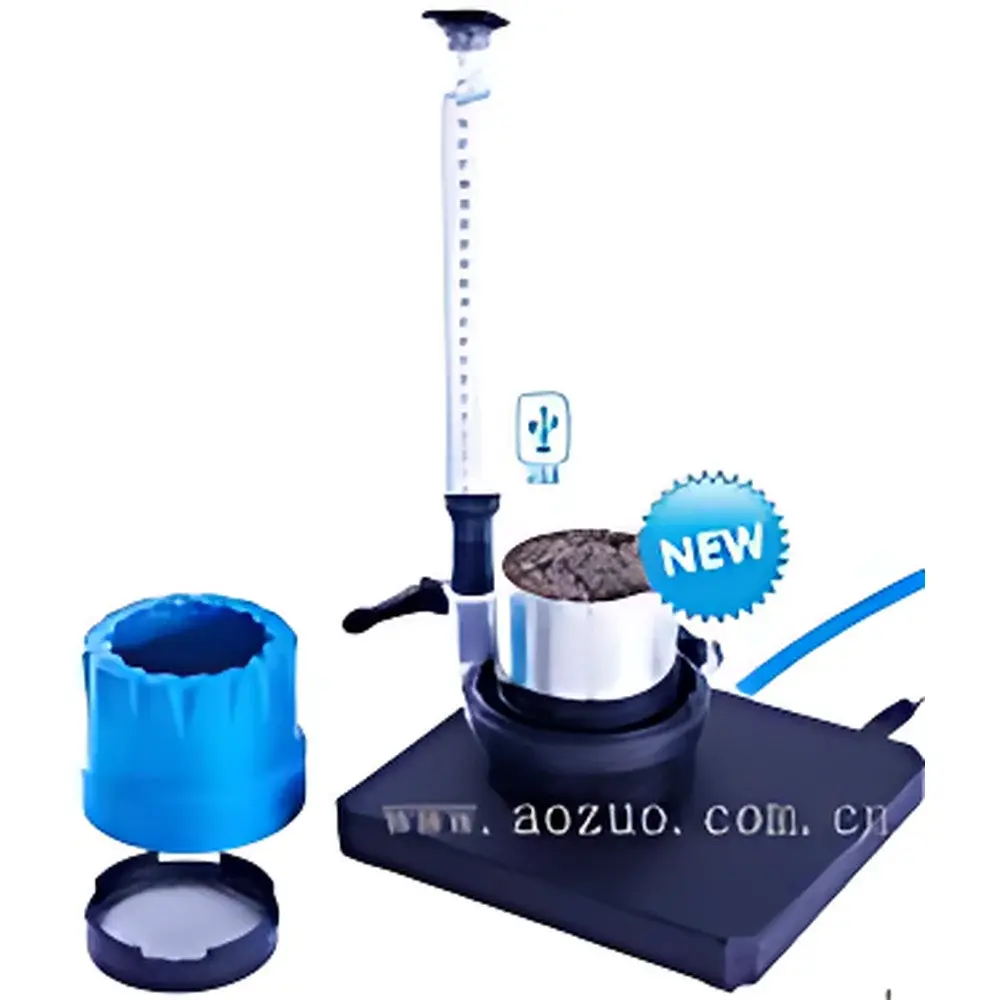
AZ Ksat Automated Soil Saturated Hydraulic Conductivity Measurement System
| Brand | AZ (Beijing Aozuo) |
|---|---|
| Origin | Germany |
| Manufacturer | Yes |
| Product Type | Imported |
| Model | Ksat |
| Instrument Category | Soil Moisture / Water Potential Analyzer |
| Measurement Principle | Constant-Head and Falling-Head Permeametry per Darcy’s Law |
| Compliance | DIN 19683-9, DIN 18130-1 |
| Ksat Range | 0.01–5000 cm/d |
| Ceramic Plate Permeability | 20,000 cm/d |
| Measurement Accuracy | ±2% |
| Pressure Sensor Resolution | 1 Pa |
| Temperature Sensor Accuracy | ±0.2 °C |
| Sample Volume | 250 mL |
| Core Ring Dimensions | 50 mm height × 80 mm inner diameter |
| Software | KcView 1.0 with Automatic Temperature Compensation |
| Repeatability | High (CV < 3% across replicate undisturbed cores) |
Overview
The AZ Ksat Automated Soil Saturated Hydraulic Conductivity Measurement System is a precision-engineered laboratory permeameter designed for the quantitative determination of saturated hydraulic conductivity (Ksat) in intact soil cores. Grounded in Darcy’s law, the system quantifies the volumetric flow rate of water through a fully saturated soil specimen under controlled hydraulic gradient conditions—either constant-head (for high-permeability soils) or falling-head (for low-permeability clays and compacted layers). This dual-mode operational architecture ensures metrological validity across heterogeneous soil types—from coarse sands (>1000 cm/d) to dense silty clays (<1 cm/d)—without manual mode switching or recalibration. The instrument is specifically engineered for reproducible, evaporation-free measurement environments, eliminating mass loss artifacts common in open-system permeameters. Its mechanical and sensor architecture conforms to the physical requirements of DIN 19683-9 (Agricultural Hydraulics) and DIN 18130-1 (Geotechnical Infiltration Testing), making it suitable for regulatory reporting, research-grade hydrological modeling, and long-term soil health monitoring programs.
Key Features
- Dual-mode hydraulic control: Selectable constant-head or falling-head configuration via software-driven solenoid valve sequencing—optimized for dynamic range coverage from 0.01 to 5000 cm/d.
- Integrated ceramic plate base (permeability ≥20,000 cm/d) ensuring uniform inflow distribution and eliminating preferential flow paths at the soil–plate interface.
- High-fidelity pressure sensing (±1 Pa resolution) coupled with PT100-class temperature monitoring (±0.2 °C) enables real-time thermal correction of viscosity and density parameters in Ksat computation.
- Sealed, closed-loop fluid circuit with optical liquid-level detection prevents evaporative loss during extended tests (up to 72 h), preserving mass balance integrity.
- Standardized core holder accommodates 50 mm × 80 mm (height × internal diameter) undisturbed soil monoliths—compatible with ASTM D5084 and ISO 11274 sample preparation protocols.
- Modular design supports optional integration with automated peristaltic dosing units for sequential multi-step infiltration experiments (e.g., transient unsaturated–saturated transitions).
Sample Compatibility & Compliance
The AZ Ksat system accepts both disturbed and undisturbed soil samples prepared in standard ring samplers (250 mL volume). It is validated for use with mineral soils ranging from gravelly sands to structured vertisols, provided samples maintain structural integrity during saturation and mounting. All measurement procedures adhere to DIN 19683-9 (field-scale irrigation design support) and DIN 18130-1 (foundation drainage assessment), and data output formats are compatible with GLP-compliant laboratory information management systems (LIMS). While not certified to ISO/IEC 17025 out-of-the-box, the system’s traceable sensor calibration paths and audit-ready test logs support full accreditation readiness when deployed within ISO 17025-accredited labs.
Software & Data Management
KcView 1.0 is a Windows-based, CE-marked application that governs all hardware interactions, real-time data acquisition, and Ksat computation. It implements automatic temperature compensation using the IAPWS-95 formulation for water dynamic viscosity and density, referenced to in-situ sensor readings. Each test generates a timestamped CSV report containing raw pressure vs. time series, calculated flux rates, intermediate Ksat values per time step, and final statistically weighted mean Ksat with coefficient of variation (CV). Audit trails record operator ID, calibration events, and parameter modifications—supporting 21 CFR Part 11 compliance when paired with network-authenticated user accounts and electronic signatures.
Applications
- Quantifying infiltration capacity for agricultural drainage design and subsurface water management planning.
- Validating pedotransfer functions (PTFs) used in regional-scale hydrological models (e.g., SWAT, HYDRUS-1D).
- Assessing compaction effects on soil hydraulic architecture following tillage or vehicular traffic.
- Supporting landfill liner performance evaluation and leachate migration risk analysis.
- Long-term monitoring of soil structure evolution under climate-resilient cropping systems.
- Calibrating neutron probe and TDR-based field moisture sensors against laboratory-derived Ksat baselines.
FAQ
What sample preparation protocols are recommended prior to Ksat testing?
Undisturbed cores should be saturated from below over 24–48 h using de-aired water; gravimetric water content and bulk density must be recorded pre-test per ISO 11272.
Can the system measure anisotropic Ksat (vertical vs. horizontal)?
Yes—by rotating the core orientation in the holder and repeating the test under identical hydraulic boundary conditions.
Is external PC hardware required for operation?
Yes—a Windows 10/11 PC with USB 2.0 port and minimum 4 GB RAM is mandatory for KcView 1.0 execution and real-time control.
How often must pressure sensors be recalibrated?
Annual recalibration against NIST-traceable dead-weight testers is recommended; factory calibration certificates are supplied with each unit.
Does the system support custom test sequences (e.g., multi-step head gradients)?
Not natively in KcView 1.0; however, ASCII protocol documentation is provided for third-party LabVIEW or Python automation integration.







