
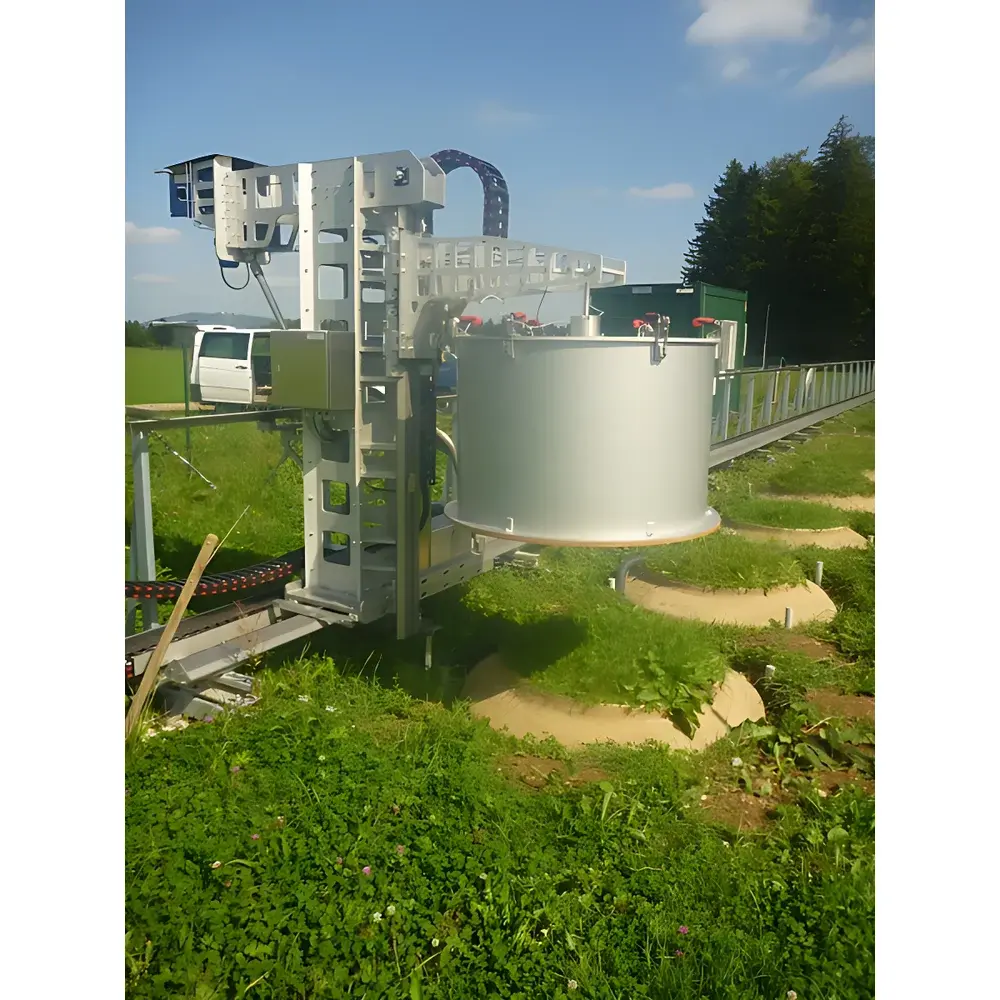
AZ EcoScope Ecological Simulation Control System
| Brand | AZ (Beijing Aozuo) |
|---|---|
| Origin | Beijing, China |
| Manufacturer Type | Direct Manufacturer |
| Product Origin | Domestic (China) |
| Model | EcoScope |
| Price | USD 145 (approx. based on ¥1000 at 1:6.9 exchange rate) |
Overview
The AZ EcoScope Ecological Simulation Control System is an engineered platform for controlled-environment ecosystem experimentation, designed to replicate and manipulate key abiotic drivers—temperature, precipitation (including snowfall and melt), atmospheric CO2 concentration, and nitrogen deposition—in soil–plant–atmosphere continuum studies. Built upon principles of soil hydrology, micrometeorology, and biogeochemical flux monitoring, the system enables long-term ecological observation and hypothesis-driven manipulative experiments under field-relevant boundary conditions. Its architecture supports mechanistic investigation into how global change factors modulate carbon sequestration, nitrogen cycling, evapotranspiration partitioning, and root-zone water dynamics—particularly the coupling between aboveground productivity and belowground biogeochemical processes. Unlike static chamber-based systems, EcoScope integrates dynamic boundary layer control at the soil column base to preserve natural soil hydraulic gradients and matric potential profiles, ensuring experimental fidelity to in situ pedological behavior.
Key Features
- Modular, user-configurable control units—including programmable precipitation controllers, temperature regulation modules, and optional snowfall/snowmelt actuators—designed for seasonal and diurnal cycle emulation.
- Hexagonal soil column array with central service well, enabling spatially uniform replication and eliminating positional bias across treatment plots.
- Bottom-boundary layer control system that maintains realistic soil water retention curves and unsaturated hydraulic conductivity profiles, critical for modeling infiltration, drainage, and root water uptake.
- Integrated multi-sensor telemetry: real-time acquisition of volumetric water content (VWC), soil temperature, electrical conductivity (EC), and soil water potential (matric suction) at multiple depths per column.
- Automated soil solution extraction capability via ceramic suction lysimeters or passive capillary samplers, compatible with subsequent ion chromatography or isotopic analysis.
- Optional greenhouse gas (CO2, CH4, N2O) sampling ports integrated into column headspace, supporting closed-chamber or gradient-based flux quantification protocols.
- Patented rotary-cutting snow depth and accumulation sensor (CE-certified, deployed in >100 EU research sites), providing high-resolution temporal resolution of snowpack dynamics and meltwater release timing.
Sample Compatibility & Compliance
The EcoScope system accommodates standard soil column dimensions (e.g., 30–100 cm diameter × 100–200 cm height), supporting both undisturbed monoliths and re-packed horizons with known texture and organic matter content. It is compatible with common edaphic substrates including loam, clay loam, sandy soils, and peat-based media. All embedded sensors comply with IEC 60529 (IP67 ingress protection) and ISO/IEC 17025 traceability requirements for environmental monitoring instrumentation. Data logging and control firmware adhere to GLP-compliant audit trail standards, with timestamped event logs, user-access permissions, and immutable data storage—supporting regulatory readiness for long-term ecological monitoring programs aligned with LTER (Long Term Ecological Research) network protocols and IPCC AR6 land-use change reporting frameworks.
Software & Data Management
The system operates under ENVIdata—a proprietary web-based data platform developed by Beijing Aozuo Ecological Instruments Co., Ltd. (registered software copyright No. 2021SR0876542). ENVIdata provides secure remote access, role-based user management, and automated calibration validation workflows. The core EcoScope Control Software enables synchronized scheduling of irrigation events, heating/cooling cycles, CO2 injection pulses, and nitrogen solution dosing—all programmable via absolute time or environmental triggers (e.g., soil moisture threshold, air temperature setpoint). Visualization tools support cross-column comparison, multi-layer profile overlays, time-series anomaly detection, and export to CSV, NetCDF, or HDF5 formats for integration with R, Python (SciPy/Pandas), or MATLAB-based modeling pipelines (e.g., HYDRUS-1D, DAYCENT, LPJ-GUESS). All data transactions are logged with SHA-256 hash integrity verification, satisfying FDA 21 CFR Part 11 electronic record requirements when configured with digital signature authentication.
Applications
- Controlled simulation of climate change scenarios: Free-Air CO2 Enrichment (FACE)-compatible open-top chamber integration, stepwise warming gradients (+1°C to +6°C), altered precipitation regimes (intensity/frequency shifts), and chronic vs. pulse nitrogen deposition treatments.
- Soil–hydrological process studies: Quantifying preferential flow pathways, hysteresis in soil water characteristic curves, freeze–thaw effects on macroporosity, and snowmelt infiltration efficiency under variable canopy cover.
- Root–microbe–nutrient interaction research: Coupling rhizosphere sensor arrays with isotopic tracer (e.g., 15N, 13C) labeling to resolve C:N stoichiometric feedbacks under elevated CO2.
- Model parameterization and validation: Providing high-temporal-resolution boundary condition data for terrestrial biosphere models (e.g., CLM5, ORCHIDEE) and catchment-scale hydrological simulators (e.g., SWAT, MIKE SHE).
- Governance-supporting science: Generating evidence for national adaptation planning under UNFCCC National Adaptation Plans (NAPs) and IPCC land degradation neutrality (LDN) indicators.
FAQ
Can EcoScope be deployed in remote field stations with limited power infrastructure?
Yes—system modules support 12 V DC input and optional solar-charging battery banks; low-power sleep modes reduce average consumption to <2 W per column during idle periods.
Is third-party sensor integration supported?
Yes—RS-485, SDI-12, and analog (0–5 V / 4–20 mA) interfaces allow seamless integration of external sensors (e.g., PAR meters, sap flow probes, gas analyzers) via configurable Modbus RTU protocols.
How is data security ensured during cloud transmission?
All ENVIdata communications use TLS 1.3 encryption; on-premise deployment options are available for institutions requiring air-gapped data sovereignty compliance.
Does the system support automated calibration routines?
Yes—built-in reference checks for TDR moisture sensors and thermistor arrays occur at user-defined intervals, with drift compensation applied automatically using NIST-traceable calibration coefficients.
What is the typical lead time for a custom-configured EcoScope system?
Standard configurations ship within 8 weeks; site-specific engineering (e.g., permafrost-capable columns, saline-soil corrosion packages) requires 12–16 weeks following finalized technical specifications and field survey report approval.





