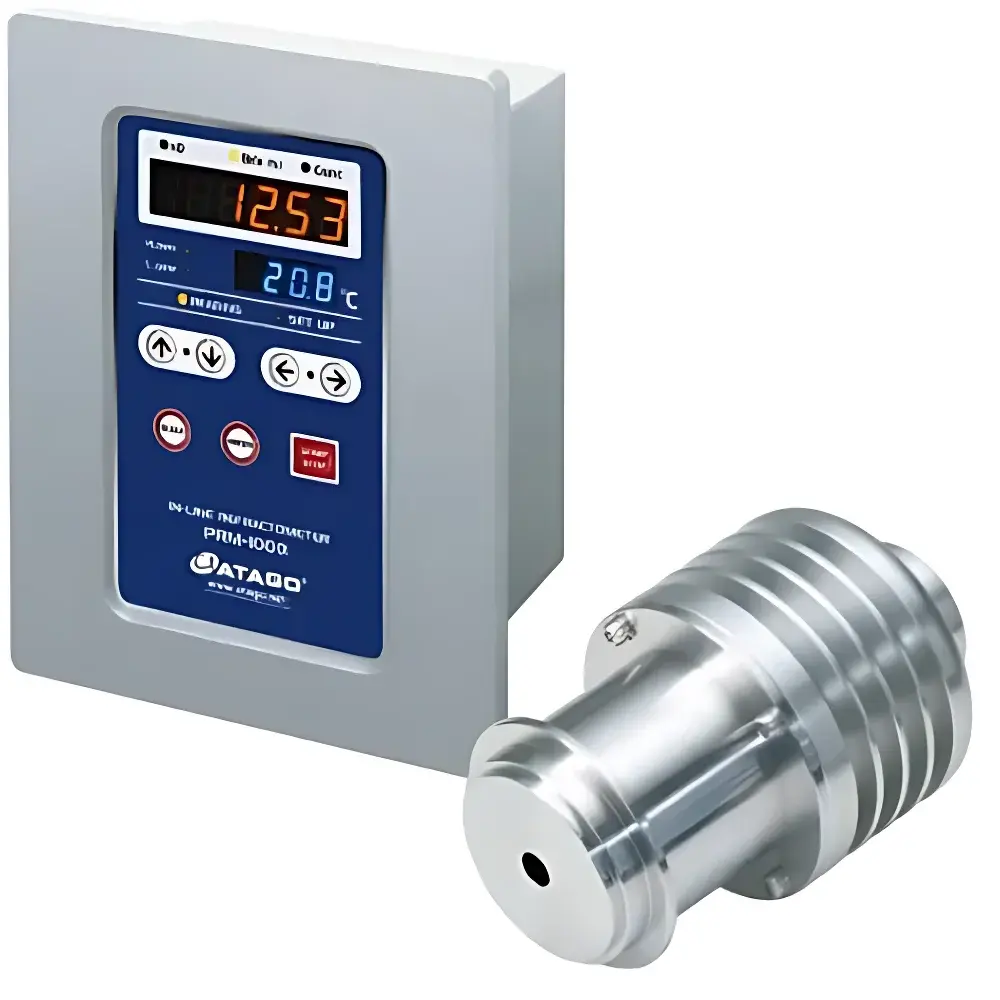
ATAGO PRM-100α DX High-Precision Online Refractometer
| Brand | ATAGO |
|---|---|
| Origin | Japan |
| Model | PRM-100α DX |
| Refractive Index Range | 1.32000–1.55700 |
| Temperature Measurement Range | 5.0–100.0°C |
| Basic Instrument Error | ±0.00010 (nD) |
| Resolution | 0.0001 or 0.00001 (nD), 0.01% or 0.1% (Brix) |
| Display Unit Dimensions | 19.2 × 10 × 24 cm, 3.3 kg |
| Sensor Unit Dimensions | 10.8 × 17.26 × 10.8 cm, 2.6 kg |
| IP Rating | IP67 (both units) |
| Prism Material | Sapphire |
| Sample Cell Material | SUS316L |
| Output | RS-232C, 4–20 mA analog, RS-485 (sensor-to-display cable, standard 15 m, up to 200 m) |
| Power Supply | AC 100–240 V, 50/60 Hz |
| Power Consumption | 30 VA |
| Measurement Time | ~1 second |
Overview
The ATAGO PRM-100α DX is a high-precision, dual-unit online refractometer engineered for continuous, real-time measurement of refractive index (nD), Brix (% w/w sucrose equivalent), and temperature-corrected concentration in industrial liquid process streams. Unlike conductivity-based analyzers—whose output is highly sensitive to ionic composition and temperature-induced drift—the PRM-100α DX employs total internal reflection (TIR) optics with a sapphire prism interface to directly quantify solute density via the fundamental optical property of refractive index. This principle ensures high reproducibility across non-ionic and weakly ionic solutions (e.g., sugars, alcohols, glycols, organic acids, polymers), independent of electrical conductivity or pH. The instrument is designed for integration into sanitary, hygienic, and corrosion-resistant process environments, with an IP67-rated sensor unit suitable for washdown and hazardous area proximity (non-explosion-proof classification). Its ATC (Automatic Temperature Compensation) algorithm applies ISO 21542-compliant polynomial correction over 5.0–100.0°C, enabling stable Brix readings even during dynamic thermal transients in evaporation, mixing, or CIP cycles.
Key Features
- High-resolution optical detection: 0.00001 or 0.0001 refractive index resolution selectable via configuration; ±0.00010 nD basic error verified against NIST-traceable sucrose standards under controlled thermal conditions
- Sapphire prism and SUS316L sample chamber: Chemically inert, scratch-resistant interface compatible with aggressive media including caustic cleaners, acidic process liquors, and high-viscosity syrups
- True dual-unit architecture: Physically separated sensor (process-mounted) and display/control unit (panel- or wall-mounted), connected via shielded RS-485 cable (standard 15 m, extendable to 200 m), minimizing signal degradation and enabling remote operator access
- Robust environmental rating: IP67 protection on both sensor and display units ensures operational integrity in humid, dusty, and high-pressure washdown environments common in food, pharma, and chemical manufacturing
- Fast, stable measurement cycle: <1-second response time with digital filtering to suppress flow-induced noise; no moving parts or consumables required
- Multi-parameter output: Simultaneous analog 4–20 mA outputs for nD, Brix, and temperature; RS-232C serial interface for direct PLC or SCADA integration and firmware updates
Sample Compatibility & Compliance
The PRM-100α DX is validated for use with aqueous and organic solvent-based solutions where refractive index correlates linearly or polynomially with solute concentration—including sucrose, glucose, fructose, sodium hydroxide, sodium carbonate, ethanol, ethylene glycol, propylene glycol, citric acid, lactic acid, and PEG solutions. It is not intended for opaque, highly scattering, or strongly absorbing suspensions (e.g., slurries, emulsions >1% oil-in-water). In regulated industries, the device supports ALCOA+ data integrity principles when integrated with compliant control systems: its fixed measurement interval, non-volatile parameter storage, and timestamped analog/digital outputs facilitate audit-ready records. While the instrument itself is not FDA 21 CFR Part 11 certified, its deterministic output behavior and traceable calibration methodology align with GMP/GLP documentation requirements for concentration monitoring in USP method validation contexts.
Software & Data Management
The PRM-100α DX operates autonomously without embedded software or operating system dependencies. Configuration and calibration are performed via front-panel keypad navigation or external terminal (RS-232C). All settings—including Brix conversion coefficients, ATC parameters, output scaling, and display units—are stored in EEPROM with battery-backed retention. Analog outputs provide direct connection to DCS or PLC I/O modules without protocol translation. For centralized data logging, third-party SCADA platforms (e.g., Ignition, Siemens Desigo, Rockwell FactoryTalk) can poll RS-232C registers at user-defined intervals. Calibration verification reports may be generated manually using reference sucrose standards (ASTM D1078, ISO 21542), and historical output trends are reconstructable from 4–20 mA loop recordings archived in plant historians.
Applications
- Real-time Brix control in juice concentration, syrup blending, and dairy evaporation—reducing over-concentration waste and ensuring batch consistency per ISO 2173
- In-line monitoring of cleaning solution strength (NaOH, HNO3, citric acid) during CIP cycles to verify minimum effective concentration and endpoint detection
- Continuous verification of coolant, quench oil, and metalworking fluid concentration in machining lines to prevent tool wear and surface defects
- Concentration tracking in pharmaceutical API crystallization, buffer preparation, and lyophilization feedstock conditioning under cGMP conditions
- Blend ratio verification in polymer emulsion production, paint formulation, and agrochemical dilution where refractive index serves as a primary quality attribute
FAQ
Is the PRM-100α DX suitable for measuring conductivity?
No. This is a refractometer—not a conductivity meter. It measures refractive index, not electrical conductance. Do not substitute it for ionic strength or salinity assessment.
Can the sensor be installed in pressurized pipelines?
Yes. The sensor housing is rated for continuous operation at up to 1.0 MPa (10 bar) with appropriate flange or sanitary clamp mounting (tri-clamp optional). Pressure rating assumes ambient temperature ≤60°C.
How often does it require recalibration?
Under stable process conditions and routine maintenance (daily prism wipe, weekly water rinse), annual verification against certified sucrose standards is recommended. More frequent checks are advised after sensor replacement, mechanical impact, or exposure to abrasive particulates.
Does it support Modbus RTU or Profibus protocols?
No. Native communication is RS-232C (ASCII commands) and 4–20 mA analog. Modbus or Profibus integration requires an external protocol converter.
What is the minimum detectable flow rate for reliable measurement?
A laminar, non-turbulent flow of ≥0.3 m/s across the prism surface is recommended. For low-flow or static applications, optional flow cell accessories with integrated bypass regulation are available.