
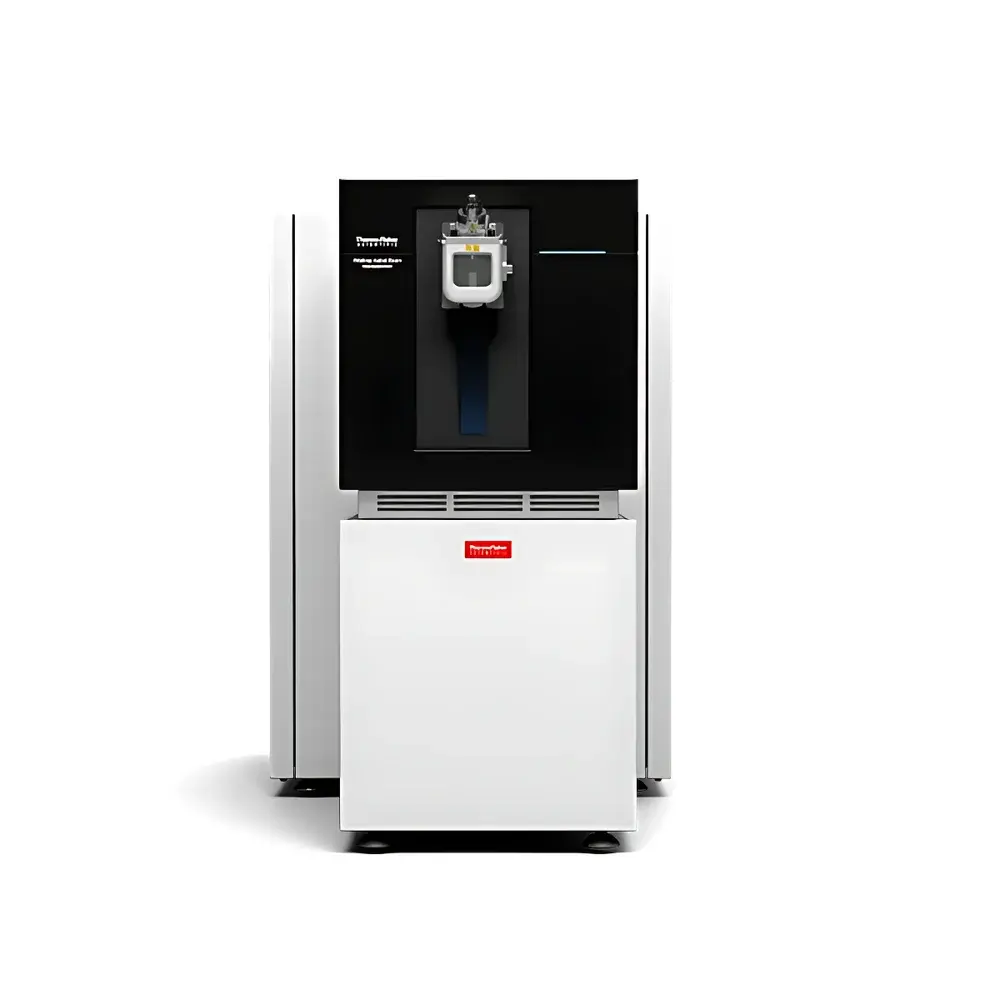
Thermo Fisher Orbitrap Astral Zoom Mass Spectrometer
| Brand | Thermo Fisher |
|---|---|
| Origin | Germany |
| Manufacturer Type | Original Equipment Manufacturer (OEM) |
| Origin Category | Imported |
| Model | Orbitrap Astral Zoom Mass Spectrometer |
| Instrument Type | Orbitrap Mass Spectrometer |
| Application Scope | Specialized |
| Mass Range | m/z 40–6000 |
| Sensitivity | SIM mode — 50 fg on-column reserpine, S/N ≥ 150:1 |
| MS/MS mode — 50 fg on-column reserpine, S/N ≥ 100 | 1 |
| Resolution | 100,000 FWHM at m/z 138 |
| Mass Accuracy | <5 ppm RMS |
Overview
The Thermo Fisher Orbitrap Astral Zoom Mass Spectrometer represents a paradigm shift in high-resolution, high-throughput mass spectrometry for life science discovery. Engineered around an advanced Orbitrap-based architecture with integrated ion pre-concentration and ultrafast scanning capabilities, the system leverages electrostatic trapping principles combined with real-time transient digitization to deliver simultaneous high resolution, high sensitivity, and rapid duty cycle performance. Unlike conventional Orbitrap platforms, the Astral Zoom incorporates a redesigned mass analyzer featuring enhanced ion transmission efficiency, optimized electric field geometry, and adaptive scan speed control—enabling robust operation across diverse sample types without compromising spectral fidelity. Designed specifically for deep proteomics, single-cell multi-omics, and spatially resolved metabolomics, it serves as a core analytical platform for laboratories requiring reproducible, quantitative, and structurally informative data under GLP- and GMP-aligned workflows.
Key Features
- Ultra-High Throughput Acquisition: Achieves up to 270 Hz full-scan acquisition rate in high-resolution mode, enabling comprehensive analysis of >300 samples per day when coupled with Vanquish Neo UHPLC and EASY-Spray PepMap columns using 4.8-min gradients—yielding >8,200 protein identifications from 200 ng HeLa digest.
- Enhanced Ion Pre-Concentration: Integrates a high-efficiency bent linear ion trap with a fast-switching ion filter to accumulate and compress ion packets prior to injection into the Orbitrap analyzer, significantly improving signal-to-noise ratio and dynamic range.
- Extended Dynamic Range Quantification (eDR): Supports quantification across >4 orders of magnitude in a single run, allowing concurrent detection and accurate relative quantitation of both high-abundance housekeeping proteins and low-abundance signaling peptides.
- Low-Input & Single-Cell Optimized Modes: Includes dedicated LFQ-DIA and TMTpro HR acquisition methods validated for sub-nanogram inputs—enabling identification of >6,500 proteins from 250 pg HeLa digest or >5,800 proteins per HEK293F single cell.
- Structural Biology Enablement: Implements stepped collision energy ramping and cross-linking-compatible fragmentation protocols, supporting confident identification of protein-protein interaction interfaces and conformational states.
Sample Compatibility & Compliance
The Orbitrap Astral Zoom is compatible with standard electrospray ionization (ESI) sources—including nanospray, microspray, and chip-based interfaces—as well as optional atmospheric pressure photoionization (APPI) and atmospheric pressure chemical ionization (APCI) modules. It supports integration with automated sample introduction systems compliant with ISO/IEC 17025 and FDA 21 CFR Part 11 requirements, including audit-trail-enabled instrument control software and electronic signature support. All acquisition and processing workflows adhere to guidelines outlined in ISO 13485 (for clinical research applications), CLSI EP28-A3c (for precision evaluation), and USP (analytical instrument qualification).
Software & Data Management
Data acquisition and processing are managed through Thermo Scientific™ Compound Discoverer™ 3.3 and Proteome Discoverer™ 2.5 platforms, both certified for 21 CFR Part 11 compliance with role-based access control, electronic signatures, and immutable audit trails. Raw data files are stored in Thermo’s proprietary .raw format, fully compatible with open-source tools such as MaxQuant, FragPipe, and Skyline via vendor-neutral conversion utilities (e.g., msConvert). The system supports direct export to LIMS environments via RESTful APIs and includes built-in metadata tagging aligned with MIAPE and PSI-MI standards for FAIR data management.
Applications
- Proteomics: Deep coverage single-cell proteomics, targeted pathway profiling, immunopeptidomics, and cross-linking mass spectrometry (XL-MS) for structural modeling.
- Metabolomics & Lipidomics: Untargeted single-cell metabolite profiling, SQUAD (Stable Isotope-Assisted Quantitative Analysis of Dynamics), and high-resolution lipid class differentiation using retention time–m/z correlation networks.
- Clinical & Translational Research: Large-cohort biomarker discovery in oncology, host–microbiome interaction mapping, and longitudinal monitoring of post-translational modifications in disease progression cohorts.
- Spatial Omics: Integration with MALDI and DESI imaging platforms for co-localized protein and metabolite mapping at cellular resolution in FFPE and frozen tissue sections.
FAQ
What is the maximum recommended sample loading volume for optimal performance in low-input proteomics mode?
The system achieves optimal sensitivity with 1–5 µL injections of desalted peptide digests at concentrations between 0.1–10 ng/µL, depending on column dimensions and flow rate configuration.
Is the Orbitrap Astral Zoom compatible with third-party chromatography systems beyond Thermo’s Vanquish platform?
Yes—it supports standard ESI interfaces and offers configurable trigger signals and analog/digital I/O ports for synchronization with non-Thermo UHPLC systems meeting ISO 8573-1 purity Class 1 air specifications.
Does the instrument support real-time data-dependent acquisition (DDA) decision logic during acquisition?
Yes—the Astral Zoom implements intelligent real-time peak detection and dynamic exclusion algorithms that adapt precursor selection based on intensity, charge state, and retention time windows without interrupting scan cycles.
How is mass calibration maintained across extended acquisition runs?
Internal lock-mass correction is applied continuously using a dual-frequency calibration ion (e.g., polysiloxane or cesium iodide cluster ions), with recalibration intervals configurable down to every 30 seconds.
Can raw data files be processed offline using open-source software without proprietary license dependencies?
Yes—Thermo provides native .raw file readers and converters (e.g., msConvert) supporting mzML, mzXML, and HDF5 output formats, enabling full compatibility with Galaxy-P, OpenMS, and Python-based analysis pipelines (e.g., PyOpenMS, MZmine).




