
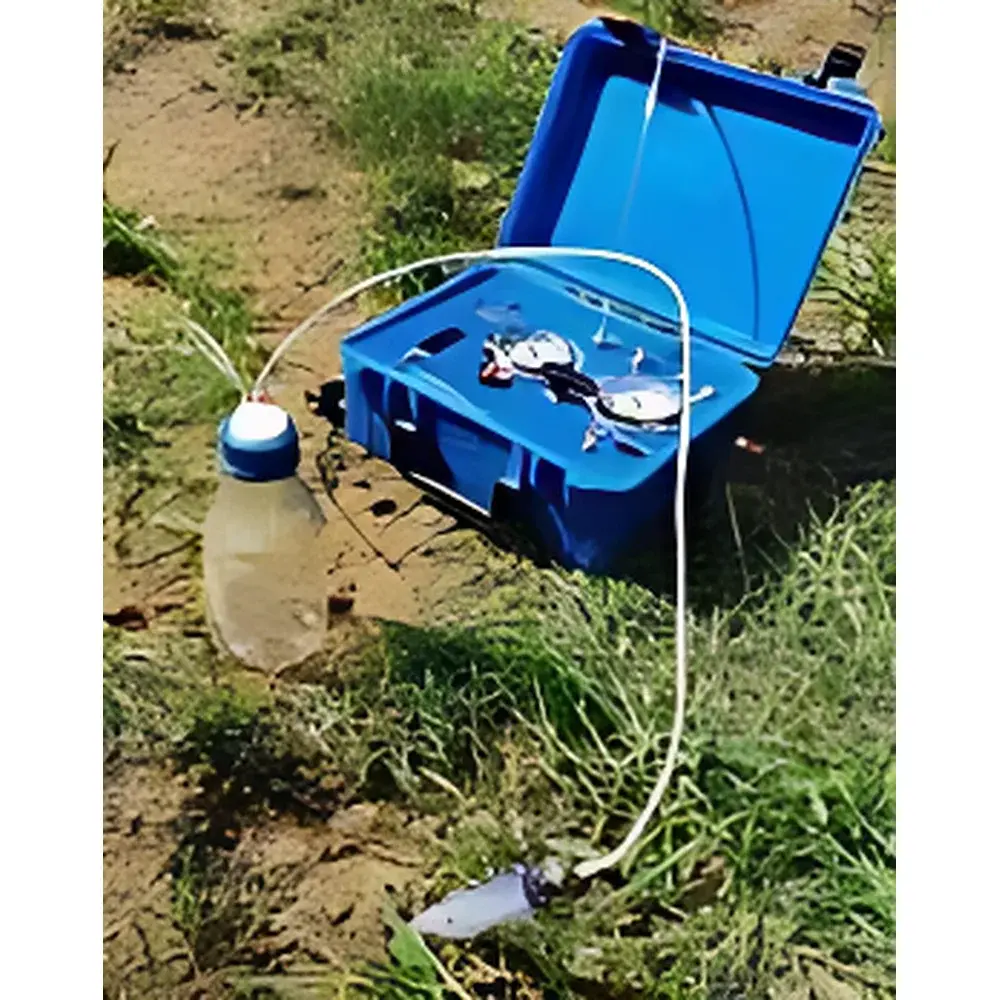
AZW-100 Soil Pore Water Sampler by AZ (Beijing AoZuo)
| Brand | AZ (Beijing AoZuo) |
|---|---|
| Origin | Beijing, China |
| Manufacturer Type | Direct Manufacturer |
| Region of Origin | Domestic (China) |
| Model | AZW-100 |
| Vacuum Pump Pressure Range | 0 to –85 kPa |
| Ceramic Cup Dimensions | Ø22 mm × 60 mm |
| Sampling Tube Lengths | 20 / 40 / 50 / 100 / 200 cm (standard: 20 cm) |
| Sampling Tube Material | Reinforced PVC, OD 22 mm |
| Tubing Material | PTFE, OD 3.12 mm / ID 1.6 mm |
| Sample Bottle Capacity | 250 mL |
| Sample Bottle Material | Borosilicate Glass |
| Sampling Bottle Housing | Triple-bottle underground enclosure |
| pH Compatibility | 4–9 |
| Operating Duration (Pump) | ≥12 h per charge |
| Sustained Sampling Duration (with insulated enclosure) | Up to 48 h |
| Analyte Compatibility | Nitrate, chloride, sulfate, Ca²⁺, Na⁺, NH₄⁺, phosphate |
Overview
The AZW-100 Soil Pore Water Sampler is a field-deployable, suction-based lysimeter system engineered for the quantitative extraction of soil solution from unsaturated and variably saturated zones. It operates on the principle of controlled negative pressure (tension) applied across a semi-permeable ceramic membrane—enabling equilibrium-driven sampling that preserves in situ solute composition without significant matrix disturbance. Unlike percolation or centrifugation methods, this device captures pore water representative of the actual chemical activity at defined depths, making it suitable for long-term biogeochemical monitoring, nutrient leaching studies, and vadose zone contaminant transport assessment. The system is designed for installation in both agricultural, ecological, and remediation sites where low-disturbance, time-integrated aqueous phase sampling is required under ambient field conditions.
Key Features
- Ceramic suction cup (Ø22 mm × 60 mm) fabricated from inert, sintered alumina-based material with uniform microporosity (pore size ~1–3 µm), ensuring consistent hydraulic conductivity and minimal cation exchange interference within pH 4–9.
- Modular sampling tube assembly available in five standardized lengths (20, 40, 50, 100, and 200 cm), constructed from UV-stabilized reinforced PVC (OD 22 mm) for mechanical durability and resistance to soil abrasion during insertion.
- Chemically inert PTFE capillary tubing (OD 3.12 mm / ID 1.6 mm) minimizes adsorption losses of polar analytes—including nitrate, ammonium, and orthophosphate—and prevents leaching of plasticizers into collected samples.
- Integrated portable vacuum pump (12 V DC, rechargeable battery) delivers precise, adjustable suction up to –85 kPa; automatic pressure-hold mode engages when equilibrium with local soil matric potential is reached, eliminating over-extraction artifacts.
- Borosilicate glass sample bottles (250 mL capacity) provide trace-metal-clean storage and compatibility with subsequent ion chromatography, ICP-OES, and colorimetric analysis protocols.
- Optional triple-bottle underground housing maintains thermal stability and preserves negative pressure integrity for up to 48 hours post-pumping—critical for minimizing headspace gas expansion/contraction effects during diurnal temperature fluctuations.
Sample Compatibility & Compliance
The AZW-100 is validated for routine extraction and stabilization of mobile ionic species commonly monitored in soil water quality programs—including NO₃⁻, Cl⁻, SO₄²⁻, Ca²⁺, Na⁺, NH₄⁺, and PO₄³⁻. Its ceramic interface exhibits negligible dissolution or surface complexation behavior across the operational pH range (4–9), supporting compliance with EPA Method 9060A (soil solution extraction for anion analysis) and ISO 10381-5 (sampling of soil pore water). It is explicitly not recommended for trace metal speciation (e.g., Pb, Cd, As, Cr) due to potential redox-mediated sorption on the ceramic surface and absence of chelating preservatives in the collection pathway. For regulatory reporting contexts requiring auditability, the system supports GLP-aligned documentation when paired with calibrated pressure loggers and timestamped sampling logs.
Software & Data Management
While the AZW-100 is a hardware-only passive sampling platform (no embedded firmware or digital interface), its operational parameters are fully compatible with third-party environmental data acquisition systems. Users may integrate analog pressure transducers (0–10 V or 4–20 mA output) with programmable logic controllers (PLCs) or data loggers (e.g., Campbell Scientific CR1000X, HOBO U12) to record real-time tension profiles, pump runtime, and cumulative extraction volume. All collected samples must be labeled with depth, date, duration, and applied suction level to support traceable chain-of-custody workflows compliant with ISO/IEC 17025 requirements for environmental testing laboratories.
Applications
- Long-term nitrogen and phosphorus leaching flux estimation in agricultural soils under varying irrigation and fertilizer regimes.
- Vadose zone monitoring at landfill containment boundaries and brownfield sites for early detection of anion plume migration.
- Soil solution chemistry profiling across soil horizons to inform reactive transport modeling (e.g., PHREEQC, HYDRUS-1D).
- Calibration and validation of soil moisture sensors and tensiometers through concurrent matric potential and solute concentration measurement.
- Ecological research on root-zone nutrient availability and rhizosphere solute dynamics in controlled mesocosms or field plots.
FAQ
What is the maximum sustainable suction pressure, and how is it regulated?
The integrated vacuum pump achieves a maximum negative pressure of –85 kPa (–0.85 bar); pressure regulation is achieved mechanically via a built-in pressure switch that halts pumping upon reaching user-set tension thresholds.
Can the ceramic cup be cleaned and reused?
Yes—the ceramic cup may be regenerated by soaking in 10% HNO₃ for 24 h followed by thorough rinsing with deionized water; however, repeated acid exposure beyond three cycles may degrade pore structure integrity.
Is the system compatible with frozen or water-saturated soils?
No. The AZW-100 requires unsaturated or partially saturated conditions to establish hydraulic continuity; it is ineffective in saturated zones (where positive pore pressure dominates) or frozen soils (where ice blocks ceramic pores).
How often should the PTFE tubing be replaced?
Under standard field use (≤12 months continuous deployment), replacement is recommended every 18–24 months to prevent microcrack-induced air leaks; visual inspection for discoloration or stiffness is advised prior to each sampling campaign.
Does the system meet FDA or EPA certification requirements for regulatory submissions?
The AZW-100 itself is not certified as a “regulated instrument” under 21 CFR Part 11 or EPA SW-846, but its design and materials conform to method-defined performance criteria in EPA 9060A and ISO 10381-5—making it suitable for generating defensible data in non-GLP and GLP-compliant studies when used within documented SOPs.
Related Products







