
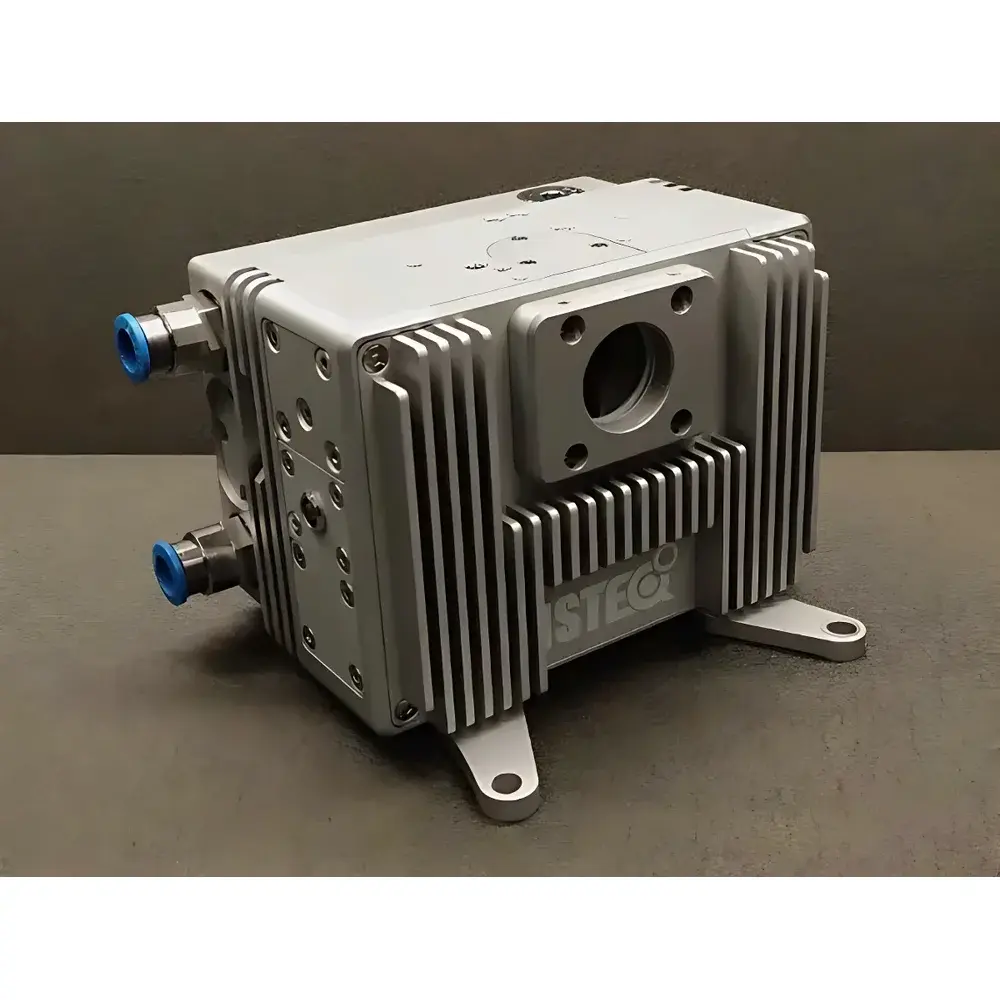
ISTEQ XWS-R High-Power Laser-Driven Plasma White Light Source
| Brand | ISTEQ |
|---|---|
| Origin | Netherlands |
| Model | XWS-R |
| Spectral Range | 190–2500 nm (UV configuration), 250–2500 nm (OFR configuration) |
| Spectral Radiance | up to 90 mW/(mm²·sr·nm) |
| Free-Space Output Power | up to 5 W |
| Fiber-Coupled Output Power | up to 1 W |
| Emitter Size | 250 × 500 µm |
| Lamp Medium | Xenon |
| Lifetime | 10,000 hours |
| Temporal Stability (ST) | < 0.15% |
| Configuration Options | Free-space and FCU (Fiber Coupling Unit) |
Overview
The ISTEQ XWS-R is a high-power, laser-driven plasma white light source engineered for demanding optical laboratory applications requiring broadband spectral continuity, exceptional radiance, and long-term temporal stability. Unlike conventional arc lamps or LED-based broadband sources, the XWS-R employs a pulsed Nd:YAG laser to generate a high-temperature, spatially confined xenon plasma within a hermetically sealed chamber. This laser-driven plasma mechanism eliminates electrode degradation, enabling stable emission across an ultra-broad spectrum—from deep ultraviolet (190 nm) through visible to near-infrared (2500 nm)—with minimal spectral structure and negligible flicker. The XWS-R delivers nearly double the output power and spectral radiance of the standard XWS-65 model, making it particularly suitable for low-light detection systems, high-resolution spectroscopic setups, and applications where photon flux per solid angle and wavelength bin is critical—such as ellipsometry, fluorescence lifetime imaging, and absorption spectroscopy in vacuum or purged environments.
Key Features
- Ultra-broad spectral coverage: 190–2500 nm (UV configuration) or 250–2500 nm (OFR configuration), with smooth, continuous emission and no mercury/xenon line artifacts
- High spectral radiance: up to 90 mW/(mm²·sr·nm) at peak—optimized for efficient coupling into monochromators, spectrometers, and fiber-optic interfaces
- Dual operational modes: free-space output (up to 5 W total radiant power) and FCU-integrated fiber-coupled output (up to 1 W into 400 µm core, NA 0.22)
- Sub-micron plasma emitter size (250 × 500 µm): enables high spatial coherence and efficient focusing into confocal or micro-optical systems
- Exceptional temporal stability: short-term fluctuation < 0.15% RMS over 1 hour (measured at 500 nm, 10 Hz bandwidth), supporting quantitative intensity-based measurements
- 10,000-hour rated lifetime with no consumable electrodes—significantly reducing maintenance cycles and calibration drift in GLP-compliant laboratories
- Integrated thermal management and active plasma position stabilization ensure reproducible beam pointing and irradiance distribution over extended operation
Sample Compatibility & Compliance
The XWS-R is compatible with standard optical breadboards, kinematic mounts, and commercial spectrometer input slits (e.g., Horiba, Ocean Insight, Avantes). Its FCU variant supports SMA905 and FC/PC fiber interfaces, enabling direct integration into microfluidic chips, wafer inspection tools, and OEM analytical platforms. From a regulatory standpoint, the system conforms to IEC 61000-6-3 (EMC emission) and IEC 61000-6-2 (immunity), and its electrical design complies with CE marking requirements for laboratory equipment. While not intrinsically certified for hazardous locations, its sealed plasma chamber and Class 1M laser safety classification (IEC 60825-1:2014) permit safe operation in ISO 17025-accredited testing labs without additional interlocks. For GMP or FDA-regulated environments, audit-ready operation logs (via optional Ethernet interface) support 21 CFR Part 11-compliant data integrity when paired with validated third-party acquisition software.
Software & Data Management
The XWS-R operates via RS-232 or optional Ethernet (TCP/IP) communication using a documented ASCII command protocol. Host software integration is supported through Python, LabVIEW, MATLAB, and C++ SDKs—enabling remote control of lamp enable/disable, pulse repetition rate (1–50 Hz), and internal shutter timing. Real-time monitoring includes plasma ignition status, internal temperature sensors (±0.5 °C resolution), and cumulative operating hours. All operational parameters are timestamped and exportable in CSV format. When used with compliant DAQ systems, the device supports full traceability—including operator ID, session start/end time, and environmental metadata—for alignment with ISO/IEC 17025 clause 7.7 (result reporting) and ASTM E2915 (spectral source qualification).
Applications
- Absorption and fluorescence spectroscopy—especially for UV-Vis-NIR quantification of thin films, biological samples, and quantum dot suspensions
- Ellipsometry and scatterometry in semiconductor metrology, including EUV mask inspection and high-NA lithography development
- Confocal and widefield fluorescence microscopy—where high brightness and deep-UV capability improve signal-to-noise in DAPI/Hoechst excitation
- Optical component characterization: transmission/reflection mapping of AR coatings, filters, and photonic crystals
- Chromatographic detector illumination (e.g., diode array detectors), droplet-based microspectroscopy, and cell-based fluorescence cytometry
- Plasma diagnostics and calibration of space-qualified spectrometers requiring NIST-traceable broadband sources
FAQ
What distinguishes the XWS-R from traditional xenon arc lamps?
The XWS-R uses laser-induced plasma rather than electrode-driven discharge, eliminating electrode sputtering, spectral drift, and warm-up time—resulting in superior stability, longer lifetime, and smoother UV continuum.
Can the XWS-R be integrated into vacuum chambers?
Yes—the free-space version features a CF-40 flange option; the plasma chamber is UHV-compatible (<1×10⁻⁹ mbar), and all feedthroughs meet ISO-KF standards.
Is spectral calibration data provided with each unit?
Each XWS-R ships with factory-measured absolute spectral radiance data (NIST-traceable, ±3% uncertainty at 250–1000 nm), delivered as calibrated HDF5 and CSV files.
Does the FCU version support multimode or single-mode fibers?
The standard FCU is optimized for 400 µm core, 0.22 NA multimode fiber; custom couplers for 200 µm or polarization-maintaining fiber are available upon request.
How is thermal management handled during continuous operation?
A closed-loop water cooling system (optional) maintains plasma chamber temperature within ±0.3 °C; air-cooled variants are rated for ≤4 h continuous duty at full power.




