
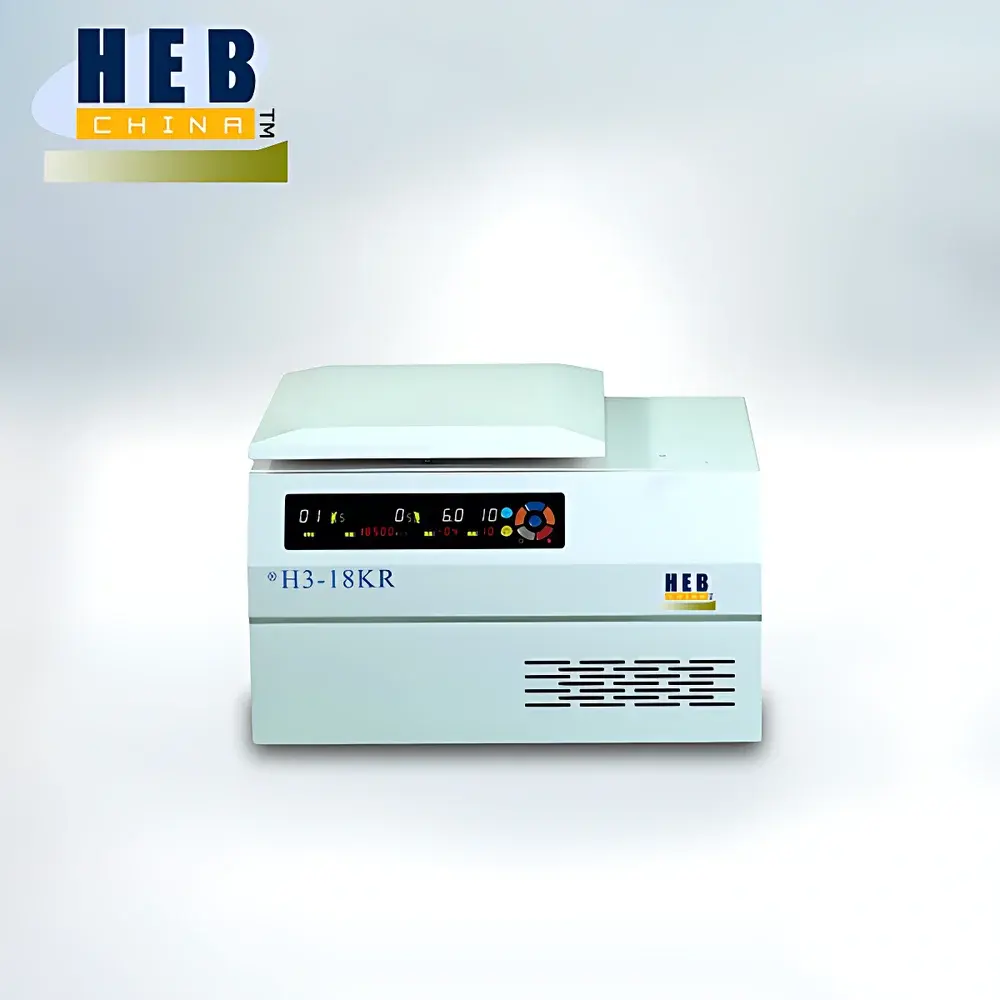
Hebei H3-18KR Benchtop High-Speed Refrigerated Centrifuge
| Brand | Jihepu (Jinan Hepu) |
|---|---|
| Origin | Shandong, China |
| Model | H3-18KR |
| Instrument Type | Benchtop Centrifuge |
| Speed Range | 0–18,500 rpm |
| Max RCF | 25,500 × g |
| Max Capacity | 4 × 100 mL |
| Temperature Range | −20 °C to +40 °C |
| Temp. Accuracy | ±1.0 °C |
| Timer Range | 1 s to 99 min 59 s |
| Acceleration/Deceleration | 10 selectable ramps |
| Noise Level | ≤60 dB(A) |
| Power Supply | AC 220 V ±10%, 50 Hz, 15 A |
| Total Power | 800 W |
| Dimensions (W×D×H) | 480 × 560 × 360 mm |
| Net Weight | 75–80 kg |
| Rotor Material | High-strength carbon-fiber composite |
| Compliance | CE-marked design principles |
Overview
The Hebei H3-18KR Benchtop High-Speed Refrigerated Centrifuge is an engineered solution for high-resolution separation of biological macromolecules—including nucleic acids, proteins, subcellular organelles, and viral particles—under precisely controlled thermal and rotational conditions. Operating on the principle of sedimentation velocity centrifugation, the instrument delivers reproducible separation performance by generating up to 25,500 × g at a maximum speed of 18,500 rpm. Its refrigerated architecture maintains sample integrity during prolonged high-speed runs, with temperature stability maintained within ±1.0 °C across the full operating range (−20 °C to +40 °C). Designed for routine use in clinical diagnostics laboratories, academic research cores, and bioprocessing QC environments, the H3-18KR integrates robust mechanical safety systems with intuitive digital control—making it suitable for both novice users and experienced technicians managing high-throughput sample preparation workflows.
Key Features
- Triple-layer structural steel housing (4 mm thickness) with stainless-steel centrifuge chamber for enhanced mechanical integrity and containment compliance.
- Brushless AC frequency-controlled motor with imported SKF bearings ensures low-noise operation (≤60 dB[A]), minimal vibration, and extended service life under continuous duty cycles.
- Dual-display interface: Optional color LCD or high-brightness LED panel supports real-time parameter visualization—including simultaneous display of speed (rpm), RCF (×g), time remaining, and chamber temperature—with second-level resolution for durations under 60 seconds.
- 10-step programmable acceleration and deceleration profiles reduce run time and mechanical stress on sensitive samples and rotor assemblies.
- Live parameter adjustment: Speed, time, and temperature may be modified mid-run without stopping the rotor—RCF recalculates and updates dynamically.
- One-touch centrifugation mode simplifies routine protocols for standardized sample processing.
- Electronic door lock system with dynamic imbalance detection halts operation immediately upon detecting load asymmetry exceeding safe thresholds.
- Carbon-fiber composite rotors—lightweight, non-corrosive, autoclavable (up to 121 °C, 20 min), and certified under Chinese national patent—offer superior burst resistance and faster spin-up/spin-down kinetics versus traditional aluminum designs.
- Eco-friendly, high-efficiency non-CFC refrigeration system achieves and sustains ≤−4 °C at maximum speed, ensuring thermal stability during demanding high-g protocols.
- Pre-cool function initiates rapid chamber cooling prior to rotor insertion, minimizing thermal shock and preserving labile biomolecules.
Sample Compatibility & Compliance
The H3-18KR accommodates a broad spectrum of tube formats via its standard angular rotor set—including 0.5 mL microtubes, 1.5/2.2 mL Eppendorf-style tubes, 5–15 mL conical tubes, 50 mL round- or conical-bottom tubes, and 100 mL bottles—supporting applications from plasmid purification to exosome isolation. All rotors are validated for repeated sterilization and conform to ISO 13485-aligned manufacturing practices. While not FDA 510(k)-cleared, the system’s operational logic, data logging capabilities, and hardware redundancy align with GLP and GMP expectations for instrument qualification (IQ/OQ/PQ). It supports traceable operation when integrated into laboratory information management systems (LIMS) via RS232 or optional USB data export.
Software & Data Management
The embedded firmware records all active run parameters—including start/stop timestamps, setpoints, actual values, error codes, and door cycle history—into non-volatile memory. Data can be exported as CSV files for external analysis or long-term archival. Though no proprietary PC software is bundled, the device complies with standard serial communication protocols (ASCII-based command set), enabling integration with custom automation scripts or third-party scheduling platforms. Audit trails meet minimum requirements for regulatory review under ISO/IEC 17025 and CLIA guidelines when paired with documented SOPs and user access controls.
Applications
- Clinical microbiology: Separation of serum, plasma, and PBMCs from whole blood.
- Molecular biology: Pellet recovery of DNA, RNA, and CRISPR ribonucleoprotein complexes.
- Proteomics: Crude fractionation of membrane proteins and protein aggregates.
- Virology: Concentration and partial purification of lentiviral and AAV vectors.
- Cell biology: Isolation of mitochondria, lysosomes, and nuclei using differential centrifugation schemes.
- Quality control: Verification of particle size distribution and suspension homogeneity in biopharmaceutical formulations.
FAQ
What is the maximum allowable imbalance tolerance before automatic shutdown?
The imbalance detection system triggers immediate deceleration if mass asymmetry exceeds 5 g per rotor position.
Can the H3-18KR maintain −20 °C at top speed?
No—it achieves ≤−4 °C at 18,500 rpm; full-range low-temperature performance (−20 °C) is specified at speeds ≤6,000 rpm.
Are rotor certifications available for international validation?
Yes—rotor mechanical test reports (burst speed, fatigue life, autoclave cycle endurance) are provided upon request in English.
Does the system support 21 CFR Part 11-compliant electronic signatures?
Not natively; however, raw run logs exported via USB may be ingested into Part 11–compliant LIMS or ELN platforms for signature attribution and retention.
What maintenance intervals are recommended for optimal performance?
Compressor oil inspection every 24 months; rotor cavity cleaning after each use; full calibration verification annually or per 500 operating hours—whichever occurs first.



