
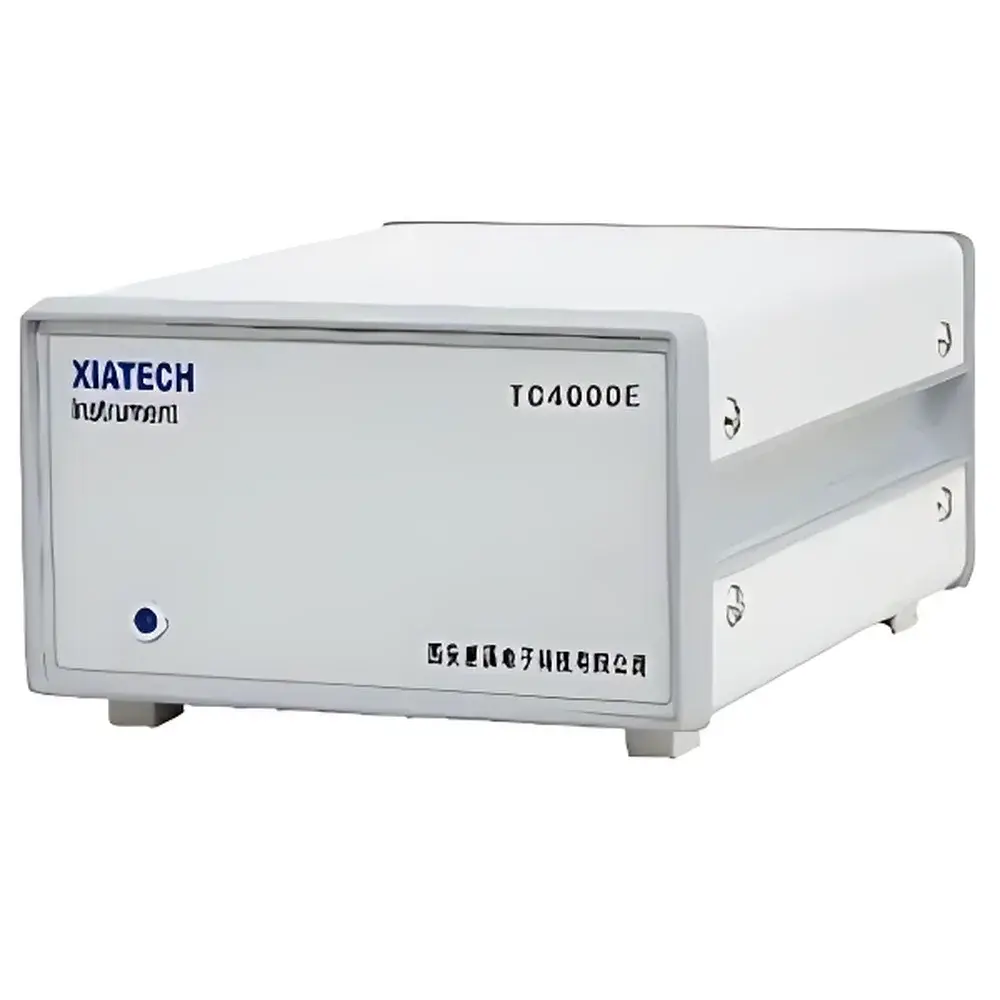
Xiatech TC4000-1 Portable Thermal Conductivity Analyzer (Hot Wire/Probe Method)
| Brand | Xiatech |
|---|---|
| Origin | Shaanxi, China |
| Model | TC4000-1 |
| Measurement Principle | Transient Hot Wire / Needle Probe Method |
| Thermal Conductivity Range | 0.02–5 W/(m·K) |
| Accuracy | ±5% |
| Repeatability | ±3% |
| Sample Forms | Paste, Gel, Liquid, Powder, Granular, and Friable Bulk Materials |
| Test Atmosphere | Ambient Air |
| Pressure Capability | High-Pressure Compatible |
| Sample Throughput | Single Sample per Test |
| Compliance | ASTM C1113, ASTM D5930, ASTM D5334, GB/T 10297, GB/T 11205 |
Overview
The Xiatech TC4000-1 Portable Thermal Conductivity Analyzer is an engineered solution for rapid, in-situ determination of thermal conductivity in heterogeneous and low-density materials using the transient hot wire principle combined with a calibrated needle probe configuration. Unlike steady-state or guarded-hot-plate methods, the TC4000-1 applies a short-duration constant-power pulse to a thin, embedded metallic probe, measuring the resulting temperature rise over time. Thermal conductivity is derived directly from the slope of the ln(t)-T curve in the linear regime—eliminating dependence on sample density, specific heat, or geometric assumptions. This first-principles approach ensures traceability to fundamental thermophysical relationships and enables reliable characterization of soft, non-rigid, or spatially inhomogeneous media—including soils, sediments, slurries, and loosely packed granular systems—where conventional contact-based methods fail due to interfacial resistance or poor thermal coupling.
Key Features
- Integrated transient hot wire + needle probe architecture optimized for field-deployable operation without sacrificing metrological integrity
- Direct thermal conductivity output—no ancillary property inputs (e.g., density or Cp) required for calculation
- Single-point insertion measurement: sensor insertion depth and orientation are decoupled from result validity within specified probe immersion limits
- Measurement cycle completed in 60–300 seconds, enabling high-throughput screening across multiple sampling locations
- Lightweight, battery-operated design with IP54-rated enclosure suitable for outdoor soil profiling, geotechnical site surveys, and process-line monitoring
- No sample preparation beyond minimal surface leveling; accommodates natural moisture content and unconsolidated structure
- Robust calibration traceability via NIST-traceable reference standards for glycerol, silicone oil, and certified sand matrices
Sample Compatibility & Compliance
The TC4000-1 accepts a broad spectrum of geotechnical and industrial materials without probe replacement or mechanical adaptation: cohesive soils (clay, silt), organic-rich sediments (peat, river mud), mineral powders (fly ash, limestone fines), agricultural particulates (grain flour, wood chips), and engineered composites (phase-change slurries, thermal interface pastes). It also supports pre-drilled rigid substrates—including rock cores and concrete specimens—when probe insertion is mechanically feasible. All measurements comply with ASTM C1113 (standard test method for thermal conductivity of refractory materials by hot wire), ASTM D5930 (thermal conductivity of plastics), ASTM D5334 (soil thermal resistivity), and Chinese national standards GB/T 10297 and GB/T 11205. The instrument’s firmware enforces data logging protocols aligned with GLP documentation requirements, including operator ID, timestamp, ambient temperature/humidity stamps, and probe serial tracking.
Software & Data Management
The TC4000-1 operates with Xiatech’s proprietary TCAware™ software suite (Windows 10/11 compatible), delivering real-time curve fitting, automatic baseline correction, and uncertainty propagation based on ISO/IEC Guide 98-3 (GUM). Raw voltage-time datasets are stored in HDF5 format with embedded metadata (probe geometry, excitation power, ambient conditions). Export options include CSV, PDF reports with digital signatures, and XML files compliant with ASTM E2500-22 for equipment qualification records. Audit trail functionality meets FDA 21 CFR Part 11 requirements for electronic records and signatures when deployed in regulated environmental testing laboratories.
Applications
- Geotechnical engineering: in-situ thermal resistivity mapping for underground power cable backfill assessment and geothermal borehole design
- Agricultural science: quantifying heat transfer behavior in cultivated soils under varying moisture and organic matter content
- Environmental remediation: monitoring thermal properties of contaminated sediments during thermal desorption treatment
- Building physics: rapid verification of insulation material performance in prefabricated panels and spray-applied coatings
- Energy storage R&D: characterizing thermal conductivity evolution in phase-change material (PCM) suspensions during melt/freeze cycling
- Food rheology: evaluating thermal transport in high-viscosity dairy gels, starch pastes, and protein-based emulsions
FAQ
Does the TC4000-1 require sample drying prior to measurement?
No—measurements are valid across natural moisture ranges typical of field-collected soils and sediments. Excess surface water should be blotted, but bulk water content is retained as part of the thermophysical system.
Can the probe be used in saturated soils without risk of electrical shorting?
Yes—the probe housing and lead insulation meet IEC 60529 IP67 specifications for temporary submersion; however, prolonged immersion beyond 30 minutes is not recommended without post-use drying protocol.
Is calibration verification possible in the field?
Yes—field-ready calibration kits include traceable glycerol vials and porous silica standards with certified k-values at 25 °C; full recalibration requires return to Xiatech’s Shaanxi service center.
How does the instrument handle anisotropic thermal behavior in layered soils?
The TC4000-1 reports effective isotropic conductivity at the probe scale (~10–20 mm radius influence zone); directional anisotropy must be assessed via multi-orientation probing or complementary lab-based directional methods.
What is the minimum sample volume required for representative measurement?
A cylindrical volume of ≥50 mL surrounding the probe (diameter ≥30 mm, depth ≥40 mm) is recommended to minimize boundary effects in low-conductivity media (<0.3 W/(m·K)).



