
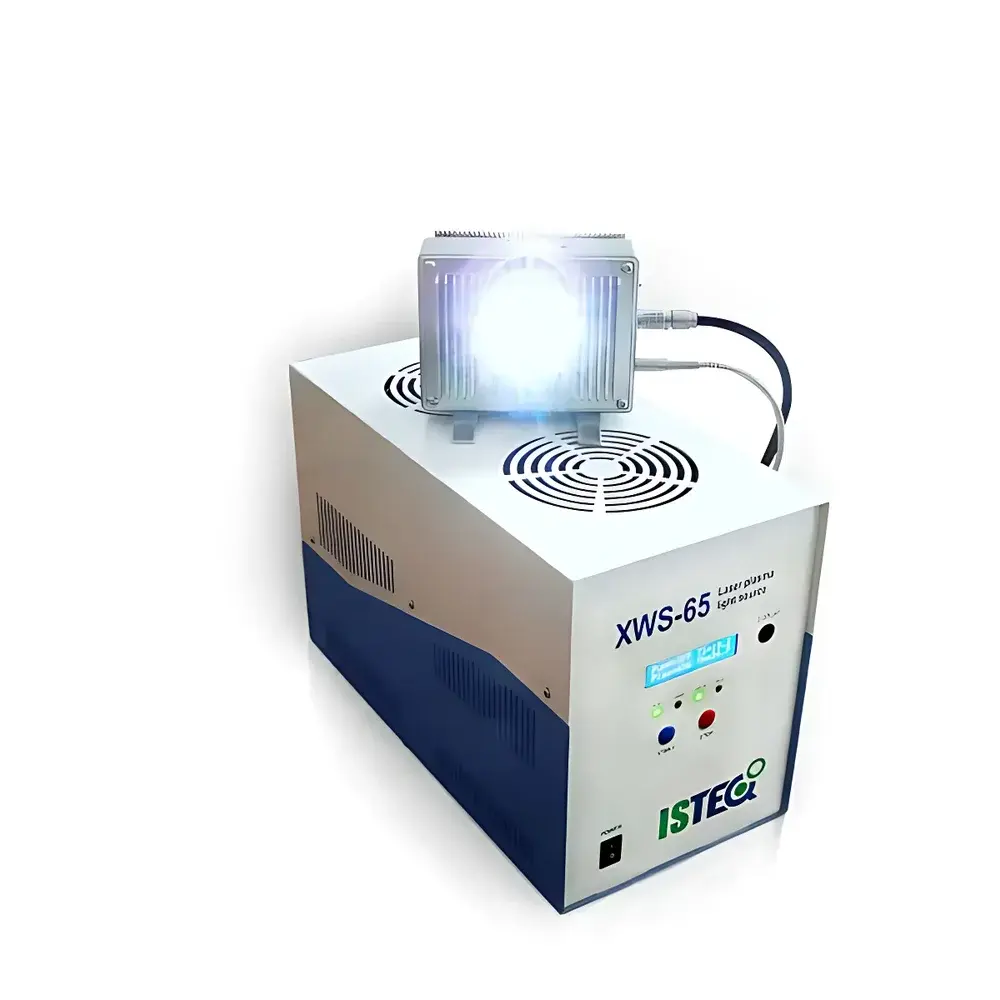
ISTEQ XWS-X High-Brightness Laser-Driven Plasma White Light Source
| Brand | ISTEQ |
|---|---|
| Origin | Netherlands |
| Model | XWS-X |
| Spectral Range | 190–2500 nm (UV configuration), 250–2500 nm (OFR configuration) |
| Spectral Radiance | up to 120 mW/(mm²·sr·nm) |
| Peak Radiance (High-Power Mode) | up to 200 mW/(mm²·sr·nm) |
| Output Power | up to 3 W (free-space), up to 0.6 W (FCU-coupled fiber) |
| Emitter Size | 250 × 500 µm |
| Lifetime | 10,000 hours |
| Spatial-Temporal Stability | ST < 0.15% |
| Output Options | Free-space beam or FCU fiber-coupled port |
| Configuration | Dual-port |
Overview
The ISTEQ XWS-X is a high-brightness, laser-driven plasma white light source engineered for demanding optical laboratory applications requiring exceptional spectral continuity, ultraviolet-rich output, and long-term radiometric stability. Unlike conventional arc lamps or LED-based broadband sources, the XWS-X employs a pulsed laser-focused xenon plasma generation mechanism—producing a spatially compact, high-temperature (~10,000 K) plasma emitter with blackbody-like spectral distribution extended deep into the vacuum ultraviolet (VUV). This physical architecture enables superior brightness across 190–2500 nm in UV-optimized configurations, with enhanced photon flux below 250 nm relative to its predecessor, the XWS-65. Its design targets applications where signal-to-noise ratio, spectral fidelity, and source reproducibility are critical—particularly in absorption spectroscopy, ellipsometry, fluorescence excitation, and high-resolution optical metrology.
Key Features
- Laser-driven plasma technology ensures stable, electrode-free operation—eliminating cathode sputtering, spectral drift, and intensity flicker associated with DC/AC arc lamps.
- Two spectral configurations: UV-optimized (190–2500 nm) and OFR (optical-fiber-ready, 250–2500 nm), each calibrated with NIST-traceable spectral radiance data.
- Dual-output architecture supports simultaneous free-space collimated beam delivery (up to 3 W total radiant power) and FCU-compatible fiber coupling (up to 0.6 W, NA 0.22) without mechanical realignment.
- Sub-250 nm enhancement: Radiance increase of ≥40% at 220 nm and ≥25% at 240 nm versus XWS-65—enabling improved sensitivity in VUV-absorption and photoemission studies.
- Compact plasma emitter (250 × 500 µm) provides high étendue efficiency and compatibility with high-magnification imaging optics and micro-spectroscopic setups.
- Thermally stabilized housing with active air-cooling maintains <0.15% spatial-temporal stability (ST) over 8-hour continuous operation—validated per ISO 9022-18 under controlled lab conditions.
Sample Compatibility & Compliance
The XWS-X is compatible with standard optical breadboards, monochromator input slits (≥50 µm), and fiber-optic spectrometers equipped with UV-enhanced CCD or back-thinned CMOS detectors. Its free-space output meets ANSI Z87.1 optical safety requirements when used with appropriate beam enclosures and UV-blocking filters. The system complies with IEC 61000-6-3 (EMC emission limits) and IEC 61000-6-2 (immunity standards). For regulated environments—including GLP-compliant analytical labs and semiconductor process control facilities—the XWS-X supports optional audit-trail logging via RS-232/USB interface, enabling traceability of operational parameters (lamp-on time, thermal status, pulse count) in alignment with FDA 21 CFR Part 11 data integrity expectations.
Software & Data Management
ISTEQ provides the XWS Control Suite v3.2—a platform-independent application (Windows/macOS/Linux) for remote operation, spectral calibration import, and real-time monitoring of plasma ignition status, cooling fan RPM, and internal temperature sensors. Users may load custom spectral response functions (SRFs) to correct for detector quantum efficiency and grating efficiency; exported radiance data conforms to ASTM E275-21 spectral measurement reporting conventions. All session logs are saved in HDF5 format with embedded metadata (wavelength array, integration time, calibration timestamp), facilitating interoperability with Python (h5py), MATLAB, and LabVIEW-based analysis pipelines.
Applications
- Absorption and fluorescence spectroscopy—especially for wideband excitation of multi-chromophore systems and time-resolved studies requiring high peak irradiance.
- Semiconductor metrology: defect inspection, thin-film thickness mapping via spectroscopic ellipsometry, and wafer-level contamination screening using UV reflectance contrast.
- Advanced microscopy: confocal reflectance imaging, fluorescence lifetime imaging (FLIM), and super-resolution techniques reliant on broadband excitation stability.
- Optical component characterization: transmission/reflection uniformity testing of AR/HR coatings, UV-grade fused silica substrates, and diffractive optical elements.
- Microfluidic and droplet-based analytics: integrated illumination for inline absorbance/fluorescence detection in lab-on-chip platforms operating down to 210 nm.
- Chromatography and capillary electrophoresis detection: broadband UV-Vis absorbance monitoring across multiple elution peaks without lamp-switching artifacts.
FAQ
What distinguishes the XWS-X from traditional xenon arc lamps?
The XWS-X replaces electrode-based discharge with a laser-sustained plasma, eliminating electrode erosion, spectral line noise, and warm-up drift—delivering superior radiance stability and VUV output.
Is the 190 nm lower limit achievable in ambient air?
No—oxygen absorption strongly attenuates below ~195 nm in air; operation below 195 nm requires purged (N₂ or Ar) or vacuum optical paths.
Can the dual-port outputs be used simultaneously without performance trade-offs?
Yes—both ports derive from the same plasma emitter via internal beam splitting; radiance per port scales linearly with configured attenuation, preserving spectral fidelity.
Does the XWS-X support external triggering for time-gated measurements?
Yes—TTL-compatible sync output (5 V, 10 ns rise time) is provided for synchronization with ICCD cameras, pulsed lasers, or lock-in amplifiers.
How is spectral calibration performed and maintained?
Each unit ships with factory-acquired NIST-traceable radiance calibration; users may perform field recalibration using optional ISTEQ SRM-200 reference standard and included calibration workflow module.




