
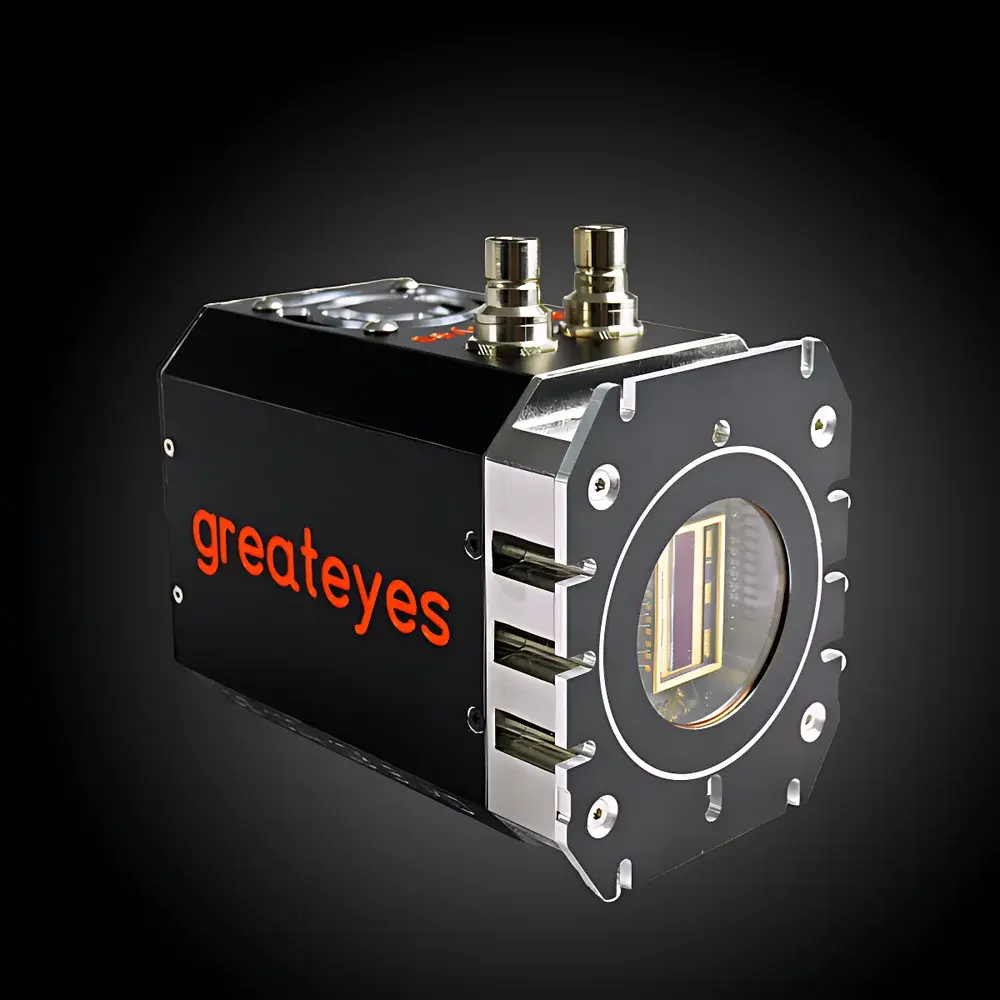
greateyes ELSE-s Series Visible-Light Full-Frame CCD Camera
| Brand | greateyes |
|---|---|
| Origin | Germany |
| Model | ELSE-s 1024×128, ELSE-s 1024×256, ELSE-s 2048×256, ELSE-s 2048×512 |
| Pixel Format | 2048 × 512 (typical) |
| Pixel Size | 26 µm × 26 µm |
| Full Well Capacity | up to 700,000 e⁻ |
| Read Noise | as low as 3.5 e⁻ (at 50 kHz) |
| Cooling Temperature | down to −100 °C |
| QE Peak | up to 98% |
| Dynamic Range | 18-bit |
| Cooling Options | liquid-cooled and forced-air-cooled variants |
| Sensor Architecture | vacuum-sealed, back-illuminated (BI), deep-depletion (DD), or front-illuminated (FI) configurations with UV-, VIS-, or NIR-optimized coatings |
Overview
The greateyes ELSE-s Series is a family of high-performance, scientific-grade full-frame CCD cameras engineered for demanding visible-light spectroscopy and low-light imaging applications. Built upon a robust vacuum-sealed architecture with multi-stage thermoelectric cooling, the ELSE-s platform delivers exceptional signal fidelity through ultra-low dark current (<0.0004 e⁻/pixel/s at −100 °C), sub-4 e⁻ read noise at slow readout speeds, and quantum efficiency exceeding 95% across the 400–700 nm range. Each camera integrates a monolithic, back-illuminated or deep-depletion CCD sensor—selected per spectral requirement—and operates on the fundamental principle of charge integration under controlled thermal and electronic conditions. This enables precise photon-to-electron conversion, linear response over six orders of magnitude, and high reproducibility essential for quantitative spectral analysis in research laboratories and industrial QA/QC environments.
Key Features
- Vacuum-encapsulated full-frame CCD sensors with single fused-silica optical window for minimal transmission loss and long-term stability
- Multi-stage Peltier cooling achieving stable sensor temperatures down to −100 °C, minimizing thermally generated dark signal
- Configurable sensor options: front-illuminated (FI), back-illuminated (BI), and deep-depletion (DD) architectures, each with spectral optimization (UV-enhanced, VIS-optimized, or NIR-sensitive coatings)
- 18-bit digitization with selectable gain modes (e.g., 0.34–1.5 counts/e⁻) to balance dynamic range and noise floor across acquisition speeds
- Flexible pixel binning (1×1 to 8×8), region-of-interest (ROI) readout, and programmable clocking for optimized frame rate vs. sensitivity trade-offs
- Comprehensive hardware synchronization: TTL trigger input/output, external shutter control, and GenICam-compliant interface for seamless integration into automated spectrometer systems
- Real-time temperature monitoring of both sensor die and cold finger, with user-accessible thermal logs for GLP/GMP traceability
Sample Compatibility & Compliance
The ELSE-s series supports a broad range of optical interfaces—including C-mount, F-mount, and custom flange adapters—and is compatible with standard spectrograph slit widths (10–200 µm) and focal ratios (f/2 to f/8). Its vacuum integrity and hermetic sealing meet ISO 10110-7 cleanliness standards for optical detector housings. The camera firmware and driver stack comply with GenICam v3.1 specifications, ensuring interoperability with third-party acquisition software (e.g., LabVIEW, MATLAB, Python-based PyCapture2 or Andor Solis). For regulated environments, the system supports audit-trail-enabled acquisition logging and timestamped metadata embedding—fully aligned with FDA 21 CFR Part 11 requirements when deployed with validated software platforms. All models are CE-marked and conform to IEC 61326-1 (EMC) and IEC 61010-1 (safety) standards.
Software & Data Management
greateyes provides the greateyes Control Software (v5.x), a cross-platform application supporting Windows, Linux, and macOS. It offers real-time image preview, non-uniformity correction (NUC), dark frame subtraction, flat-field calibration, and pixel defect mapping—all accessible via intuitive GUI or scriptable API (C/C++, Python bindings included). Raw 18-bit FITS and TIFF outputs preserve full dynamic range and metadata (exposure time, temperature, gain, binning, sensor ID). Time-series acquisitions can be exported as HDF5 files with embedded timestamps and environmental telemetry, facilitating FAIR (Findable, Accessible, Interoperable, Reusable) data practices. Integration with commercial spectroscopy suites (e.g., Ocean Insight OceanView, Horiba LabSpec, Thermo Fisher OMNIC) is supported via SDK and ASCII protocol emulation.
Applications
- Raman spectroscopy: High QE and low noise enable detection of weak Stokes/anti-Stokes bands with integration times <30 s under ambient lab conditions
- Fluorescence lifetime imaging (FLIM) and time-resolved spectroscopy: Sub-millisecond shutter control and precise trigger latency (<100 ns jitter) support gated acquisition protocols
- Absorption, transmission, and reflectance measurements: Linear response and >99.9% pixel uniformity ensure accurate Beer–Lambert law fitting across wide optical density ranges
- Near-infrared spectroscopy (NIRS): DD-NIR variants extend sensitivity to 1100 nm with <5 e⁻ read noise at 100 kHz readout
- Low-light astronomy and beam diagnostics: Vacuum packaging and Grade 0/1 sensor selection meet ESO and CERN detector qualification criteria
FAQ
What cooling method is used, and how is thermal stability maintained during long exposures?
The ELSE-s employs multi-stage thermoelectric coolers (TECs) coupled to either liquid-cooled heat exchangers or high-efficiency forced-air radiators. Sensor temperature is regulated to ±0.1 °C via PID feedback using dual platinum RTD sensors—one on the silicon die, one on the cold finger—ensuring drift <0.01 °C/hour over 8-hour acquisitions.
Can the camera be synchronized with pulsed lasers or choppers?
Yes. Hardware-level TTL-compatible trigger inputs accept rising/falling edge signals with configurable delay (0–10 ms, 1 µs resolution) and exposure gating windows as narrow as 10 µs. External shutter sync ensures precise temporal alignment with laser pulses or mechanical modulation.
Is sensor calibration data provided with each unit?
Each shipped camera includes a factory-calibrated NUC map, dark frame set (−100 °C, multiple exposure times), and quantum efficiency curve measured at NIST-traceable facilities. Calibration certificates reference ISO/IEC 17025-accredited procedures.
How does the vacuum seal impact maintenance and operational lifetime?
The all-metal, glass-ceramic vacuum enclosure is rated for >15 years MTBF under continuous operation. No consumables or re-pumping are required; vacuum integrity is verified during final test and logged in the device’s EEPROM for field verification.
Are drivers available for Linux-based spectroscopy control systems?
Yes. greateyes provides native Linux kernel modules (x86_64/ARM64), GenICam-compliant GigE Vision drivers, and open-source Python bindings compatible with Debian 12+, RHEL 9+, and Ubuntu 22.04 LTS distributions.





