
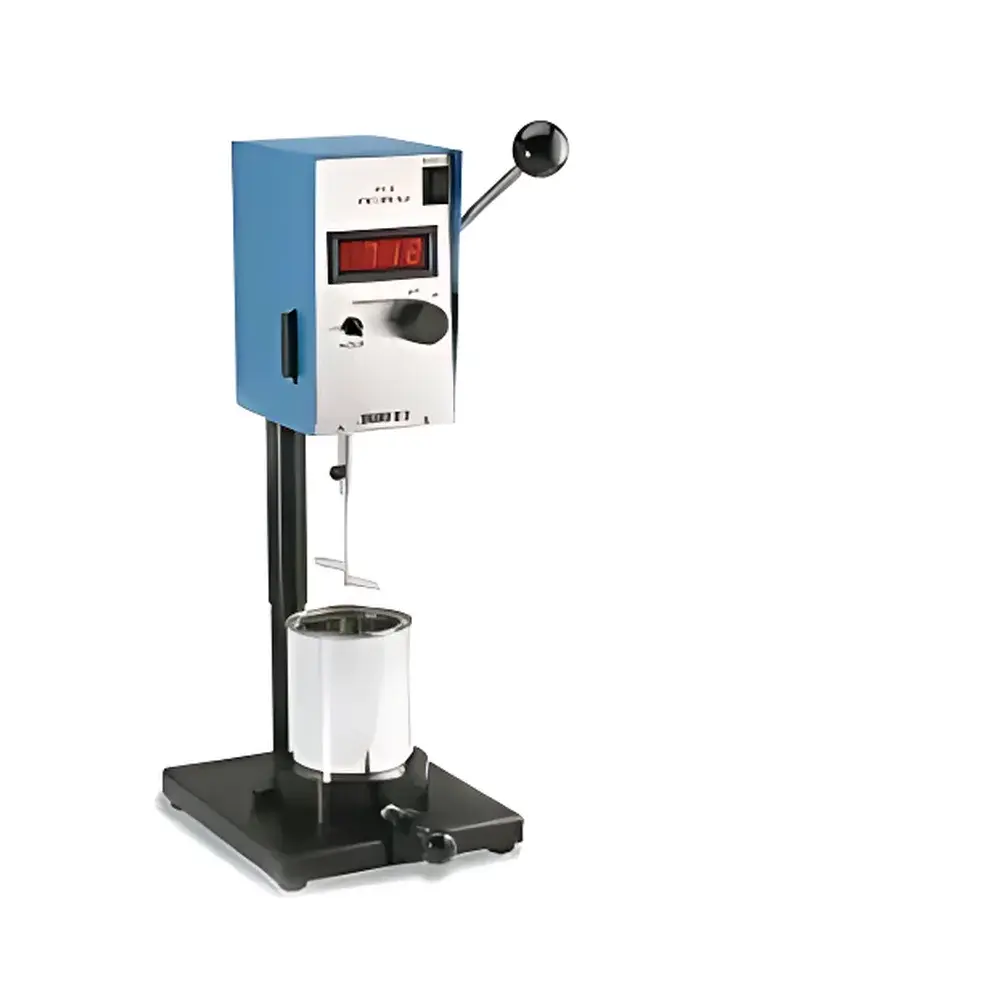
Brookfield KU-2 Krebs Unit Viscometer
| Brand | Brookfield |
|---|---|
| Origin | USA |
| Model | KU-2 |
| Measurement Range | 40–141 KU (32–1099 g, 27–5274 cP) |
| Compliance | ASTM D562 |
| Sample Container Compatibility | ½-pint, 1-pint, and 1-quart cans |
| Display Units | Krebs Units (KU), grams (g), and centipoise (cP) |
| Rotational Speed | Fixed at 200 rpm |
| Rotor Type | Standard Krebs paddle (ASTM-compliant) |
| Interface | RS-232 port for printer connectivity |
| Included Accessories | Main unit, one Krebs paddle rotor, adjustable can holder |
Overview
The Brookfield KU-2 Krebs Unit Viscometer is a dedicated rotational viscometer engineered for rapid, standardized viscosity assessment of architectural paints, industrial coatings, printing inks, and related non-Newtonian dispersions. It operates on the classical Stormer principle—measuring the torque required to rotate a standardized Krebs paddle (ASTM D1210 geometry) at a fixed speed of 200 rpm in a sample held within a standard paint can. Unlike general-purpose viscometers, the KU-2 delivers direct readings in Krebs Units (KU), grams-force equivalent (g), and centipoise (cP), eliminating manual conversion and reducing operator error. As the successor to the KU-1+, it integrates enhanced electronics, improved signal stability, and real-time dual-unit display without requiring rotor changes or mechanical counterweights. Its design strictly conforms to ASTM D562, ensuring regulatory alignment for QC laboratories operating under ISO/IEC 17025, A2LA, or FDA-regulated environments where method traceability and instrument qualification are mandatory.
Key Features
- Triple-unit simultaneous display: Krebs Units (KU), gram-force load (g), and centipoise (cP), all derived from a single measurement cycle
- Fixed-speed operation at 200 ± 0.5 rpm—no speed selection or calibration drift due to variable motor control
- Integrated can holder accommodates standard ASTM-sized containers: ½-pint (237 mL), 1-pint (473 mL), and 1-quart (946 mL) metal or plastic cans
- Zero-maintenance torque sensing: No hanging weights, pulleys, or friction-based loading mechanisms—measurement is fully electronic and digitally locked upon stabilization
- RS-232 serial interface enables direct connection to label printers or data loggers for GLP-compliant record generation
- Robust cast-aluminum housing with anti-vibration feet ensures stable readings during high-throughput production line testing
Sample Compatibility & Compliance
The KU-2 is optimized for low-to-medium-viscosity liquid coatings with yield stress behavior typical of pigment-dispersed systems. It accepts samples as received—no dilution or temperature equilibration beyond standard lab conditions (23 ± 2°C per ASTM D562). For highly thixotropic or paste-like materials (e.g., mastics, caulks, or high-solids primers), optional high-torque paddle rotors are available to extend effective range while maintaining geometric fidelity. When testing solvent-rich formulations prone to vortexing or air entrapment, the optional Air Eliminator accessory minimizes false-low readings by suppressing surface turbulence. All measurements comply with ASTM D562 and are traceable to NIST-certified reference oils. The instrument supports IQ/OQ documentation packages and meets requirements for audit readiness under 21 CFR Part 11 when paired with compliant printer firmware and secure data archiving protocols.
Software & Data Management
The KU-2 does not require proprietary software for basic operation—it functions as a standalone, self-contained instrument with front-panel digital readout and manual data capture. However, its RS-232 output supports integration into existing LIMS or MES platforms via ASCII protocol (9600 baud, 8N1). Output includes timestamped KU/g/cP triplets, instrument ID, and measurement status flags (e.g., “STABLE”, “OVERLOAD”). For labs requiring electronic records with audit trails, Brookfield’s optional PC Connect software (v3.2+) provides automated logging, statistical process control (SPC) charting, and PDF report generation compliant with GLP/GMP documentation standards. All data files are saved in .csv format for third-party analysis in JMP, Minitab, or Python-based QA pipelines.
Applications
- Batch release testing of architectural latex paints and alkyd enamels per ASTM D562 and ISO 2555
- In-process viscosity monitoring during mill-base dispersion and letdown stages
- Formulation development for rheology modifiers (e.g., associative thickeners, fumed silica)
- Supplier qualification of raw materials such as titanium dioxide slurries or acrylic emulsions
- Comparative testing across production shifts to detect pump wear, mixer inefficiency, or contamination events
- Supporting technical service responses with field-portable, factory-calibrated units deployed at customer sites
FAQ
Does the KU-2 require annual recalibration?
Yes—Brookfield recommends annual calibration using certified reference standards traceable to NIST SRM 2490 series oils. Calibration verifies torque sensor linearity, rotational speed accuracy, and unit conversion integrity.
Can I use non-standard containers?
No. ASTM D562 mandates specific can geometry and fill level (e.g., 1-pint can filled to 500 mL). Deviations invalidate KU values and compromise inter-laboratory reproducibility.
Is the KU-2 suitable for food-grade or pharmaceutical coatings?
It may be used for non-sterile, non-contact coating applications if validated per USP or ICH Q5C guidelines; however, direct product contact requires cleaning validation and material compatibility assessment of the Krebs paddle surface finish.
What is the difference between KU and cP readings on this instrument?
KU is an empirical unit defined by ASTM D562 based on torque at 200 rpm using the Krebs paddle; cP values are calculated using a proprietary Brookfield algorithm calibrated against Newtonian oil standards—not interchangeable with rotational viscometer cP at other shear rates.
How do I maintain long-term measurement consistency?
Perform daily verification with a control sample (e.g., reference paint batch), inspect paddle for nicks or coating buildup before each test, and store the instrument in a temperature-stable environment away from vibration sources.



