
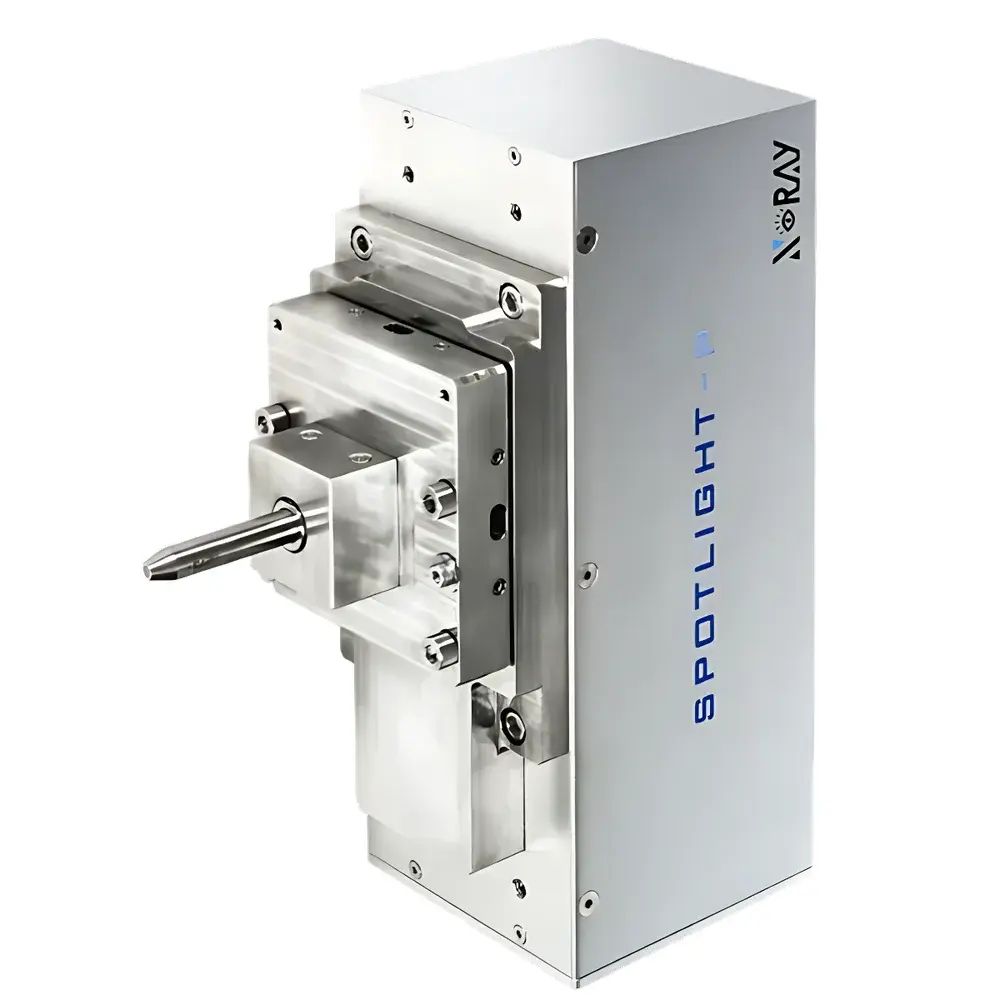
X-rayVision SpotLight-P Microfocus X-ray Source
| Brand | X-rayVision |
|---|---|
| Model | SpotLight-P |
| Type | Polycapillary-Focused Microfocus X-ray Source |
| Target Materials | Cu, Mo, Rh, Ag, W (customizable) |
| Max. Tube Voltage | ≤50 kV |
| Max. Tube Current | ≤1 mA |
| Cooling | Air + Water |
| Dimensions (w/ capillary adjuster) | 261 × 186 × 110 mm |
| Weight | 10 kg |
| Focal Spot Size (Mo-Kα, FWHM) | down to 8 µm |
| Beam Divergence (collimated) | ≤0.2° |
| Output Flux (Mo-Kα) | up to >8.1×10⁷ ph/s |
| Output Flux (Cu-Kα) | up to >8.5×10⁹ ph/s |
| Compliance | CE-marked for industrial & laboratory use |
| Software Interface | RS-232 / USB / Ethernet (SCPI-compatible) |
Overview
The X-rayVision SpotLight-P is a high-performance polycapillary-coupled microfocus X-ray source engineered for demanding synchrotron-grade applications in laboratory-scale X-ray instrumentation. Unlike conventional sealed-tube sources, the SpotLight-P integrates a low-power, high-stability transmission-target X-ray tube with a precision-aligned polycapillary optic—enabling simultaneous optimization of spatial resolution, photon flux, and beam collimation without requiring high-power infrastructure or active vacuum pumping. Its operating principle relies on total external reflection within hollow glass capillaries to collect and focus divergent X-rays from a sub-100 µm electron-beam interaction zone, delivering either tightly focused beams (FWHM down to 8 µm at Mo-Kα) or highly parallelized output (divergence <0.2°). This architecture supports both high-resolution microdiffraction and high-sensitivity grazing-incidence techniques—including GISAXS, μ-XRF, XRR, and in situ/operando XRD—across materials science, semiconductor metrology, and energy storage research.
Key Features
- Polycapillary-optic coupling enables dual-mode operation: microfocus, quasi-focal, and collimated beam configurations—selectable via mechanical alignment without hardware modification.
- Focal spot size tunable by working distance: achieves 30 µm FWHM (Mo-Kα) at 10 mm WD and maintains <380 µm up to 200 mm WD—ideal for trade-off optimization between resolution and signal throughput.
- Multi-target compatibility (Cu, Mo, Rh, Ag, W) allows spectral tailoring for specific absorption edges, fluorescence yield maximization, or penetration depth control—e.g., Cu-Kα for polymer crystallinity studies; Mo-Kα for thin-film GISAXS.
- Integrated thermal management combines forced-air pre-cooling and regulated water circulation (±0.1°C stability), ensuring long-term tube voltage/current reproducibility and eliminating thermal drift during multi-hour operando experiments.
- Embedded firmware implements automated tube conditioning (ramp-up/ramp-down power profiles), self-diagnostic routines (vacuum integrity, filament emission, coolant flow verification), and fail-safe interlock logic compliant with IEC 61010-1 safety standards.
- SCPI-compliant digital interface (RS-232/USB/Ethernet) enables seamless integration into automated goniometer stages, motorized sample chambers, or third-party DAQ systems—supporting synchronized trigger acquisition and remote parameter scripting.
Sample Compatibility & Compliance
The SpotLight-P is compatible with standard X-ray diffractometers, XRF spectrometers, and custom-built imaging rigs equipped with flat-panel detectors, CCD-based area detectors, or single-photon counting silicon drift detectors (SDDs). It meets ISO 17025-relevant traceability requirements for intensity calibration when paired with NIST-traceable reference foils (e.g., Ni, Fe, Cu). For regulated environments, its control firmware supports audit-ready logging (timestamped power settings, runtime, error flags) aligned with GLP/GMP documentation workflows. While not FDA 21 CFR Part 11 certified out-of-the-box, full electronic record functionality—including user authentication, signature capture, and immutable log export—can be implemented via optional software modules meeting pharmaceutical and medical device QA requirements.
Software & Data Management
X-rayVision provides the SpotLight Control Suite—a cross-platform application (Windows/macOS/Linux) supporting real-time monitoring of tube parameters (kV, mA, temperature, coolant pressure), beam status visualization, and scheduled power cycling. All operational data—including exposure logs, interlock events, and calibration history—are stored in SQLite databases with SHA-256 hash integrity checks. Export options include CSV, HDF5, and NeXus-compatible formats for direct ingestion into analysis pipelines (e.g., GSAS-II, PyFAI, DAWN, or custom Python-based reduction scripts). API access via RESTful endpoints allows integration with LabArchives ELN, OpenBIS, or proprietary LIMS platforms.
Applications
- In Situ/Operando Battery Research: Enables time-resolved XRD of LiFePO₄, NaVO, and NbS₂ electrodes during electrochemical cycling—capturing phase evolution, lattice strain, and amorphization kinetics over durations exceeding 500 minutes with sub-0.01° 2θ angular stability.
- Semiconductor Metrology: Supports TXRF-based surface contamination mapping on 300 mm Si wafers and XRR quantification of ultra-thin (<5 nm) ALD dielectric stacks—achieving Å-level thickness resolution and <0.5% compositional uncertainty in UBM/RDL layers.
- Advanced Materials Characterization: Powers GISAXS investigations of block copolymer self-assembly, SAXS of colloidal nanoparticles in suspension, and Laue diffraction of single-crystal turbine alloys under thermal load—all leveraging its high brilliance-to-divergence ratio.
- Failure Analysis & Reverse Engineering: Delivers micron-scale μ-XRF mapping of solder bump composition, intermetallic growth, and void distribution in flip-chip packages—without destructive cross-sectioning.
FAQ
What target materials are available, and how do I select the optimal one for my application?
Standard targets include Cu, Mo, Rh, Ag, and W. Cu-Kα (8.04 keV) offers high flux for organic/polymeric samples and general-purpose XRD; Mo-Kα (17.48 keV) provides deeper penetration for dense metals and reduced absorption in air-path GISAXS. Selection depends on sample attenuation length, required fluorescence yield, and detector quantum efficiency.
Is the SpotLight-P compatible with existing diffractometer goniometers?
Yes—mechanical mounting follows ISO 10137-compliant flange patterns (CF-63 or KF-40 adaptable); optical axis alignment is achieved via integrated kinematic mounts with ±50 µm XYZ adjustability and ±2° tip/tilt fine tuning.
Does the system require external vacuum pumping?
No—the X-ray tube is hermetically sealed and operates at fixed internal pressure; only the polycapillary optic requires ambient air or inert gas purge (optional) to minimize carbon deposition.
Can beam divergence be independently optimized for collimated versus focused modes?
Yes—collimated mode uses full-capillary acceptance angle with downstream aperture limiting; focused mode employs partial-capillary illumination with working distance–dependent demagnification—both configurable via the Control Suite GUI.
What maintenance intervals are recommended for long-term reliability?
Annual filament emission testing and capillary optic inspection (via He-Ne alignment laser) are advised; coolant fluid exchange every 24 months; no routine anode replacement required due to transmission-target geometry and thermal derating design.





