
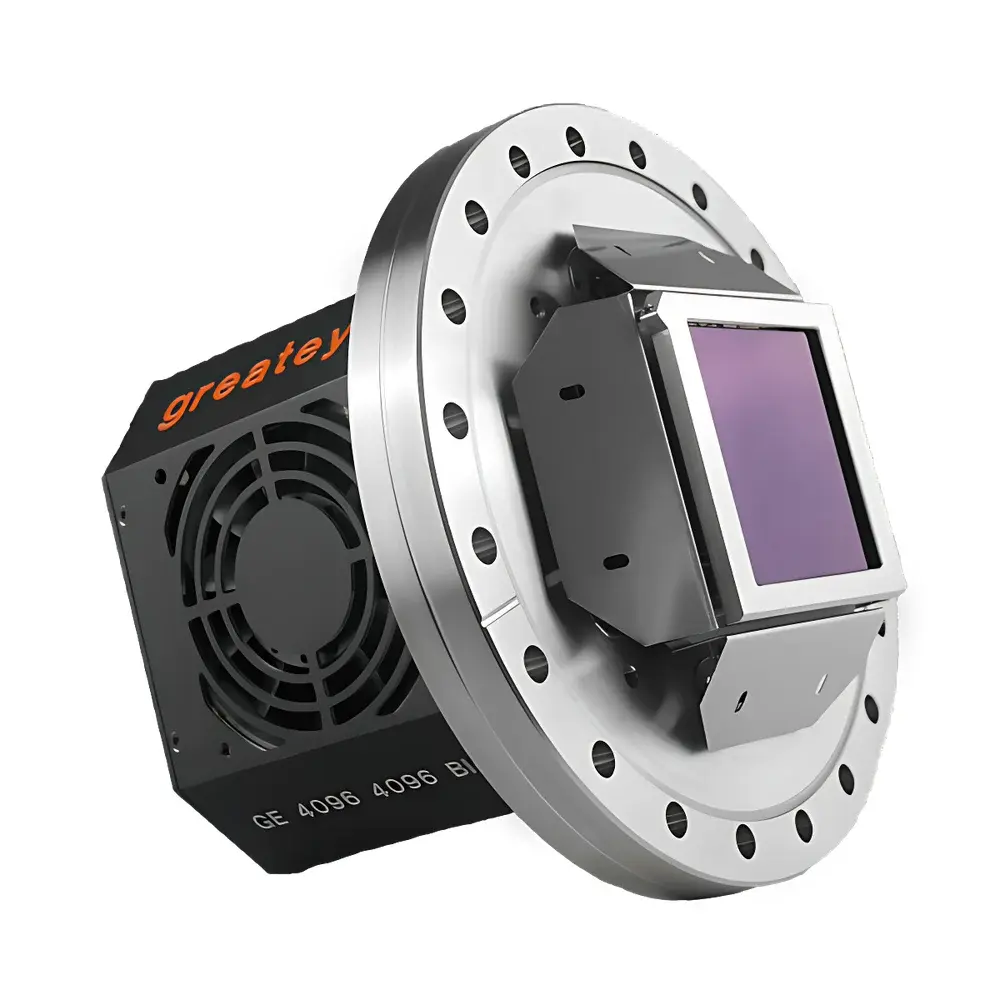
greateyes ALEX-i 4096×4096 EUV & Soft X-ray Scientific CCD Camera
| Brand | greateyes |
|---|---|
| Origin | Germany |
| Model | ALEX-i 4096×4096 |
| Effective Pixels | 4096 × 4096 |
| Pixel Size | 15 µm × 15 µm |
| Cooling Temperature | -90 °C |
| Readout Interface | GigE & USB 3.0 |
| Vacuum Compatibility | ≤1×10⁻¹⁰ mbar |
| Quantum Efficiency | up to 98% (EUV/SXR range) |
| ADC Resolution | 18-bit |
| Readout Noise | 4.8 e⁻ (at 50 kHz), 9.5 e⁻ (at 1 MHz), 20.4 e⁻ (at 3 MHz) |
| Full Well Capacity | 150 ke⁻ |
| Dark Current | 8×10⁻⁵ e⁻/pixel/s @ -90 °C |
| Sensor Grade | Grade 0 or Grade 1 |
Overview
The greateyes ALEX-i 4096×4096 EUV & Soft X-ray Scientific CCD Camera is a high-performance, ultra-low-noise imaging detector engineered for demanding applications in extreme ultraviolet (EUV, 10–124 nm), vacuum ultraviolet (VUV, 100–200 nm), and soft X-ray (0.1–2 keV) spectroscopy and radiography. Built upon monolithic back-illuminated deep-depletion silicon CCD architecture with optimized quantum efficiency (QE) response, the ALEX-i series leverages proprietary low-noise electronics and cryogenic thermo-electric cooling to achieve thermal stabilization down to -90 °C — essential for suppressing dark current and maximizing signal fidelity in photon-starved regimes. Its 4096×4096 pixel format, 15 µm pixel pitch, and 18-bit analog-to-digital conversion ensure high spatial resolution and exceptional dynamic range, enabling quantitative analysis of weak spectral lines, plasma emission structures, synchrotron beam profiles, and laser-produced plasma diagnostics.
Key Features
- Cryogenic Performance: Integrated dual-stage Peltier cooler maintains sensor temperature at -90 °C (typical), reducing dark current to ≤8×10⁻⁵ e⁻/pixel/s — critical for long-exposure EUV imaging and time-resolved SXR measurements.
- High Quantum Efficiency: Back-illuminated, deep-depletion BI-DD sensor with anti-reflective coating achieves peak QE >95% at 50 nm and >70% across 10–100 nm; extended sensitivity into soft X-ray regime via optional thinned or coated variants.
- Flexible Readout Architecture: Dual-output amplifier design supports selectable readout speeds from 50 kHz to 5 MHz, balancing noise, frame rate, and full-well capacity for diverse experimental configurations.
- Ultra-High Vacuum (UHV) Compatibility: Fully UHV-compatible housing rated to ≤1×10⁻¹⁰ mbar; all internal materials meet ASTM E595 outgassing specifications; feedthroughs conform to ISO-KF and CF flange standards.
- Dual Interface Options: Simultaneous Gigabit Ethernet (for remote operation and integration into distributed control systems) and USB 3.0 (for local high-throughput data acquisition) enable seamless interoperability with LabVIEW, Python-based control stacks, and EPICS environments.
- 18-bit Digitization & Low-Noise Electronics: Custom ASIC-based readout chain delivers typ. 4.8 e⁻ read noise at 50 kHz, preserving single-photon-level contrast while supporting full-well capacities up to 150 ke⁻ per pixel.
Sample Compatibility & Compliance
The ALEX-i 4096×4096 is designed for direct coupling with grazing-incidence optics, multilayer mirrors, zone plates, and pinhole arrays used in EUV lithography metrology, solar physics observatories (e.g., Solar Orbiter/EUI), and laboratory-scale laser-plasma sources. It complies with ISO 11146 (laser beam profiling), ASTM E1316 (non-destructive testing terminology), and IEC 61000-6-3 (EMC emissions). Its firmware architecture supports audit-trail logging and user-access controls aligned with GLP/GMP documentation requirements where traceable calibration and configuration history are mandated. Sensor grading (Grade 0 or Grade 1 per MIL-STD-883H Annex G) ensures pixel defect density and cosmetic uniformity meet stringent scientific imaging standards.
Software & Data Management
Control and acquisition are managed through the cross-platform greateyes Control Software Suite, which provides real-time histogram visualization, non-uniformity correction (NUC), bias/dark frame subtraction, and region-of-interest (ROI) binning. Raw image data is saved in FITS (Flexible Image Transport System) format — compliant with NASA/ESA archival standards — and includes embedded metadata (exposure time, temperature, gain setting, sensor ID, and calibration timestamps). The SDK supports C/C++, Python (via ctypes), and MATLAB bindings, enabling integration into custom pipelines for spectral reconstruction (e.g., using PyMCA or SpecView), tomographic reconstruction, or machine learning–based feature extraction. All firmware updates are digitally signed and validated prior to installation, satisfying integrity requirements under FDA 21 CFR Part 11 for regulated research environments.
Applications
- EUV lithography mask inspection and aerial image metrology
- Solar corona imaging and spectral line ratio analysis (e.g., Fe VIII–XVI transitions)
- Soft X-ray microscopy of biological specimens and nanomaterials
- Laser-induced plasma spectroscopy (LIPS) and transient absorption imaging
- Synchrotron beamline diagnostics (intensity profiling, coherence mapping)
- Time-resolved studies of ultrafast processes using pump-probe geometries with external trigger synchronization (TTL/RS-422)
- Vacuum UV photoelectron spectroscopy (PES) and angle-resolved measurements
FAQ
Is the ALEX-i 4096×4096 camera compatible with standard EUV multilayer mirror systems?
Yes — the sensor’s native spectral response and physical dimensions support direct mounting behind Mo/Si, Ru/B₄C, or Ni/C multilayer optics operating at 13.5 nm, 30.4 nm, or 58.4 nm wavelengths.
Can the camera operate continuously under UHV conditions without outgassing concerns?
Yes — all internal components are selected per ASTM E595, with total mass loss (TML) <1.0% and collected volatile condensable materials (CVCM) <0.10%, verified by third-party testing.
Does the system support hardware-triggered acquisition with sub-microsecond jitter?
Yes — the camera accepts external TTL or LVDS triggers with programmable delay (10 ns resolution) and supports gateable exposure modes synchronized to laser pulses or RF sources.
What calibration services are available for quantitative radiometric use?
greateyes offers NIST-traceable absolute QE calibration (10–200 nm) and linearity characterization (per ISO 15739), delivered with each unit as part of the factory certificate package.
Is remote monitoring of sensor temperature and vacuum status supported?
Yes — real-time telemetry (temperature, pressure, voltage rails, FPGA temperature) is accessible via Modbus TCP over GigE or via JSON-RPC over USB, enabling integration into facility-wide SCADA systems.




