
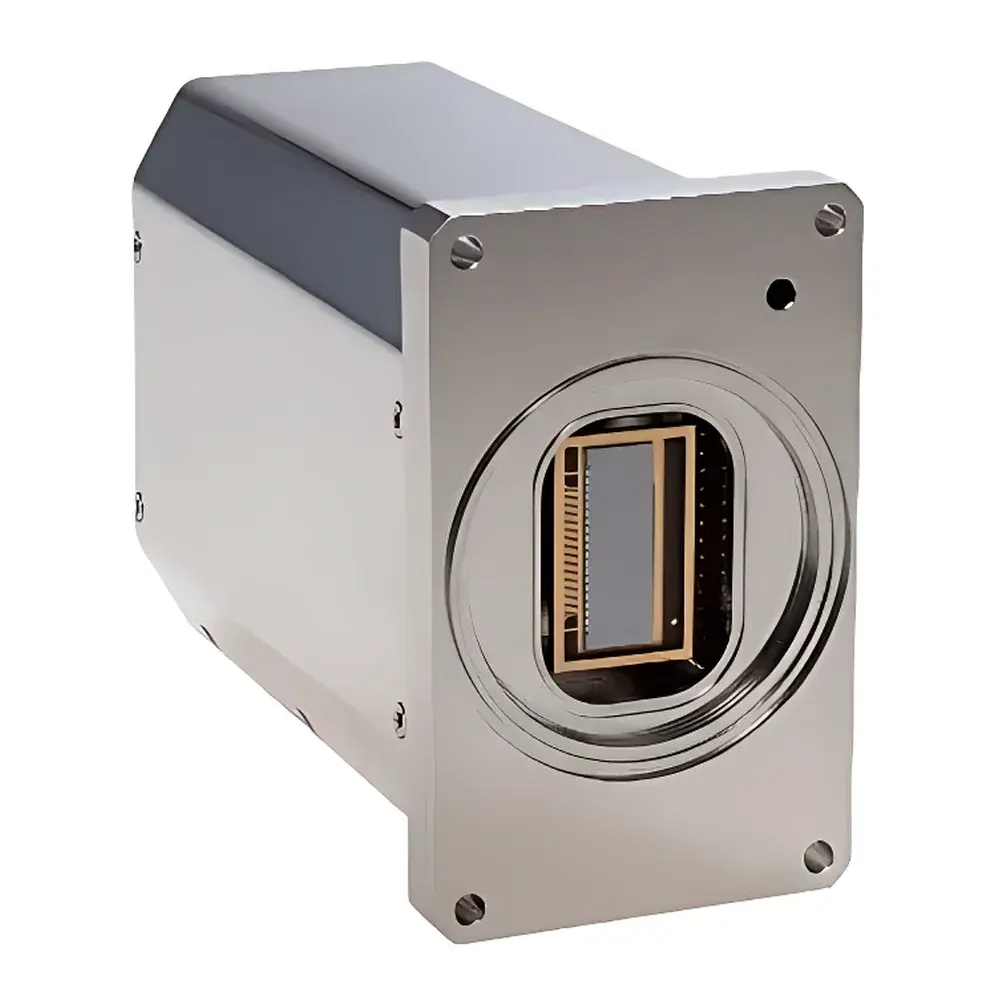
greateyes GE-VAC 1024 Series VUV/EUV/Soft X-ray Scientific CCD Camera
| Brand | greateyes |
|---|---|
| Origin | Germany |
| Model | GE-VAC 1024 |
| Sensor Format | 1024 × 1024 pixels |
| Pixel Size | 13 µm × 13 µm |
| Quantum Efficiency | up to 98% (at selected VUV/EUV wavelengths) |
| Full Well Capacity | up to 700,000 e⁻ |
| Read Noise | as low as 2.4 e⁻ (rms, slow scan mode) |
| Dynamic Range | 16-bit digitization |
| Operating Temperature | down to −70 °C (via multi-stage thermoelectric cooling + optional water cooling) |
| Vacuum Compatibility | <1 × 10⁻⁶ mbar (stainless steel or aluminum vacuum housing) |
| Cooling | integrated Peltier stages with thermal monitoring and active heat dissipation |
| Trigger & Synchronization | multiple hardware trigger modes (TTL, LVDS), external sync input/output, programmable exposure timing |
| Gain Control | software-selectable gain settings for optimized SNR across signal levels |
| Data Interface | Camera Link or USB 3.0 (model-dependent) |
Overview
The greateyes GE-VAC 1024 Series is a high-performance, ultra-high-vacuum-compatible scientific CCD camera engineered for demanding photon detection in the vacuum ultraviolet (VUV), extreme ultraviolet (EUV), and soft X-ray spectral regions (approximately 10–200 nm). Designed around a monolithic, back-illuminated, deep-depletion CCD sensor with thinned architecture and optional delta-doping, the camera achieves exceptional quantum efficiency—up to 98% at key EUV lines such as He II (30.4 nm) and O VI (103.2 nm)—without reliance on phosphor conversion or scintillation layers. Its all-metal, UHV-rated housing (stainless steel or aluminum) supports direct mounting to synchrotron beamlines, laser plasma sources, and space-borne instrumentation platforms. The detector operates in full-frame or subarray readout modes, with precise exposure control and real-time temperature stabilization critical for long-integration spectroscopic imaging under low-photon-flux conditions.
Key Features
- Back-illuminated, deep-depletion CCD sensor with high QE across VUV/EUV/soft X-ray bands
- Multi-stage thermoelectric cooling enabling stable operation down to −70 °C; integrated thermal sensors and PID-controlled regulation
- UHV-compatible mechanical design (≤1 × 10⁻⁶ mbar); flange-mounted integration with CF or ISO-K standard interfaces
- Low-noise electronics architecture: read noise as low as 2.4 e⁻ (rms) in slow-scan, low-gain configuration
- 16-bit analog-to-digital conversion ensuring >96 dB dynamic range and linear response over full well capacity (700,000 e⁻)
- Flexible readout options: programmable region-of-interest (ROI), binning, and pixel combining modes
- Hardware-triggered acquisition with TTL/LVDS compatibility; synchronized multi-camera operation support
- Software-configurable gain settings to balance sensitivity, noise floor, and saturation threshold per application
Sample Compatibility & Compliance
The GE-VAC 1024 is routinely deployed in environments requiring strict vacuum integrity and radiation hardness. Its sensor is optimized for direct photon detection—eliminating optical coupling losses and fluorescence artifacts common in intensified or fiber-optic-coupled systems. The camera complies with ISO 10110-7 (optical component cleanliness), ASTM E2523 (standard practice for EUV lithography metrology), and adheres to mechanical and electrical safety requirements per IEC 61000-6-2/6-3. While not certified for medical use, its design meets GLP-relevant traceability standards for detector calibration logs, temperature history, and firmware versioning—supporting audit-ready documentation for synchrotron facility operations and national lab QA/QC protocols.
Software & Data Management
Control and acquisition are managed via greateyes’ native greateyes Control Software, a cross-platform (Windows/Linux) application supporting scripting (Python API), batch acquisition, and metadata embedding (EXIF-compliant FITS headers). Raw frame data are saved in lossless FITS or HDF5 format, preserving calibrated ADU-to-electron conversion factors, temperature stamps, and exposure parameters. Integration with third-party platforms—including EPICS IOC drivers, LabVIEW VIs, and MATLAB Image Acquisition Toolbox—is supported through standardized SDKs. All firmware updates and sensor calibration files include cryptographic checksums and revision timestamps, satisfying documentation requirements under ISO/IEC 17025 and FDA 21 CFR Part 11 for electronic records in regulated research environments.
Applications
- Synchrotron-based EUV reflectometry and scattering (e.g., at BESSY II, MAX IV, ALS)
- Laser-produced plasma diagnostics and spectral line identification in fusion research
- Space instrumentation calibration (e.g., solar coronagraphs, planetary UV spectrometers)
- Attosecond science experiments requiring single-shot, time-resolved EUV imaging
- High-resolution grating spectrometers for atomic/molecular emission studies in VUV
- Photoelectron spectroscopy (PES) and angle-resolved photoemission spectroscopy (ARPES) beamline detectors
FAQ
Is the GE-VAC 1024 suitable for hard X-ray detection?
No—the sensor thickness and QE profile are optimized for photons below ~2 keV. For hard X-ray applications (>5 keV), greateyes offers complementary hybrid pixel detectors (e.g., GE-HPC series).
Can the camera operate continuously under UHV without outgassing concerns?
Yes—the housing uses only metal seals, ceramic feedthroughs, and vacuum-rated adhesives; total outgassing rate is verified per ASTM E595 and remains below 1.0 × 10⁻⁵ Pa·m³/s·m².
Does the system support shutterless acquisition for pump-probe experiments?
Yes—hardware-triggered global reset and rolling shutter modes enable precise timing synchronization with femtosecond laser systems via external TTL signals.
What calibration services are available?
NIST-traceable absolute QE calibration (10–200 nm), dark current mapping, and linearity verification are offered annually or per project requirement, with full uncertainty budgets compliant with ISO/IEC 17025.
Is remote operation supported over Ethernet or fiber?
While the primary interface is Camera Link or USB 3.0, optional PCIe-based frame grabbers with TCP/IP server modules enable secure remote acquisition and monitoring via encrypted SSH tunnels.



