
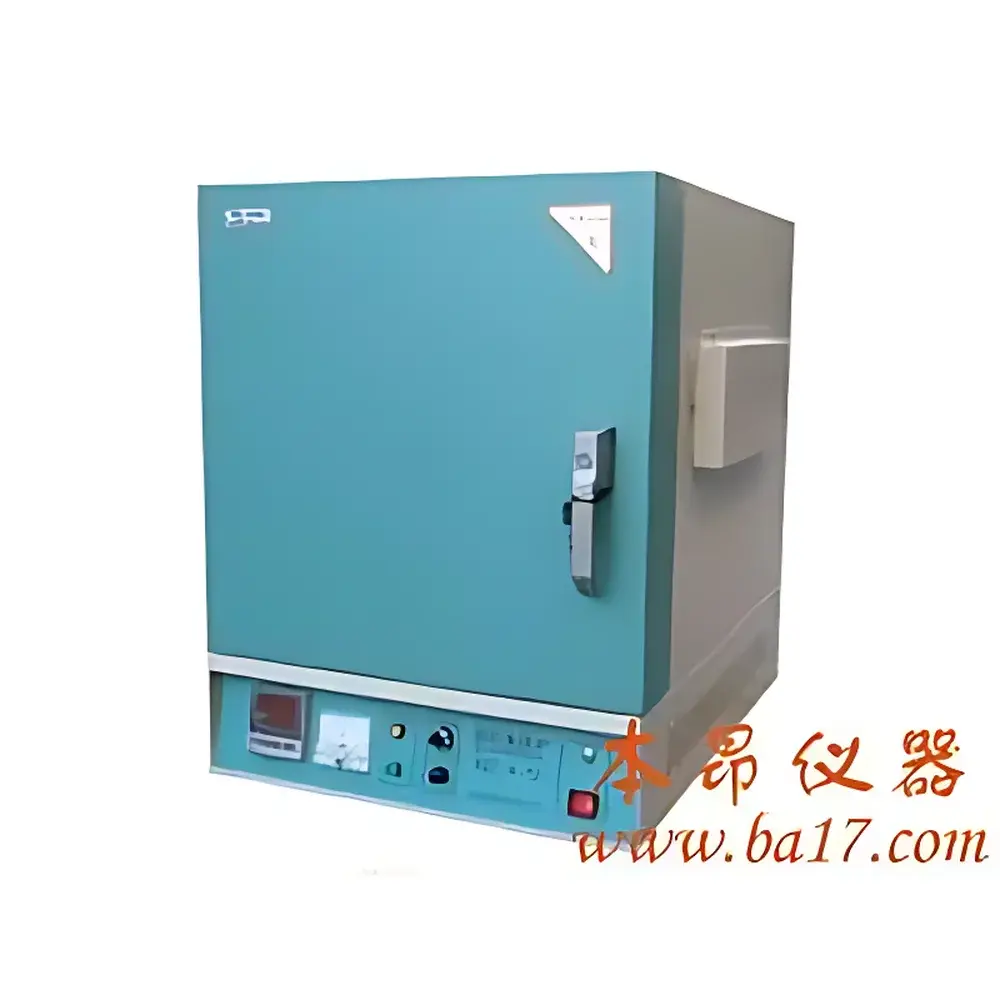
BenAng BA-4-13A Ceramic Fiber Muffle Furnace
| Brand | BenAng |
|---|---|
| Origin | Shanghai, China |
| Model | BA-4-13A |
| Maximum Temperature | 1300 °C |
| Chamber Dimensions | 250 × 150 × 100 mm |
| Heating Rate | ≥60 °C/min |
| Temperature Uniformity | ±1 °C |
| Control System | PID Intelligent Controller |
| Thermocouple Type | Platinum-Rhodium 10 (Type S) |
| Power Supply | AC 220 V |
| Rated Power | 4 kW |
| Rated Current | 30 A |
| Insulation | 50 mm High-Purity Alumina-Silica Ceramic Fiber |
| Heating Element | Kanthal® Super (Sweden) |
Overview
The BenAng BA-4-13A Ceramic Fiber Muffle Furnace is a high-performance laboratory box furnace engineered for rapid thermal processing, precise temperature control, and long-term operational reliability in demanding research and quality control environments. Designed around the principles of resistive heating within an insulated refractory cavity, it utilizes Kanthal® Super resistance wire — a globally recognized alloy system optimized for stability at elevated temperatures up to 1300 °C — embedded within a 50 mm-thick monolithic lining of high-purity alumina-silica ceramic fiber. This architecture enables exceptional thermal efficiency: surface temperature remains below 60 °C at 1000 °C internal setpoint (well under the ISO 7637-2 limit of 100 °C), while achieving ramp rates exceeding 60 °C per minute and reaching 1000 °C in under 12 minutes. Its compact chamber (250 × 150 × 100 mm) supports standardized sample handling protocols without compromising thermal homogeneity or energy economy — consuming approximately 40% less power than conventional brick-lined muffle furnaces operating under identical duty cycles.
Key Features
- High-efficiency thermal insulation: 50 mm thick, low-density, high-purity ceramic fiber board (alumina content ≥96%) minimizes heat loss and ensures rapid cooldown for improved throughput.
- Precision temperature regulation: Integrated PID intelligent controller with Type S (Platinum-Rhodium 10) thermocouple feedback delivers ±1 °C accuracy across the full 100–1300 °C operating range.
- Robust heating system: Kanthal® Super heating elements provide uniform resistive heating, extended service life, and minimal resistance drift over repeated thermal cycling.
- Comprehensive safety architecture: Includes door-mounted interlock switch (automatic power cutoff upon opening), over-temperature cut-off, power-failure restart prevention, and surface temperature monitoring with independent thermal cutoff.
- Energy-optimized design: Achieves ~60% reduction in preheating time versus traditional refractory brick furnaces; measured energy consumption aligns with IEC 61000-3-2 Class A harmonic emission limits.
Sample Compatibility & Compliance
The BA-4-13A accommodates standard crucibles (alumina, quartz, platinum, stainless steel), ceramic substrates, powdered samples, and small-volume biological or pharmaceutical specimens. It meets core requirements for ASTM E1112 (laboratory furnace performance), ISO/IEC 17025:2017 clause 6.4.2 (environmental conditioning equipment qualification), and supports GLP-compliant workflows through traceable temperature logging and stable thermal profiles. While not certified to UL 61010-1 or CE EN 61000-6-3 out-of-the-box, its electrical and thermal safety features conform to essential risk mitigation principles referenced in FDA 21 CFR Part 11 Annex 11 (for data integrity in thermal validation) and USP (thermally assisted analytical method development).
Software & Data Management
The furnace operates via a front-panel digital interface with real-time temperature display, programmable multi-segment ramp/soak profiles, and manual override capability. Optional RS485 communication port (Modbus RTU protocol) enables integration into centralized lab management systems for remote monitoring, automated data capture, and audit-trail generation. When paired with compliant third-party SCADA or LIMS platforms, the system supports electronic record retention aligned with 21 CFR Part 11 requirements — including user authentication, change history, and timestamped event logs for all parameter modifications and cycle executions.
Applications
- Materials science: Ashing, sintering, annealing, and heat treatment of ceramics, composites, and advanced functional materials.
- Environmental & geochemical analysis: Determination of loss-on-ignition (LOI), ash content, volatile matter, and fixed carbon in soils, sediments, coal, and biomass per ASTM D3174, D3175, and ISO 1171.
- Pharmaceutical QA/QC: Residue on ignition (USP ), moisture content by thermogravimetric methods, and excipient compatibility screening.
- Academic research: Teaching laboratories for thermal decomposition kinetics, catalyst calcination, and solid-state reaction studies.
- Metallurgy & electronics: Precise pre-firing of metallized substrates, solder paste testing, and controlled oxidation of thin films.
FAQ
What is the maximum continuous operating temperature?
The BA-4-13A is rated for continuous operation at 1300 °C, with a recommended maximum working temperature of 1250 °C for extended element lifetime.
Is the furnace suitable for ashing organic samples in compliance with EPA Method 1631?
Yes — its uniform temperature distribution, rapid ramp capability, and low particulate shedding make it appropriate for regulated ashing procedures when used with certified crucibles and validated SOPs.
Does the unit include calibration documentation?
Factory calibration certificate (traceable to NIST standards) is provided with each unit; users are advised to perform periodic verification using a calibrated reference thermocouple per ISO/IEC 17025 guidelines.
Can the furnace be integrated into a networked lab environment?
Yes — optional RS485 Modbus RTU interface allows connection to PLCs, SCADA systems, or custom data acquisition software for automated process control and electronic recordkeeping.
What maintenance is required for long-term reliability?
Routine inspection of door gasket integrity, visual check of heating element continuity, and annual verification of thermocouple response time and PID tuning parameters are recommended per manufacturer’s maintenance schedule.



