
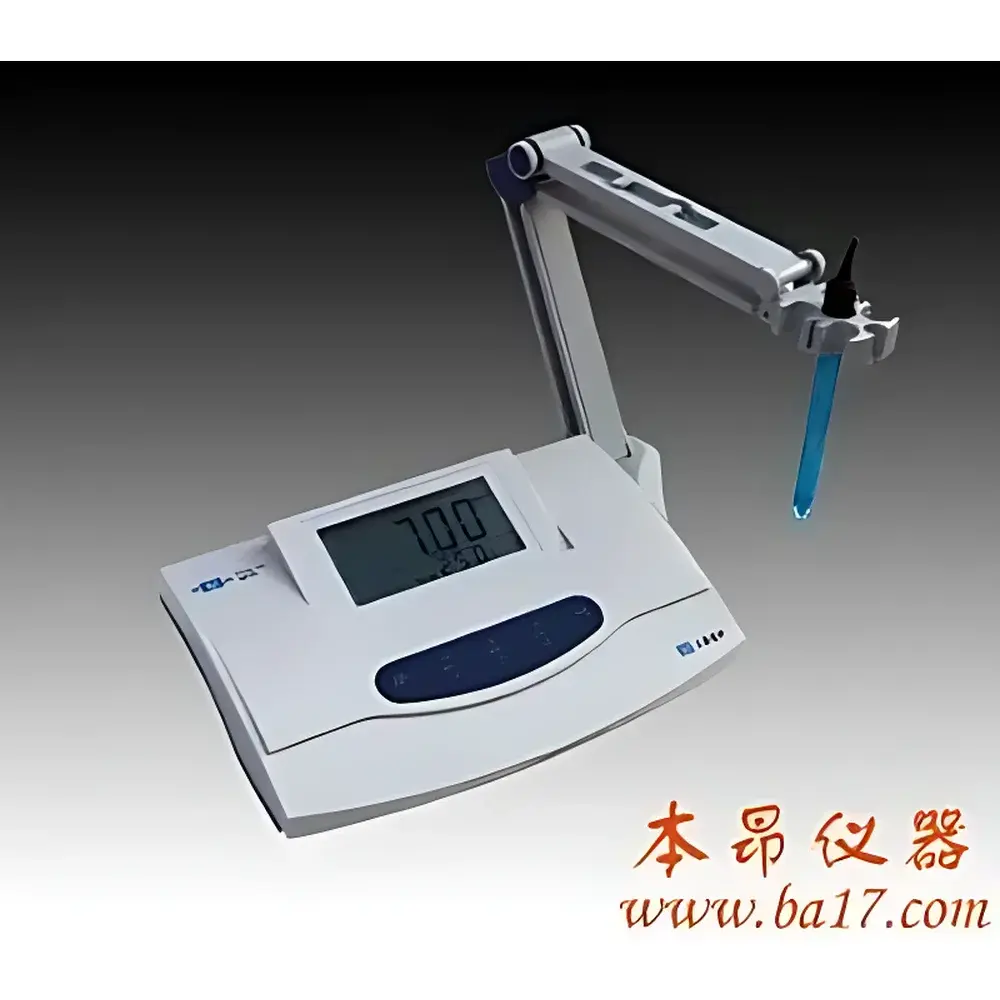
Leici PHS-3C Precision Benchtop pH Meter
| Brand | Leici |
|---|---|
| Model | PHS-3C |
| Type | Benchtop pH/mV Meter |
| Measurement Principle | Potentiometric pH Detection via Glass Electrode |
| pH Range | 0.00–14.00 pH |
| pH Resolution | 0.01 pH |
| pH Accuracy | ±0.01 pH ±1 digit |
| mV Range | ±1999 mV |
| mV Resolution | 1 mV |
| mV Accuracy | ±0.1% FS |
| Input Impedance | ≥1 × 10¹² Ω |
| Temperature Compensation | Manual, 0–60 °C |
| Sample Temp. Range | 5–60 °C |
| Stability | ±0.01 pH ±1 digit / 3 h |
| Display | Segment LCD (Large-Format, Fixed-Character) |
| Calibration | Two-Point with Auto-Buffer Recognition (NIST-traceable buffers) |
| Power Supply | AC 220 V ±10%, 50 Hz |
| Dimensions (W×D×H) | 290 × 210 × 95 mm |
| Weight | 1.5 kg |
Overview
The Leici PHS-3C Precision Benchtop pH Meter is a laboratory-grade potentiometric instrument engineered for reliable, repeatable pH and millivolt measurements in quality control, academic research, and routine chemical analysis environments. Based on the Nernst equation, it measures the potential difference between a pH-sensitive glass electrode and a stable reference electrode immersed in aqueous solution, converting the resulting electromotive force into a calibrated pH value. Designed to meet the performance criteria of Class 0.01 pH instruments per GB/T 11165–2022 (equivalent to ISO 7027-1:2016 referencing electrochemical metrology practices), the PHS-3C delivers high input impedance (>1 × 10¹² Ω) to minimize loading errors—critical when measuring low-conductivity or high-resistance samples such as deionized water, ethanol-water mixtures, or biological buffers. Its fixed-segment LCD display ensures legibility under varied ambient lighting without graphical rendering latency, supporting uninterrupted workflow in GLP-compliant laboratories.
Key Features
- Precision potentiometric measurement architecture compliant with international electrochemical standards (ISO 7027-1, ASTM D1293)
- Two-point calibration with automatic NIST buffer recognition (pH 4.01, 6.86, 9.18) — eliminates manual buffer selection errors and accelerates setup
- Manual temperature compensation (0–60 °C) aligned with standard pH electrode response curves; supports accurate correction for thermal drift in non-thermostatted samples
- Dual-parameter operation: simultaneous pH and mV (±1999 mV) modes with auto-polarity indication for redox potential assessment
- High-stability analog front-end: drift ≤ ±0.01 pH ±1 digit over 3 hours, verified under controlled environmental conditions (25 °C, 50% RH)
- Integrated compatibility with Leici E-201-C-Q9 combination pH electrode — optimized for rapid response, low junction potential, and extended service life in routine aqueous matrices
Sample Compatibility & Compliance
The PHS-3C is validated for use with aqueous solutions across a broad chemical spectrum: standard buffer solutions, process water, pharmaceutical formulations, food extracts, soil leachates, and mild electrolyte solutions (conductivity >50 µS/cm). It is not intended for non-aqueous solvents, highly viscous media, or aggressive oxidizers (e.g., concentrated HNO₃ or Cl₂-saturated solutions) without appropriate electrode adaptation. The instrument conforms to electromagnetic compatibility requirements per GB/T 18268.1–2010 (IEC 61326-1:2012), and its electrical safety design complies with GB 4793.1–2007 (IEC 61010-1:2010). While not FDA 21 CFR Part 11–certified out-of-the-box, its manual calibration logs, fixed-display output, and deterministic measurement path support audit-ready documentation in GMP/GLP settings when paired with standardized SOPs.
Software & Data Management
The PHS-3C operates as a standalone hardware meter with no embedded microprocessor-based data logging or USB/Bluetooth connectivity. All measurements are displayed in real time on the segment LCD; users record results manually or interface externally via optional RS-232 adapters (not included). This architecture prioritizes operational simplicity, long-term reliability, and immunity to firmware vulnerabilities—making it suitable for regulated environments where software validation overhead must be minimized. Calibration history, date/time stamps, and operator ID must be documented externally per ISO/IEC 17025:2017 Clause 7.7 requirements. For laboratories requiring electronic records, integration with LIMS or ELN systems is achievable through third-party serial-to-digital converters compliant with Modbus RTU or ASCII protocols.
Applications
- QC testing of purified water and WFI (Water for Injection) per USP conductivity/pH correlation protocols
- pH monitoring during titration endpoint verification in acid-base and redox assays
- Stability-indicating measurements in pharmaceutical formulation development (e.g., buffer capacity evaluation)
- Environmental testing of surface water, wastewater effluents, and sediment pore water per EPA Method 150.1
- Educational labs for teaching fundamental electrochemistry principles including liquid junction potential and activity coefficient effects
- Food & beverage QA for product consistency checks (e.g., dairy fermentation, juice acidity profiling)
FAQ
Does the PHS-3C support automatic temperature compensation (ATC)?
No—it features manual temperature compensation only. Users must enter the measured sample temperature using the front-panel keys before calibration or measurement.
Is the E-201-C-Q9 electrode included with the instrument?
Yes—the PHS-3C is supplied with one Leici E-201-C-Q9 pH combination electrode, pre-calibrated and ready for immediate use.
Can the PHS-3C measure ORP (oxidation-reduction potential)?
Yes—in mV mode, it displays redox potential with auto-polarity detection, enabling qualitative ORP assessment without dedicated ORP electrodes.
What NIST-traceable buffer standards are compatible?
The instrument recognizes NIST-certified pH 4.01, 6.86, and 9.18 buffers at 25 °C; calibration accuracy assumes buffers are within their certified shelf life and stored per manufacturer instructions.
Is the unit suitable for field use?
It is designed for benchtop laboratory use only—AC-powered, non-battery-operated, and not rated for IP protection against dust or moisture.
Related Products




