
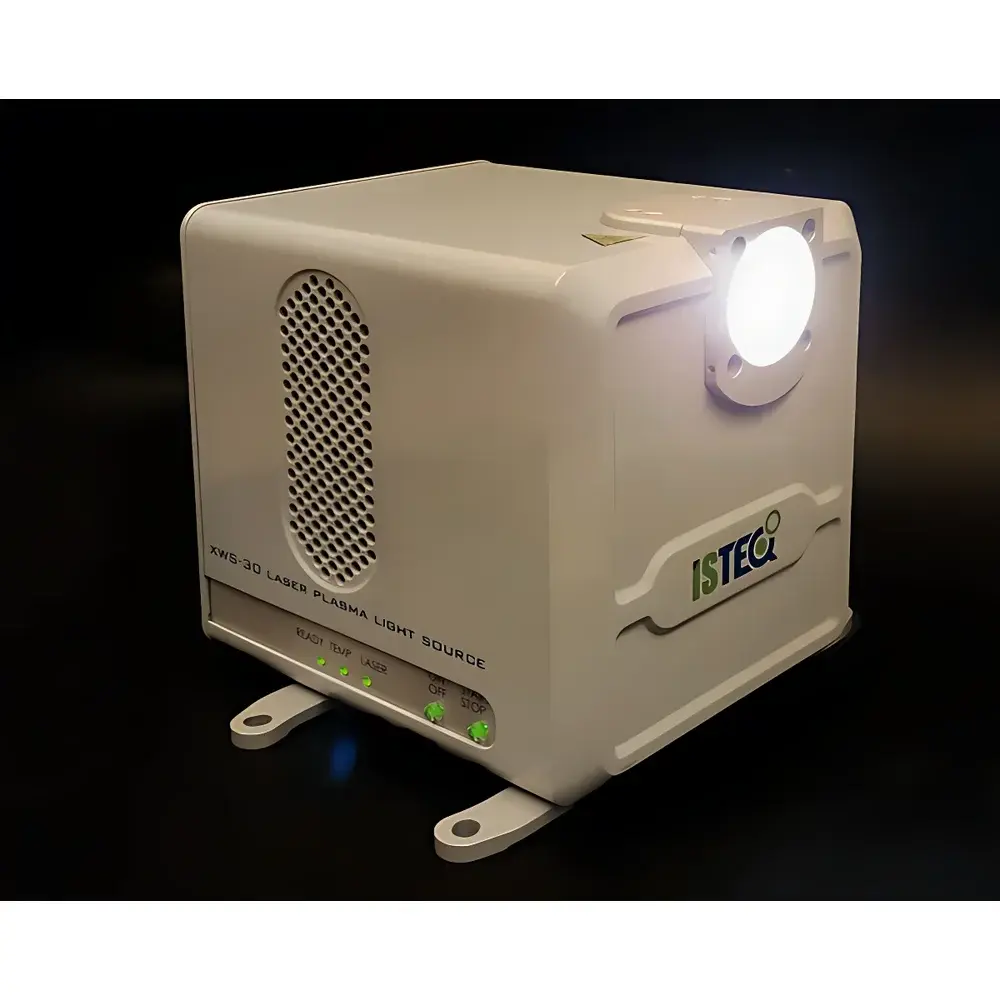
ISTEQ XWS-30 Compact Laser-Driven Plasma White Light Source
| Brand | ISTEQ |
|---|---|
| Origin | Netherlands |
| Model | XWS-30 |
| Spectral Range | 190–2500 nm (UV configuration), 250–2500 nm (OFR configuration) |
| Spectral Radiance | up to 40 mW/(mm²·sr·nm) |
| Output Power | up to 1.5 W (free-space), up to 0.4 W (fiber-coupled, FCU) |
| Emitter Size | 100 × 200 µm |
| Lifetime | 10,000 hours |
| Spatial-Temporal Stability | ST < 0.15% |
| Dimensions | 110 × 110 × 120 mm |
| Cooling | Passive (no external cooling required) |
| Control Interface | USB-to-RS485 adapter for PC/laptop |
Overview
The ISTEQ XWS-30 is a compact, laser-driven plasma white light source engineered for applications demanding high spectral brightness, exceptional spatial stability, and minimal thermal footprint in constrained optical setups. Unlike conventional arc lamps (e.g., xenon or mercury short-arc), the XWS-30 employs a pulsed solid-state laser to generate a transient, high-temperature plasma within a sealed xenon gas environment—yielding a continuum emission spectrum without discrete atomic lines. This physical mechanism enables broadband output from deep UV (190 nm) through visible to near-infrared (2500 nm), with radiance peaking at up to 40 mW/(mm²·sr·nm) — a level unattainable by thermally limited halogen or deuterium sources. Its all-in-one mechanical design integrates plasma generation, collimation optics, and electronic driver into a single 110 × 110 × 120 mm housing, eliminating the need for external water cooling, air blowers, or bulky power supplies. The absence of electrode degradation ensures intrinsic long-term radiometric stability (< 0.15% spatial-temporal fluctuation over 8-hour operation), making it suitable for quantitative spectroscopic measurements requiring trace-level repeatability.
Key Features
- True laser-driven plasma architecture — no electrodes, no cathode sputtering, no spectral drift from filament aging
- Passively cooled monolithic enclosure — operates continuously at ambient temperatures without forced convection or liquid cooling
- High-brightness point-like emitter (100 × 200 µm) optimized for efficient coupling into single-mode fibers or high-NA microscope objectives
- Dual spectral configurations: UV-enhanced (190–2500 nm) with MgF₂ optics; OFR-optimized (250–2500 nm) with fused silica transmission path
- Fully digital control via RS485 protocol over USB interface — supports TTL triggering, intensity modulation (0–100% PWM), and real-time status monitoring (lamp health, pulse count, thermal load)
- Compliant with IEC 62471 photobiological safety classification (Risk Group 1 for free-space output under standard viewing conditions)
Sample Compatibility & Compliance
The XWS-30 is compatible with standard optical breadboards, kinematic mounts, and OEM integration platforms. Its free-space output is collimated to ≤1.5 mrad divergence (FWHM), while FCU variants support 200 µm core multimode fiber (NA 0.22) with >65% coupling efficiency. All optical materials comply with RoHS 2011/65/EU and REACH SVHC regulations. The system meets electromagnetic compatibility requirements per EN 61326-1:2013 (industrial environment) and carries CE marking for EU deployment. For regulated laboratories, audit-ready operation logs (via optional firmware extension) support GLP-compliant record retention aligned with ISO/IEC 17025:2017 clause 7.7.1 on equipment performance verification.
Software & Data Management
ISTEQ provides the XWS-Control Suite (v3.2+), a cross-platform application (Windows/macOS/Linux) enabling full parameter scripting, automated spectral calibration routines, and time-stamped event logging. Raw RS485 telemetry includes pulse counter, internal heatsink temperature (±0.5°C resolution), and lamp-on duration — exportable as CSV or HDF5 for traceability. The API supports Python (PySerial), MATLAB (Instrument Control Toolbox), and LabVIEW (VISA drivers), facilitating integration into custom DAQ workflows. When deployed in FDA-regulated environments (e.g., QC labs performing USP spectrophotometer qualification), optional 21 CFR Part 11-compliant user access control and electronic signature modules are available upon request.
Applications
- Absorption, reflectance, and fluorescence spectroscopy — particularly where line-free continuum excitation eliminates interference from Hg/Xe emission spikes
- Ellipsometry and scatterometry in semiconductor metrology — leveraging stable UV-VIS-NIR output for thin-film thickness modeling (e.g., SiO₂/SiNₓ on silicon wafers)
- Confocal and widefield fluorescence microscopy — enabling multi-channel excitation without filter wheel synchronization delays
- Optical component testing — including transmittance/reflectance mapping of AR coatings, dichroics, and GRIN lenses across broad wavelength bands
- Microfluidic absorption detection and droplet-based spectrometry — benefiting from low thermal load and vibration-free operation adjacent to sensitive MEMS devices
- Calibration of array detectors (CCD/CMOS), spectrometer wavelength accuracy validation (per ISO 17025 Annex C), and reference source qualification per ASTM E275 and E334
FAQ
What distinguishes laser-driven plasma emission from traditional xenon arc lamps?
Laser-driven plasma avoids electrode erosion and thermal drift inherent in DC/AC arc lamps, delivering superior radiometric stability (< 0.15% vs. typical 1–2% for xenon arcs) and eliminating spectral line artifacts.
Can the XWS-30 be synchronized with camera acquisition or lock-in amplifiers?
Yes — the unit provides TTL-compatible trigger input/output ports supporting external gating at frequencies up to 10 kHz, with jitter < 50 ns RMS.
Is spectral recalibration required after extended operation?
No — the plasma geometry and optical path are mechanically invariant; factory spectral irradiance calibration certificates (NIST-traceable) remain valid for the full 10,000-hour lifetime unless physically damaged.
Does the system support OEM integration into custom enclosures?
Yes — mechanical drawings, thermal dissipation profiles, and electrical pinouts are provided under NDA; fanless operation simplifies thermal management in sealed housings.
How is lamp lifetime defined and verified?
Lifetime is specified as time to 80% initial radiance at 500 nm under continuous operation at 25°C ambient; validated per IES LM-80 methodology using integrated photodiode monitoring.




