
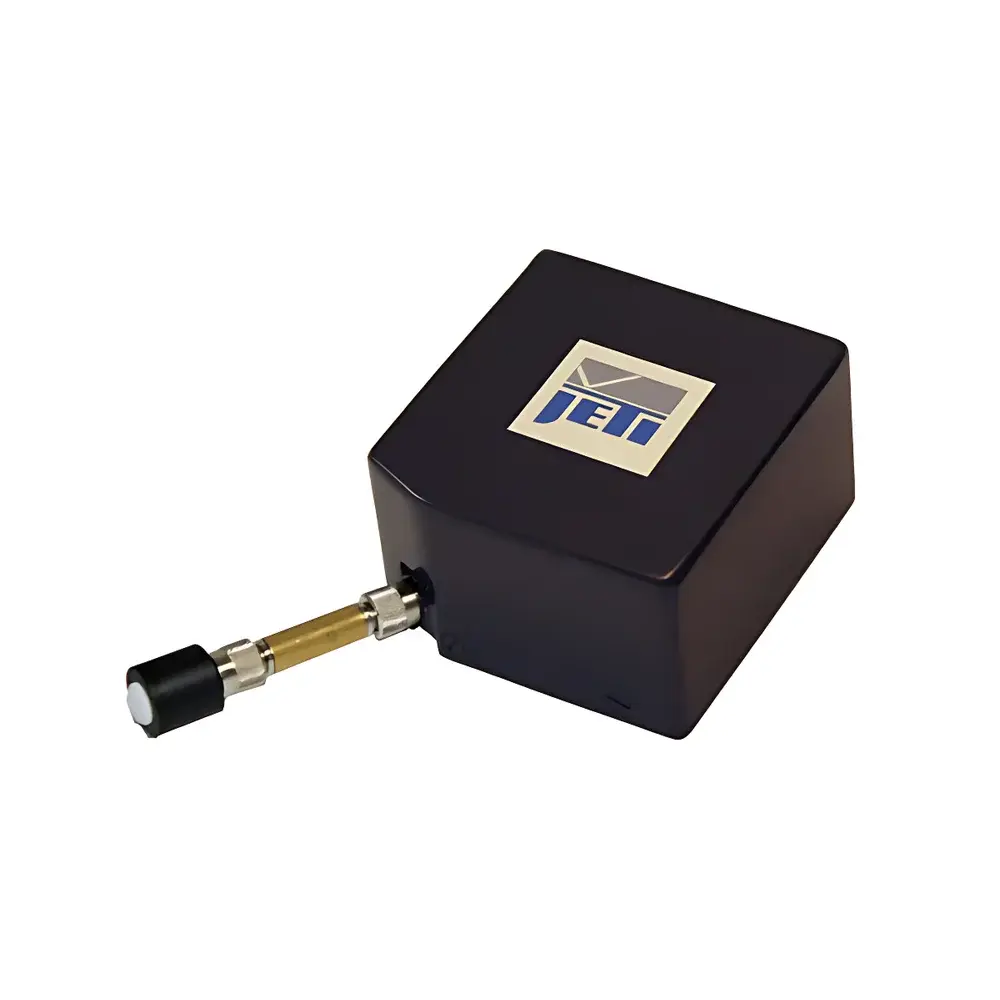
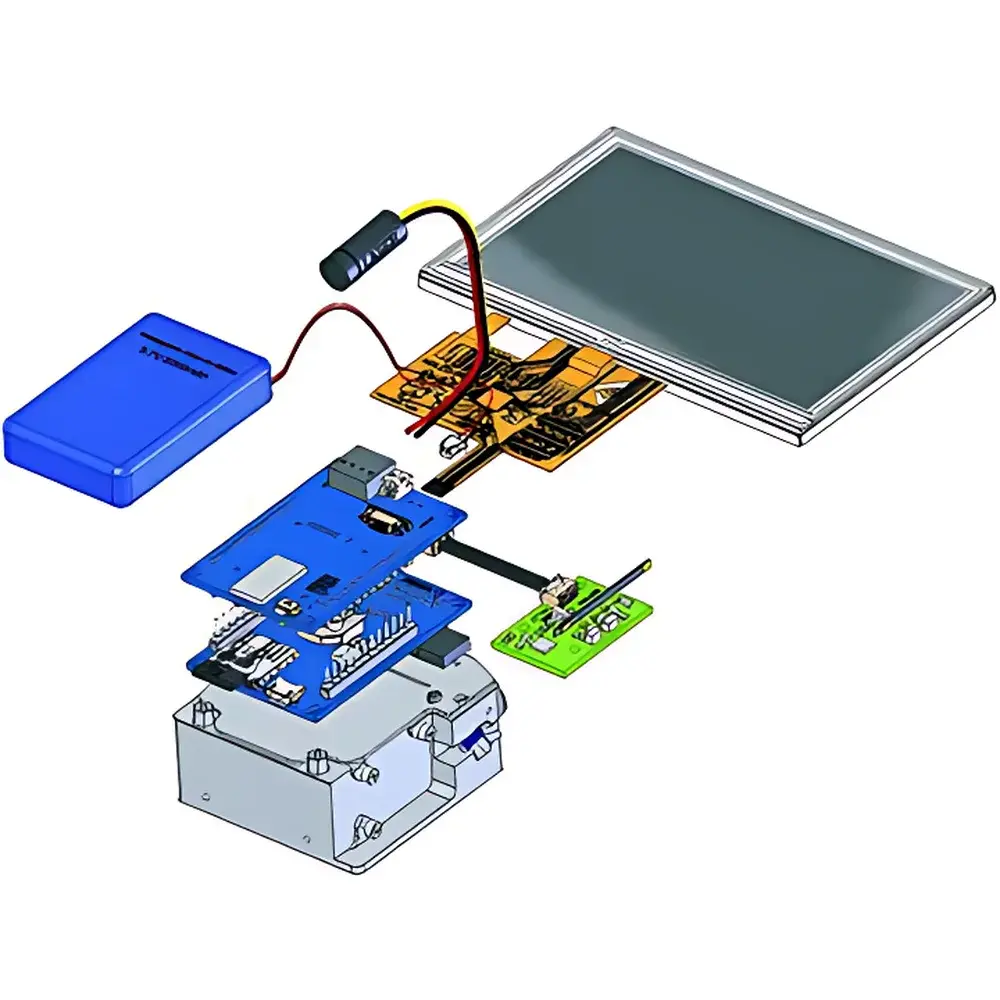
RU40/90 Flat-Field Fiber Optic Spectrometer
| Origin | Germany |
|---|---|
| Manufacturer Type | Authorized Distributor |
| Origin Category | Imported |
| Model | RU40/90 |
| Spectral Range | 300–1000 nm |
| Detector | CMOS |
| Optical Resolution | < 4.5 nm (with 50 µm slit) |
| Sensitivity | 5×10¹⁶ counts/W·s @ 300 nm |
| Signal-to-Noise Ratio | 3000:1 |
| Dynamic Range | 10,000:1 |
| Stray Light | < 0.1 % |
Overview
The RU40/90 Flat-Field Fiber Optic Spectrometer is a compact, high-performance benchtop spectrometer engineered for precision spectral analysis across laboratory, industrial, and field-deployable applications. Based on flat-field concave holographic grating optics, it eliminates astigmatism and curvature of the focal plane—enabling uniform spectral dispersion across the full 300–1000 nm range without refocusing or mechanical repositioning. This optical architecture delivers intrinsic wavelength linearity and spatial stability critical for radiometric, photometric, and colorimetric measurements. Designed and assembled in Germany, the RU40/90 integrates a thermally stabilized CMOS linear image sensor with low-noise readout electronics, supporting high-speed acquisition (up to 1 kHz full-spectrum frame rate) while maintaining robust thermal drift compensation (< 0.02 nm/°C). Its miniature footprint (approx. 125 × 80 × 45 mm) and rigid aluminum housing make it suitable for OEM integration into portable analyzers, inline process monitors, LED/Laser characterization rigs, and handheld spectral measurement systems.
Key Features
- Flat-field optical design with concave holographic grating ensures minimal aberration and uniform pixel-to-wavelength mapping across the entire spectral range
- Integrated piezoelectric mechanical shutter enables precise dark-current acquisition and real-time baseline correction—essential for high-accuracy radiance and reflectance quantification
- Onboard firmware supports dark noise subtraction, absolute irradiance calibration (via NIST-traceable reference sources), and real-time spectral normalization
- Native SCPI-compliant command set (IEEE 488.2) ensures seamless interoperability with LabVIEW, Python (PyVISA), MATLAB, and industrial PLC environments
- Dual-mode operation: standalone mode via included JETI VersaSpec software; embedded mode via DLL, SDK, or UART/I²C interfaces for custom firmware integration
- Thermal management system maintains detector stability over ambient temperatures from 5 °C to 40 °C without active cooling
Sample Compatibility & Compliance
The RU40/90 accepts standard SMA 905 fiber-optic input (core diameters 50–600 µm), enabling direct coupling to integrating spheres, collimators, microscope ports, or remote probe heads. It complies with IEC 61326-1 (EMC for laboratory equipment) and meets RoHS 2011/65/EU material restrictions. While not certified as medical or safety-critical hardware, its spectral data output supports traceable calibration workflows aligned with ISO/IEC 17025 requirements when used with accredited reference standards (e.g., NIST SRM 2035, 2065). The device supports audit-ready data logging—including timestamped metadata, firmware version, calibration ID, and environmental sensor readings (optional)—to facilitate GLP/GMP-aligned documentation protocols.
Software & Data Management
JETI VersaSpec provides turnkey spectral acquisition, visualization, and post-processing—including CIE 1931 xy chromaticity, CCT, CRI, TM-30 metrics, absorbance/transmittance/reflectance conversion, and spectral derivative analysis. All raw and processed spectra are saved in HDF5 format with embedded calibration matrices and metadata headers compliant with the ASTM E2758-21 spectral data exchange standard. The SDK includes C/C++, C#, and Python bindings with thread-safe API calls, asynchronous trigger handling, and memory-mapped buffer access for low-latency streaming. Firmware updates are performed via signed binary packages with SHA-256 verification, satisfying basic cybersecurity hygiene for instrument control systems.
Applications
- LED and OLED spectral power distribution (SPD) characterization for binning and quality control
- In-line color consistency monitoring in paint, textile, and plastic manufacturing lines
- UV-Vis absorption spectroscopy for chemical concentration assays (e.g., nitrate, chlorophyll-a)
- Fluorescence excitation/emission profiling in bioanalytical instrumentation
- Portable solar simulator spectral match validation per IEC 60904-9 Ed. 3
- OEM integration into handheld spectroradiometers, agricultural NDVI sensors, and UV disinfection dose meters
FAQ
Does the RU40/90 support radiometric calibration with NIST-traceable standards?
Yes—factory calibration includes absolute irradiance response curves referenced to NIST-traceable tungsten halogen and deuterium lamps. Users may perform field recalibration using optional JETI-calibrated reference sources.
Can the mechanical shutter be triggered externally via TTL signal?
Yes—the piezoelectric shutter accepts 3.3 V / 5 V TTL pulses with configurable delay and dwell time via register-level control or SCPI commands.
Is the CMOS detector cooled?
No—thermal stabilization is achieved passively via aluminum housing mass and internal thermal shunts. Dark current remains stable at ≤ 15 e⁻/pixel/s at 25 °C ambient.
What is the maximum integration time supported?
From 1 ms to 10 s in 100 µs increments, adjustable per acquisition with automatic exposure control option.
Does the SDK support multi-device synchronization?
Yes—hardware trigger-in/out ports enable sub-millisecond inter-unit timing alignment for array-based or multi-angle spectral setups.




