
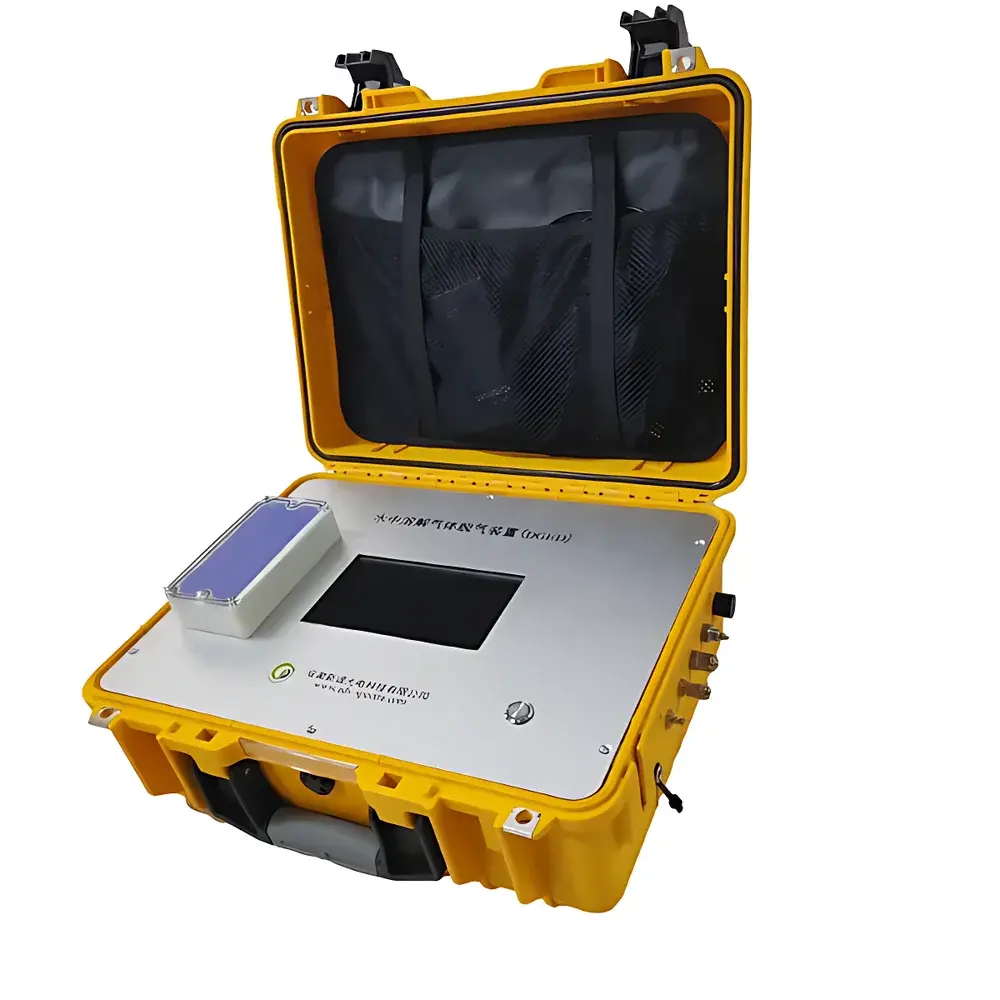
DGED-01 Dissolved Gas Extraction and Degassing System by CASP
| Brand | CASP |
|---|---|
| Model | DGED-01 |
| Origin | Anhui, China |
| Manufacturer Type | Direct Manufacturer |
| Power Input | 12 VDC, 30 W |
| Dimensions | 430 mm × 345 mm × 188 mm |
| Weight | 5 kg |
| Liquid Sample Temperature Range | 0–40 °C |
| Liquid Flow Rate | 80 mL/min |
| Communication Interface | USB (serial protocol) |
| Fluid Connections | 1/4" OD tubing for liquid ports |
| Data Logging | Internal real-time storage |
| Channel Configuration | 1 liquid inlet, 1 liquid outlet, 1 purge gas inlet, 1 gas outlet |
Overview
The DGED-01 Dissolved Gas Extraction and Degassing System is an engineered laboratory-scale membrane-based degasser designed for continuous, non-destructive separation of dissolved gases from aqueous liquid streams. It operates on the principle of selective permeation through hydrophobic microporous hollow-fiber membranes, enabling efficient mass transfer of dissolved volatile species—including O₂, CO₂, N₂, CH₄, H₂, and low-molecular-weight hydrocarbons—into a counter-flow or co-flow purge gas stream. Unlike vacuum or thermal degassing methods, the DGED-01 preserves sample integrity, avoids bubble nucleation artifacts, and maintains stable liquid-phase composition during real-time extraction. Its compact architecture and low-power DC operation make it suitable for integration into mobile environmental monitoring platforms, field-deployable water quality analyzers, and inline process analytical technology (PAT) systems in pharmaceutical or municipal water treatment applications.
Key Features
- Continuous, real-time dissolved gas extraction with simultaneous quantification of both gaseous-phase concentration and aqueous-phase molar concentration
- Low-power consumption (30 W at 12 VDC), enabling battery- or solar-powered deployment in remote or unpowered field environments
- Integrated internal data logger supporting time-stamped storage of all sensor and flow-derived parameters without external PC dependency
- Modular fluidic interface: 1/4″ OD compression fittings for liquid in/out; standardized micro quick-connects for purge gas routing to external gas analyzers (e.g., GC, PID, NDIR, or electrochemical sensors)
- Compact footprint (430 × 345 × 188 mm) and lightweight design (5 kg) optimized for benchtop use, vehicle-mounted installations, or portable instrumentation racks
- Thermally stable operation across 0–40 °C liquid sample temperature range, compatible with ambient, refrigerated, or moderately warmed aqueous streams
Sample Compatibility & Compliance
The DGED-01 is validated for use with deionized water, tap water, surface water, groundwater, and low-turbidity wastewater matrices. It is not recommended for high-viscosity fluids (>5 cP), suspensions with >10 mg/L total suspended solids (TSS), or samples containing surfactants or membrane-fouling organics without upstream filtration. The system complies with general laboratory equipment safety standards per IEC 61010-1 for electrical safety and electromagnetic compatibility (EMC). While not certified to specific regulatory frameworks out-of-the-box, its architecture supports traceability and audit readiness when integrated into GLP-compliant workflows: all logged timestamps, flow rates, and temperature readings are stored in non-volatile memory with write-protection options. When paired with FDA 21 CFR Part 11–compliant host software, electronic records meet basic ALCOA+ data integrity criteria.
Software & Data Management
The DGED-01 communicates via USB virtual COM port using a documented ASCII-based serial protocol (baud rate: 9600, 8N1). Host software—whether custom LabVIEW/VB.NET applications or third-party SCADA/HMI platforms—can poll device status, configure sampling intervals (1–60 s), initiate manual data dumps, and synchronize timestamps with external clocks. Internal logging retains up to 72 hours of high-resolution data (sampled at 1 Hz) before overwrite. Export formats include CSV and plain-text log files with ISO 8601 timestamps, facilitating post-acquisition analysis in MATLAB, Python (Pandas), or commercial statistical packages. No proprietary drivers or cloud dependencies are required; firmware updates are performed via DFU mode over USB.
Applications
- Field-deployable dissolved oxygen (DO), methane (CH₄), and carbon dioxide (CO₂) monitoring in limnological and marine research
- In-line degassing for online IC/ICP-MS sample introduction systems requiring gas-free aqueous streams
- Calibration verification of dissolved gas sensors using known equilibrium concentrations generated under controlled purge flow
- Process water surveillance in semiconductor fab ultrapure water (UPW) loops where residual O₂ or CO₂ must remain below sub-ppb thresholds
- Environmental compliance reporting per EPA Method 330.1 (DO) and ASTM D5173 (total dissolved gases) when coupled with certified gas analyzers
FAQ
What purge gases are compatible with the DGED-01?
Nitrogen, helium, and synthetic air are routinely used. Inert gases minimize interference in downstream detection; humidified purge streams may be employed to reduce membrane drying effects.
Can the DGED-01 handle seawater or brackish water?
Yes—with optional stainless steel or PTFE-wetted components and pre-filtration to ≤5 µm; long-term exposure to >3.5% salinity requires periodic membrane cleaning per CASP Technical Note TN-DGED-03.
Is the internal data logger accessible without USB connection?
No. Data retrieval requires active USB communication; however, logging continues autonomously during disconnection.
Does the system support analog output signals (e.g., 4–20 mA)?
Not natively. Analog interfacing requires external signal conditioning modules or programmable logic controllers (PLCs) configured to parse the serial data stream.
How often does the hollow-fiber membrane module require replacement?
Under typical freshwater use at 80 mL/min and ambient temperature, service life exceeds 12 months. Replacement intervals shorten with elevated TSS, biofilm formation, or exposure to chlorinated water—monitoring extraction efficiency decline is recommended as the primary maintenance indicator.



