
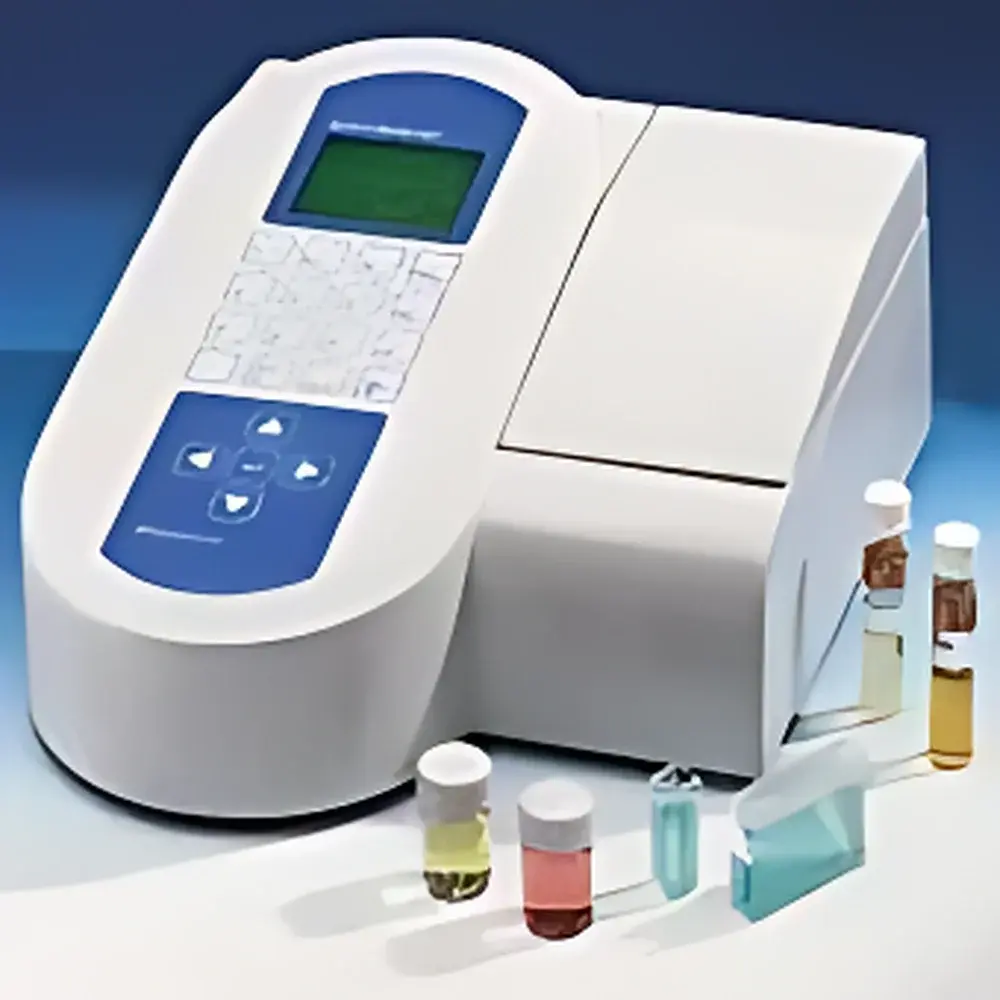
Lovibond ET99730 Advanced Multi-Parameter Photometric COD/TOC Analyzer
| Brand | Lovibond (Tintometer) |
|---|---|
| Origin | United Kingdom |
| Model | ET99730 |
| Wavelength Range | 330–900 nm |
| Spectral Bandwidth | 10 nm |
| Wavelength Resolution | ±1 nm |
| Wavelength Accuracy | ±2 nm |
| Optical System | Holographic grating monochromator |
| Light Source | Tungsten-halogen lamp |
| Photometric Range | 0.3–2.5 ABS |
| Sample Cell Compatibility | Round cells (Ø16 mm, Ø24 mm) |
| Data Storage | 1000 measurement records (including timestamp, sample ID, and method ID) |
| Interface | RS232 serial port (PC connectivity and thermal printer support) |
| Power Supply | 230 V AC / 50 Hz |
| Dimensions (Analyzer) | 275 × 340 × 165 mm |
| Weight | 3.2 kg |
| Compliant Methods | APHA 5220D, US EPA Method 410.4 (COD), and standard protocols for TOC, total nitrogen, ammonia-N, phosphate, total hardness, and arsenic |
Overview
The Lovibond ET99730 is a high-performance, multi-parameter photometric analyzer engineered for precise, trace-level quantification of key water quality parameters in environmental, municipal, and industrial laboratories. It operates on the principle of absorbance spectroscopy—measuring light attenuation at defined wavelengths following colorimetric reactions—and integrates a holographic grating monochromator with a tungsten-halogen light source to deliver stable, reproducible spectral output across a broad range (330–900 nm). Unlike single-parameter benchtop analyzers, the ET99730 supports standardized wet-chemistry methods—including dichromate-based chemical oxygen demand (COD) per APHA Standard Method 5220D and US EPA Method 410.4—as well as TOC estimation via persulfate oxidation coupled with UV digestion and colorimetric detection. Its optical architecture enables simultaneous method validation across 43 distinct test categories and 60 validated measurement endpoints, including total nitrogen, ammonia-nitrogen, orthophosphate, total hardness (as CaCO₃), and inorganic arsenic (As³⁺/As⁵⁺), all within a single platform.
Key Features
- Automated wavelength scanning via patented optical path design—eliminates manual filter selection and ensures optimal bandpass alignment for each assay.
- Dual calibration capability: factory-installed reference curves plus user-defined calibration using custom standards, supporting method adaptation for non-standard matrices (e.g., high-salinity wastewater or landfill leachate).
- Integrated zero-point auto-calibration prior to each measurement cycle, reducing drift and enhancing inter-day reproducibility (CV < 1.8% at mid-range COD concentrations).
- Three-tier COD measurement ranges (0–150 mg/L, 0–1500 mg/L, 0–15000 mg/L) with pre-filled, vacuum-sealed reagent vials compliant with ISO 6060 and ASTM D1253—ensuring shelf stability (>24 months unopened), minimal heavy-metal interference, and reduced operator exposure risk.
- RS232 interface enabling direct data export to LIMS or spreadsheet applications; supports GLP-compliant audit trails when paired with Lovibond’s optional PC software (ET99730-PC v3.2+).
- Self-diagnostic firmware with real-time error logging, including lamp intensity monitoring, cell compartment contamination alerts, and temperature deviation flags during photometric acquisition.
Sample Compatibility & Compliance
The ET99730 accommodates diverse sample formats: round cuvettes (Ø16 mm and Ø24 mm) for routine COD and TOC assays, and rectangular cells (10–50 mm path length) for low-concentration analytes requiring extended optical paths. All measurements adhere to internationally recognized regulatory frameworks: COD results are traceable to NIST SRM 2632a (potassium hydrogen phthalate), while TOC protocols align with ISO 8245 and EN 1484. The system meets IEC 61000-4 electromagnetic compatibility requirements and carries CE marking under Directive 2014/30/EU (EMC) and 2014/35/EU (LVD). When used in conjunction with the ET99125 digestion block—certified to IEC 61010-1 for laboratory equipment safety—the full workflow satisfies QA/QC criteria outlined in EPA Contract Laboratory Program (CLP) guidelines for wastewater analysis.
Software & Data Management
Data integrity is maintained through time-stamped storage of up to 1000 measurement records, each containing sample ID, operator code, method version, date/time stamp, raw absorbance values, and calculated concentration. The RS232 port supports bidirectional communication: users may upload updated method libraries (e.g., newly validated arsenic speciation protocols) directly from Lovibond’s secure FTP server or via encrypted USB dongle. Firmware updates preserve existing calibration coefficients and historical datasets. Optional software modules provide automated report generation compliant with 21 CFR Part 11 (electronic signatures, audit trail, role-based access control) and support CSV/Excel export for integration into enterprise environmental management systems (EMS).
Applications
The ET99730 serves as a core analytical instrument in accredited environmental testing labs performing compliance monitoring under NPDES permits, drinking water utilities verifying disinfection by-product precursors, and industrial facilities conducting pretreatment verification per local sewer use ordinances. Its flexibility extends to research applications—including nutrient cycling studies in constructed wetlands (TN/TP ratios), oxidative stress assessment in bioremediation trials (COD:TOC ratio trends), and rapid screening of arsenic-contaminated groundwater in field-deployable configurations (when paired with portable power inverters and ruggedized cases). Routine QC checks include daily verification with Lovibond’s certified reference standards (CRS-COD-100, CRS-TOC-5.0) and quarterly performance verification using spiked recovery samples per ISO/IEC 17025 Clause 7.7.
FAQ
Does the ET99730 require annual recalibration by an authorized service center?
No—user-performed calibration verification using included NIST-traceable standards is sufficient for routine operation; however, full optical alignment verification is recommended every 24 months or after physical impact.
Can the instrument measure COD without digestion?
No—COD determination requires strong acid dichromate oxidation at elevated temperature; the ET99730 must be used in tandem with the ET99125 digestion block or equivalent certified heater.
Is method validation documentation available for regulatory submissions?
Yes—Lovibond provides Method Validation Kits (ET-KIT-MV) containing precision, accuracy, LOD/LOQ, and matrix spike data packages aligned with EPA SW-846 Chapter 4 requirements.
What is the expected lifetime of the tungsten-halogen lamp?
Rated for ≥2,500 hours of continuous operation; automatic lamp usage tracking is embedded in firmware and triggers maintenance alerts at 90% end-of-life threshold.
Are reagents supplied with method-specific lot certification?
Yes—all Lovibond COD and TOC reagent kits include CoA documents listing batch-specific absorbance blank values, stability profiles, and heavy metal impurity limits (Pb < 0.1 ppm, Hg < 0.05 ppm).
Related Products







