
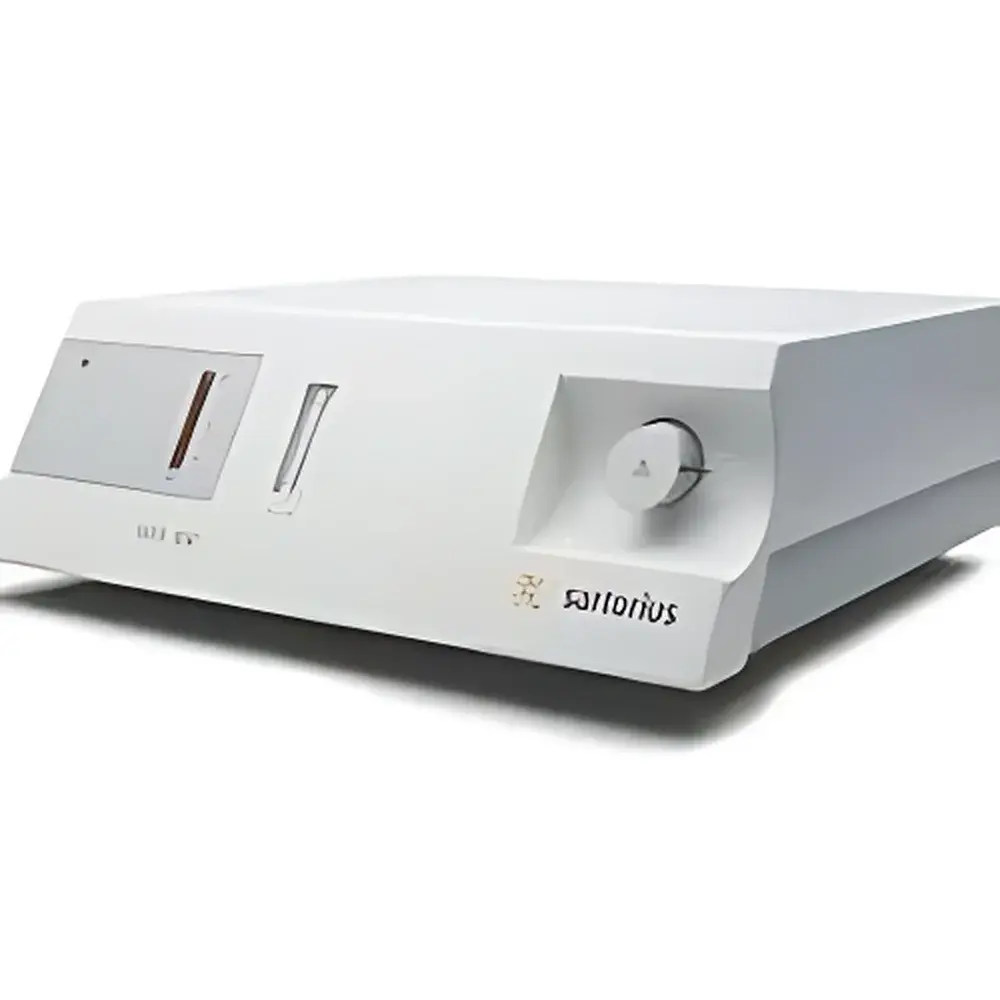
Sartorius LMA400 Moisture Determination System
| Brand | Sartorius |
|---|---|
| Origin | Germany |
| Model | LMA400 |
| Measurement Principle | Integrated Coulometric Karl Fischer + P₂O₅ Electrolytic Hygrometry + Gravimetric Drying (Hybrid Method) |
| Detection Limit | 1 µg H₂O |
| Typical Range | 0.001–40 wt% H₂O |
| Repeatability | ±2% absolute moisture content |
| Compliance | Designed for GLP/GMP environments |
Overview
The Sartorius LMA400 Moisture Determination System is a high-precision, hybrid analytical platform engineered for trace- to macro-level water content quantification in solid, semi-solid, and paste-like samples. Unlike conventional single-principle instruments, the LMA400 integrates three complementary moisture measurement methodologies—coulometric Karl Fischer titration, phosphorus pentoxide (P₂O₅) electrolytic hygrometry, and gravimetric drying—within a single, unified hardware architecture. This multi-modal design enables method selection based on sample matrix, water concentration, and regulatory requirements, eliminating the need for instrument switching or method revalidation across diverse QC and R&D workflows. The system operates on the principle of electrochemical water quantification: coulometric KF measures water via iodine generation proportional to sample water content; P₂O₅ hygrometry detects residual moisture in evolved gases through controlled electrolysis of adsorbed H₂O on a P₂O₅-coated sensor; and gravimetric drying provides mass-loss correlation under controlled thermal conditions. This tripartite approach ensures metrological traceability, minimizes matrix interference, and supports method transfer between laboratories adhering to ISO 8573-3, ASTM E1064, and USP .
Key Features
- Triple-method architecture: Simultaneous access to coulometric Karl Fischer, P₂O₅-based gas-phase hygrometry, and thermogravimetric drying—each calibrated independently and cross-validated internally.
- Sub-microgram detection capability: Achieves reliable quantification down to 1 µg H₂O with optimized electrode geometry, sealed reaction cell design, and real-time drift compensation.
- No consumable reagents required for P₂O₅ or gravimetric modes: Eliminates dependency on toxic, hygroscopic, or expensive KF reagents—reducing operational cost, hazardous waste generation, and analyst exposure risk.
- Automated method selection and sequence execution: Predefined SOPs for pharmaceutical actives, excipients, polymers, catalysts, and battery electrode slurries are stored and executed with one-touch initiation.
- Modular thermal control unit: Programmable drying profiles (ramp/hold/cool cycles) with ±0.5 °C temperature stability across 50–250 °C range, validated per ASTM E2550.
- Integrated balance subsystem: High-resolution monolithic load cell (0.01 mg readability) with automatic draft shield compensation and internal calibration routine.
Sample Compatibility & Compliance
The LMA400 accommodates heterogeneous matrices including crystalline powders, amorphous solids, viscous pastes, lyophilized biologics, and solvent-wet filter cakes—without pre-dilution or derivatization. Sample introduction is performed via hermetically sealed vial insertion or direct placement on the heated sample pan, minimizing ambient moisture ingress. All measurement modes comply with Good Laboratory Practice (GLP) and Good Manufacturing Practice (GMP) documentation requirements when paired with Sartorius LabX software. Full electronic records—including raw sensor signals, temperature/time logs, mass change curves, and method parameters—are timestamped, user-authenticated, and cryptographically signed to satisfy FDA 21 CFR Part 11 and EU Annex 11 data integrity mandates. Instrument qualification packages (IQ/OQ/PQ) are available and aligned with ASTM E2656 and ISO/IEC 17025 calibration frameworks.
Software & Data Management
Control and data handling are managed through Sartorius LabX™, a 21 CFR Part 11-compliant laboratory software platform. LabX provides role-based user management, electronic signature workflows, automated report generation (PDF/CSV/XML), and seamless integration with LIMS and ERP systems via OPC UA or HL7 interfaces. All moisture results include uncertainty estimation derived from combined standard uncertainties of balance resolution, temperature deviation, electrode sensitivity, and background drift—calculated per GUM (JCGM 100:2008). Audit trails record every parameter modification, method execution, and data export event with immutable timestamps and operator ID linkage.
Applications
- Pharmaceutical: Residual solvent and hydrate water quantification in APIs per ICH Q5C; moisture mapping of tablet granulations prior to compression.
- Materials Science: Water content analysis in lithium-ion battery cathode/anode slurries and solid electrolytes—critical for cycle life prediction.
- Food & Agriculture: Accurate determination of moisture in low-water-activity products (e.g., powdered dairy, spices) where traditional oven methods overestimate due to volatile loss.
- Chemicals & Polymers: Monitoring hydrolytic degradation in polyesters and polyamides via precise bound-water tracking.
- Environmental Testing: Quantification of adsorbed moisture in activated carbon and zeolite desiccants per ISO 787-2.
FAQ
Can the LMA400 replace Karl Fischer titration entirely?
Yes—for most solid and semi-solid samples. Its coulometric KF module meets ASTM D6304 performance criteria, while the P₂O₅ and gravimetric modes eliminate KF reagent use for non-reactive or highly viscous matrices.
Is method validation support provided?
Sartorius supplies application notes, validation templates (per ICH Q2(R2)), and on-site IQ/OQ assistance through certified field service engineers.
What maintenance is required?
Annual sensor recalibration and quarterly balance verification using NIST-traceable weights; P₂O₅ sensor lifetime exceeds 2 years under typical usage.
Does it support unattended overnight operation?
Yes—fully automated batch processing with up to 24 sample positions, integrated cooling, and real-time email/SMS alerts upon completion or error condition.
How is traceability ensured across global sites?
All instruments ship with factory calibration certificates traceable to PTB (Physikalisch-Technische Bundesanstalt), and LabX enforces centralized method library synchronization across distributed installations.




