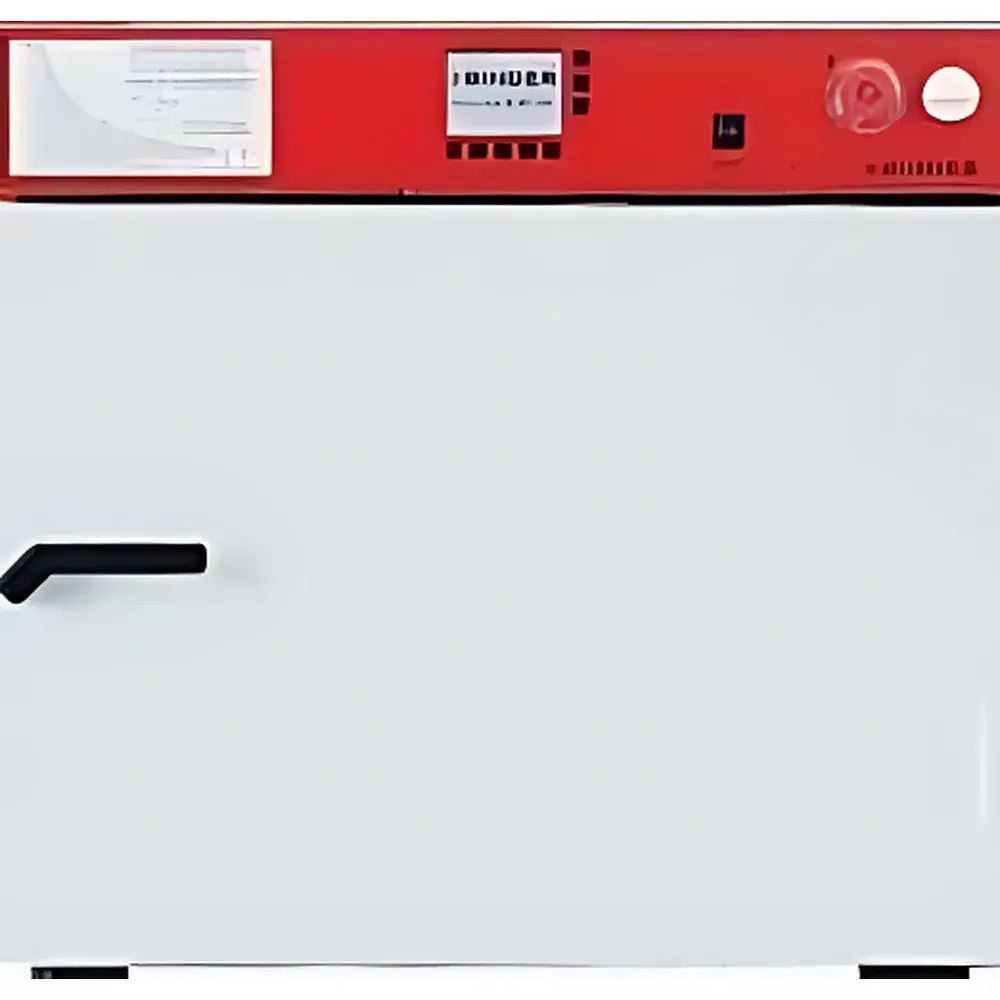
Binder BD/BF Series Precision Incubators
| Brand | BINDER |
|---|---|
| Origin | Germany |
| Model | BD/BF |
| Temperature Range | +5 °C to 99.9 °C (above ambient) |
| Control Accuracy | ±0.1 °C |
| Temperature Uniformity | ≤±0.3 °C (at 37 °C, empty chamber) |
| Heating System | APT-Line® preheating chamber technology |
| Safety Class | DIN 12880 Class 3.1 |
| Timer | 0–99 h 59 min |
| Display | LED, microprocessor-based PID controller |
| Communication Interface | RS422 (compatible with APT-COM software) |
| Sterilization Capability | Dry-heat decontamination at 99 °C |
| Interior Door | Tempered glass, smooth surface |
| Air Circulation | Forced convection (BF series) |
| Compliance | CE, ISO 13485 (for medical device manufacturing environments), GLP-ready architecture |
Overview
The BINDER BD/BF Series Precision Incubators are engineered for laboratories requiring stringent thermal stability, repeatability, and contamination control in cell culture, microbiological growth, enzyme assays, and stability testing. These incubators operate on the principle of precise air temperature regulation within a thermally insulated chamber, utilizing BINDER’s proprietary APT-Line® preheating chamber technology—a patented design where the entire inner chamber wall is actively heated and controlled independently from the main heating elements. This architecture eliminates cold spots, minimizes thermal gradients, and ensures rapid, uniform heat distribution across the working volume. Unlike conventional incubators relying solely on top- or bottom-mounted heaters, the APT-Line® system maintains spatial temperature uniformity ≤±0.3 °C (measured at 37 °C, empty chamber), meeting critical requirements for ISO/IEC 17025-accredited testing labs and GMP-compliant bioprocessing workflows.
Key Features
- APT-Line® preheating chamber technology for superior temperature homogeneity and reduced recovery time after door opening
- Microprocessor-based PID controller with LED display, offering setpoint resolution of 0.1 °C and real-time deviation monitoring
- DIN 12880 Class 3.1 independent safety thermostat—hardware-redundant, fail-safe temperature limitation preventing overheating under fault conditions
- RS422 serial interface enabling bidirectional communication with APT-COM software for remote parameter setting, data logging, and audit-trail generation
- Smooth-surface tempered glass inner door facilitating visual inspection without compromising thermal integrity or introducing particulate contamination
- Dry-heat decontamination protocol validated up to 99 °C—fully compliant with ISO 14644-1 Class 5 cleanroom maintenance protocols and suitable for depyrogenation of non-critical labware
- Forced-convection airflow (BF series) optimized for high-throughput applications requiring <10-minute temperature recovery after 30-second door opening at 37 °C
Sample Compatibility & Compliance
The BD/BF incubators accommodate standard tissue culture flasks (T-25 to T-225), Petri dishes (up to 150 mm), multiwell plates (6–96-well), and roller bottles. Their stainless-steel interior (electropolished AISI 304), seamless corners, and absence of internal seams prevent microbial harborage—supporting routine cleaning per USP Analytical Instrument Qualification guidelines. The systems are CE-marked and designed to support compliance with ISO 13485:2016 (medical device quality management), FDA 21 CFR Part 11 (when used with validated APT-COM configurations), and EU Annex 11 (computerized system validation). Optional IQ/OQ documentation packages are available for GLP and GMP-regulated environments.
Software & Data Management
APT-COM software provides full lifecycle instrument control—including ramp/soak profiles, alarm history export (CSV), and electronic signature support for 21 CFR Part 11 compliance. All temperature events—setpoint changes, deviations >±0.5 °C, door-open duration, and safety thermostat activation—are timestamped and stored locally with configurable retention (up to 30 days). Data export supports integration into LIMS platforms via standardized .csv or .xml formats. Audit trails are immutable and include user ID, action type, and system clock synchronization traceability.
Applications
- Mammalian and insect cell line propagation under tightly controlled CO₂-free conditions
- Bacterial and fungal culture for pharmaceutical raw material testing (USP , )
- Stability studies per ICH Q1A(R2) guidelines (long-term, accelerated, intermediate conditions)
- Enzyme kinetics assays requiring sub-degree thermal stability over extended durations
- Seed germination and plant tissue culture in academic and agricultural research
- Quality assurance of diagnostic reagents and monoclonal antibody production intermediates
FAQ
What is the difference between BD and BF series?
The BD series uses natural convection for gentle, low-turbulence environments ideal for suspension cultures or sensitive primary cells. The BF series employs forced convection with adjustable fan speed, delivering faster temperature equilibration and higher throughput—particularly suited for stacked plate formats and automated incubator-integrated workflows.
Is dry-heat sterilization at 99 °C sufficient for mycological decontamination?
Yes—99 °C for ≥30 minutes achieves ≥6-log reduction of Aspergillus niger spores per ISO 14644-1 Annex B. Validation reports are available upon request.
Can the incubator be integrated into a central monitoring system?
Yes—via RS422-to-Ethernet gateways or Modbus TCP adapters, enabling real-time status polling and alarm forwarding to SCADA or building management systems.
Does BINDER provide installation qualification (IQ) documentation?
Yes—factory-verified IQ templates aligned with ASTM E2500-13 and GAMP5 principles are included with each unit; site-specific OQ/PQ support is available through certified service partners.
Related Products