
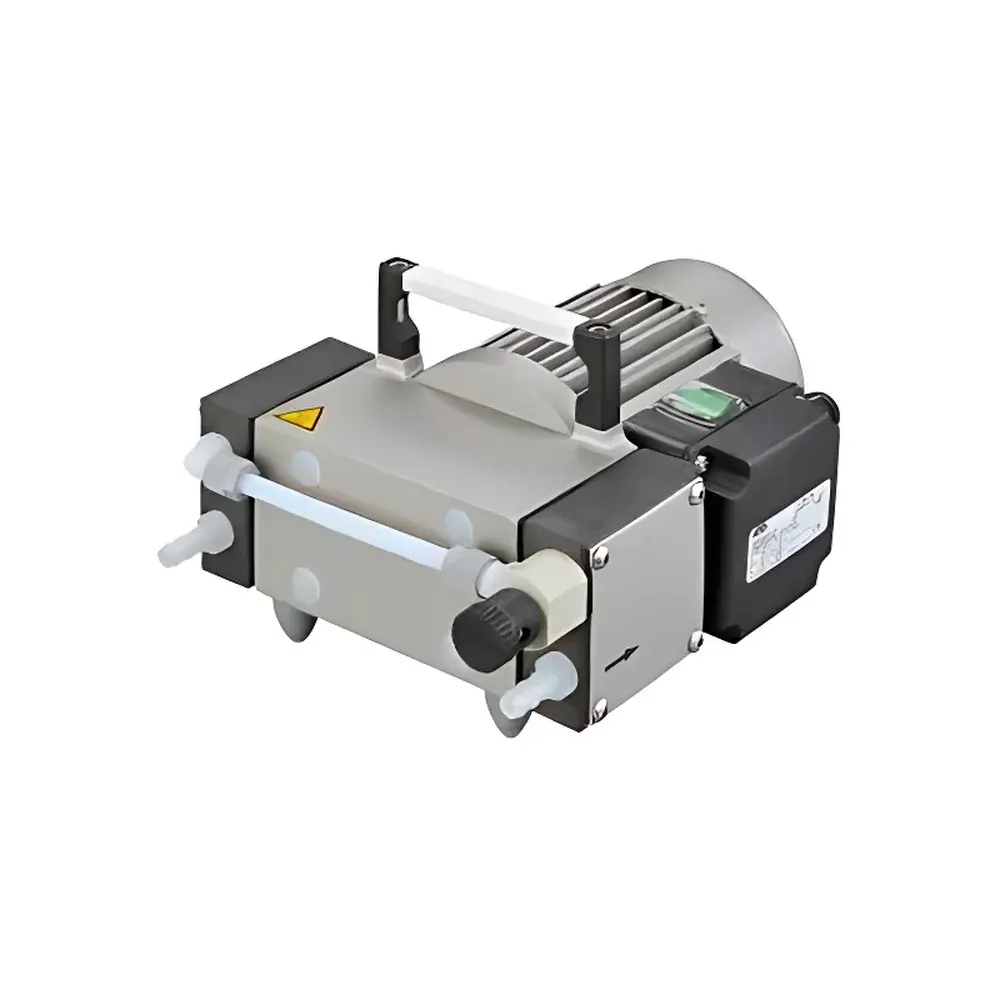
ILMVAC MPC101Z Chemically Resistant Two-Stage Diaphragm Vacuum Pump (< 8 mbar)
| Origin | Germany |
|---|---|
| Manufacturer Type | Authorized Distributor |
| Origin Category | Imported |
| Model | MPC101Z |
| Final Vacuum Pressure | < 8 mbar |
| Suction Speed | 1.0 m³/h (16.7 L/min) |
| Weight | 6.5 kg |
| Voltage | 220 V AC |
| Construction | PTFE-coated & carbon-fiber-reinforced wetted parts |
| Diaphragm | Multi-layer (sandwich-structured) elastomeric diaphragm |
Overview
The ILMVAC MPC101Z is a two-stage, oil-free diaphragm vacuum pump engineered for precision laboratory and pilot-scale applications requiring chemically inert, dry vacuum generation. Operating on positive displacement principles, it achieves ultimate vacuum pressures below 8 mbar (absolute) through sequential compression stages—each featuring a reinforced elastomeric diaphragm actuated by an eccentric cam mechanism. Unlike rotary vane or scroll pumps, the MPC101Z eliminates lubricants, condensable vapors, and hydrocarbon backstreaming risks, making it inherently suitable for corrosive gas handling, solvent-laden vapors, and moisture-sensitive processes. Its design adheres to fundamental vacuum engineering principles: volumetric efficiency is maintained across variable inlet pressures via optimized chamber geometry and low-compliance diaphragm dynamics; thermal stability is ensured by passive air cooling and thermally isolated motor housing. This pump is not intended for high-vacuum applications (< 0.1 mbar), but excels in rough vacuum regimes (1–100 mbar) where chemical compatibility, operational reliability, and regulatory compliance are paramount.
Key Features
- Chemically inert wetted path: All gas-contact surfaces—including pump head, valves, diaphragms, and inlet/outlet ports—are fully coated with polytetrafluoroethylene (PTFE) and structurally reinforced with carbon fiber composite layers, providing resistance to aggressive solvents (e.g., acetone, chloroform, concentrated acids/bases), halogenated compounds, and oxidizing agents.
- Two-stage diaphragm architecture: Enables deeper ultimate vacuum (< 8 mbar) and higher volumetric throughput (1.0 m³/h at ambient conditions) compared to single-stage equivalents, while maintaining low pulsation and stable flow profiles under variable load.
- Sandwich-structured diaphragm: Composed of alternating layers of fluorocarbon elastomer and high-tensile carbon-fiber mesh, delivering enhanced fatigue resistance (> 10,000 h MTBF under continuous duty), reduced permeation, and consistent stroke linearity over extended service life.
- Dry, oil-free operation: Eliminates need for oil changes, vapor traps, or exhaust filtration—reducing maintenance intervals and enabling direct connection to sensitive instrumentation (e.g., mass spectrometers, residual gas analyzers) without risk of contamination.
- Compact and lightweight design: Weighing only 6.5 kg with integrated vibration-damping feet and IP54-rated enclosure, the MPC101Z fits seamlessly into fume hoods, gloveboxes, and modular lab benches without structural reinforcement.
- 220 V AC input with thermal overload protection: Compliant with IEC 61000-3-2 harmonic emission standards and equipped with automatic shutdown at >70 °C motor winding temperature.
Sample Compatibility & Compliance
The MPC101Z is validated for use with organic solvents (including esters, ketones, ethers), aqueous acidic/basic solutions (pH 1–14), and reactive gases (Cl₂, SO₂, H₂S) when operated within its specified pressure and temperature envelope (5–40 °C ambient). It meets ISO 8573-1 Class 0 air purity requirements for oil-free operation and conforms to EU Directive 2014/30/EU (EMC) and 2014/35/EU (LVD). While not certified for ATEX Zone 1/2 use, its non-sparking motor and static-dissipative housing (surface resistivity < 10⁹ Ω) support safe deployment in controlled laboratory environments per NFPA 45 and DIN EN 14470-1 guidelines. No internal lubricants or seals require replacement during routine GLP/GMP audits; full traceability of PTFE batch certification is available upon request.
Software & Data Management
The MPC101Z operates as a standalone analog device with no embedded firmware or digital interface. However, its stable pressure output and linear speed response enable seamless integration with third-party vacuum controllers (e.g., MKS 925, Pfeiffer TPG300) via 0–10 V analog input/output signals. For automated process logging, it supports connection to LabVIEW™, MATLAB®, or Python-based SCADA systems using standard RS-485 (Modbus RTU) adapters (sold separately). All operational parameters—including runtime hours, thermal cycles, and pressure setpoint deviations—can be archived in CSV or SQL formats compliant with FDA 21 CFR Part 11 audit trail requirements when paired with validated data acquisition hardware.
Applications
- Vacuum distillation of heat-sensitive compounds (e.g., essential oils, pharmaceutical intermediates) where thermal degradation or solvent residue must be avoided.
- Continuous evacuation of jacketed reactors and autoclaves during exothermic synthesis, ensuring consistent pressure control without introducing reactive contaminants.
- High-throughput vacuum filtration of aggressive slurries (e.g., metal oxide precipitates in nitric acid media) with minimal filter clogging or pump corrosion.
- Gentle solvent removal in rotary evaporation systems handling chlorinated or fluorinated solvents, preserving condenser integrity and cold trap performance.
- Controlled dehydration of hygroscopic APIs and biologics in vacuum ovens, meeting ICH Q5C stability protocol requirements for residual moisture analysis.
FAQ
What is the maximum allowable inlet vapor concentration for continuous operation?
The MPC101Z is rated for up to 30% by volume saturated solvent vapor (e.g., ethanol, ethyl acetate) at 20 °C; condensable loads exceeding this threshold require upstream chilled traps or scrubbers.
Can the pump be mounted vertically or inverted?
No—only horizontal orientation with base-mounted feet is permitted to ensure proper diaphragm alignment and valve seating; deviation exceeds mechanical tolerance limits and voids warranty.
Is calibration required before first use?
No factory calibration is needed; however, users must verify ultimate pressure with a traceable capacitance manometer (e.g., MKS Baratron® 626A) prior to GLP-critical applications.
How often should the diaphragm be replaced under typical lab usage?
Under continuous operation (8 h/day, 5 days/week), diaphragm replacement is recommended every 18–24 months or after 6,000 operating hours—whichever occurs first—as determined by visual inspection for microcracking or loss of elasticity.
Does the pump meet USP & EP requirements for pharmaceutical vacuum processes?
Yes—when operated within validated parameters and maintained per ILMVAC’s documented SOP-VP-01, it satisfies USP Analytical Instrument Qualification and EP 2.6.27 Vacuum System Validation criteria for non-sterile manufacturing environments.



