
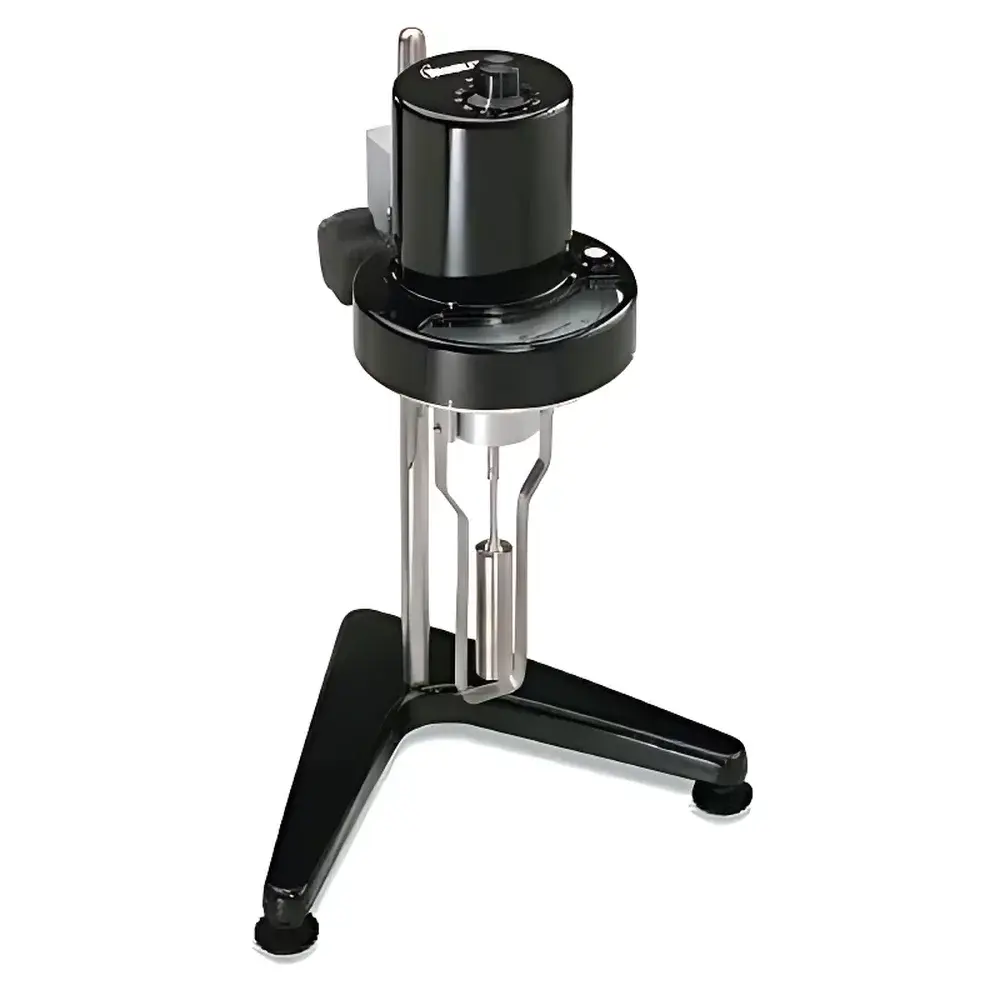
Brookfield HBT Dial-Reading Viscometer
| Brand | Brookfield |
|---|---|
| Origin | USA |
| Model | HBT |
| Accuracy | ±1.0% of full-scale range |
| Repeatability | ±0.2% |
| Viscosity Range | 800–64,000,000 cP |
| Speed Range | 0.5–100 rpm |
| Display Type | Analog dial (torque %), convertible to centipoise (cP) |
| Motor | Low-noise, high-reliability brushed DC motor |
| Explosion-Proof Option | Available for UL Class 1, Group D hazardous locations (motorless configuration) |
| Standard Accessories | Instrument body, spindle set (LV/ RV/HB series compatible), support stand, protective foot, carrying case |
Overview
The Brookfield HBT Dial-Reading Viscometer is a legacy-class mechanical viscometer engineered for robust, repeatable viscosity measurement in industrial quality control and routine laboratory environments. Based on the Couette principle—where torque required to rotate a spindle at constant speed within a fluid is directly proportional to its dynamic viscosity—the HBT delivers analog torque readings (% scale) that are linearly convertible to centipoise (cP) using standardized calibration factors. As one of the longest-produced rotational viscometers in the Brookfield product line, the HBT maintains mechanical simplicity without sacrificing metrological integrity. Its fully analog architecture eliminates dependency on digital electronics or firmware, making it intrinsically suitable for environments with electromagnetic interference (EMI), high humidity, or stringent validation requirements where software-based instruments may introduce audit complexity. Designed for fixed-speed operation across 18 discrete speeds (0.5–100 rpm), the HBT provides deterministic, operator-independent measurements traceable to NIST-certified standard oils.
Key Features
- Mechanically driven analog dial display showing real-time torque percentage—enabling immediate visual assessment of fluid resistance without power-dependent electronics
- High-stability brushed DC motor delivering consistent rotational speed across all 18 calibrated settings (0.5, 1, 2, 2.5, 4, 5, 10, 20, 30, 50, 60, 75, 100 rpm and intermediate values)
- ±1.0% full-scale accuracy and ±0.2% repeatability—validated per ASTM D2196 and ISO 2555 procedures using certified reference fluids
- Modular spindle compatibility with Brookfield’s full LV, RV, and HB series—supporting viscosity measurement from 800 cP up to 64 million cP depending on spindle geometry and speed selection
- Optional motorless configuration certified for UL Class 1, Group D hazardous locations—ideal for solvent-based coatings, petrochemical intermediates, and pharmaceutical suspensions requiring intrinsic safety compliance
- Integrated mechanical damping system minimizes oscillation during startup and speed transitions, ensuring stable torque equilibrium within <3 seconds
- Field-serviceable design with accessible gear train and calibrated spring assembly—supporting in-house maintenance and periodic verification per GLP guidelines
Sample Compatibility & Compliance
The HBT accommodates Newtonian and mildly non-Newtonian fluids in batch mode, including paints, adhesives, polymer melts, food emulsions, and ceramic slurries. Sample volume requirements range from 20 mL (with UL adapter) to 500 mL (in standard 600-mL sample cup). All contact surfaces comply with FDA 21 CFR 177.2600 for indirect food contact. The instrument meets CE marking requirements under the EU Machinery Directive 2006/42/EC and Electromagnetic Compatibility Directive 2014/30/EU. Calibration documentation supports IQ/OQ protocols aligned with ISO/IEC 17025-accredited laboratories. Traceable calibration certificates (NIST-traceable oils, certificate # included) are available upon request for GMP-regulated environments.
Software & Data Management
As an analog-only instrument, the HBT does not incorporate embedded software, firmware, or data logging capabilities—eliminating concerns related to 21 CFR Part 11 electronic record integrity, cybersecurity vulnerabilities, or software validation overhead. Torque % readings are manually recorded or transcribed into LIMS or ELN systems via standardized templates. Optional analog-to-digital converters (e.g., Brookfield DIGI-LOG interface) enable analog output (0–10 VDC or 4–20 mA) for integration into PLC-controlled process monitoring loops—retaining regulatory compliance through hardware-based signal conditioning without software intervention.
Applications
- QC release testing of architectural coatings and industrial primers per ASTM D1084 and ISO 2555
- In-process monitoring of hot-melt adhesives during extrusion and coating operations
- Batch consistency verification of pharmaceutical ointments and topical gels under USP <911>
- Viscosity grading of bituminous binders in asphalt production (AASHTO T202)
- Educational demonstrations of rheological fundamentals in undergraduate materials science labs
- Baseline characterization of shear-thinning behavior in drilling muds prior to advanced rheometry
FAQ
Is the HBT compliant with FDA 21 CFR Part 11?
No—because it contains no electronic records or signatures, the HBT falls outside the scope of 21 CFR Part 11. Its analog output satisfies ALCOA+ principles (Attributable, Legible, Contemporaneous, Original, Accurate) when manual entries are made in bound logbooks with witness signatures.
Can I use modern Brookfield spindles with the HBT?
Yes—the HBT accepts all current-generation LV, RV, and HB spindles (e.g., LV-1 through LV-4, RV-1 through RV-7, HB-1 through HB-3) via standardized threaded connection (1/8″ NPT).
What is the recommended recalibration interval?
Brookfield recommends annual verification using certified reference oils; however, frequency should be risk-assessed per ISO/IEC 17025 Clause 6.5.2 based on usage intensity, environmental conditions, and criticality of measurement outcomes.



