
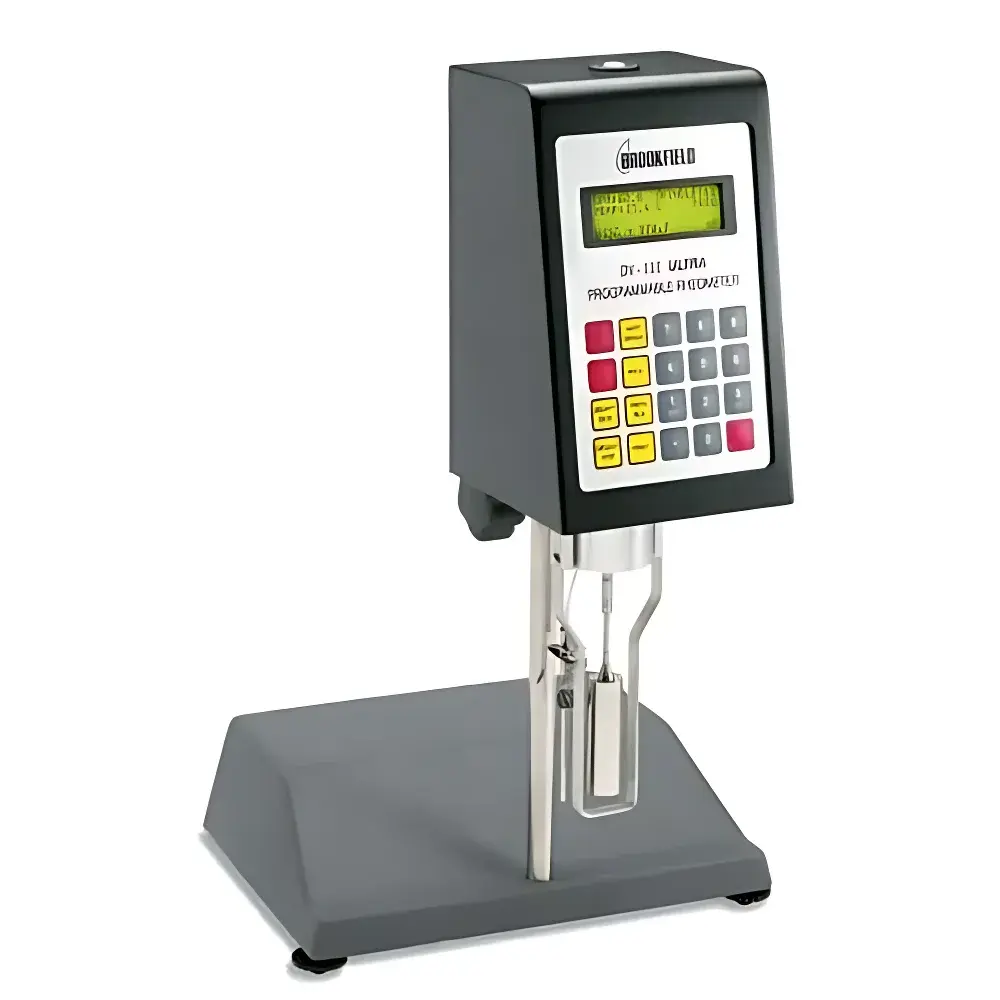
Brookfield LVDV-III Ultra Advanced Programmable Rheometer
| Brand | Brookfield |
|---|---|
| Origin | USA |
| Model | LVDV-III Ultra |
| Viscosity Range | 100–40,000,000 cP |
| Speed Range | 0.01–250 rpm |
| Accuracy | ±1% of reading |
| Repeatability | ±0.2% |
| Temperature Sensing | Integrated RTD probe (optional) |
| Control Modes | Standalone with built-in display & keypad + PC-controlled via RheoCalc32 software |
| Mathematical Modeling | Onboard yield stress and flow curve analysis (Bingham, Herschel-Bulkley, Casson, Power Law) |
| Included Accessories | Instrument base, support stand, protective legs, standard spindle set, RheoLoader utility, RheoCalc32 software, EZ-Yield software, RTD temperature probe |
Overview
The Brookfield LVDV-III Ultra is a high-precision, microprocessor-controlled rotational rheometer engineered for comprehensive viscoelastic characterization of complex fluids under controlled shear conditions. Operating on the principle of Couette flow—where torque is measured as a function of angular velocity applied to a rotating spindle immersed in the sample—the instrument delivers quantitative rheological data essential for product development, quality control, and process optimization in industries including coatings, adhesives, pharmaceuticals, food, and personal care. Its dual-mode architecture supports both autonomous operation via an integrated graphical LCD interface and full PC-based control, enabling seamless transition between lab-floor usability and regulated data environments. Designed to meet the functional demands of ISO 2555, ASTM D2196, and USP methodologies, the LVDV-III Ultra provides traceable, reproducible measurements across six decades of viscosity (100–40 × 10⁶ cP), making it suitable for low-shear yield stress evaluation and high-shear flow behavior assessment.
Key Features
- Full standalone functionality: Real-time torque, speed, viscosity, and temperature monitoring with programmable test sequences directly from the front-panel interface.
- Ultra-wide speed range: 0.01–250 rpm in 0.01 rpm increments, supporting precise low-shear rate profiling critical for yield stress determination and thixotropic recovery studies.
- Onboard mathematical modeling: Built-in algorithms for Bingham plastic, Herschel-Bulkley, Casson, and Power Law regression—enabling immediate calculation of yield stress, consistency index, and flow behavior index without external software.
- High-resolution torque transduction: Electromagnetic damping system ensures stable readings with ±1% accuracy over full scale and ±0.2% repeatability under identical experimental conditions.
- Dual-control architecture: Seamless integration with RheoCalc32 software for automated method scripting, multi-step ramp tests, real-time graphing, and audit-trail-compliant data export (CSV, XLSX, PDF).
- Modular accessory compatibility: Supports all Brookfield LV-series spindles, thermally regulated jacketed vessels (with optional Peltier or water-circulated systems), and RTD temperature probes meeting ASTM E74 and ISO/IEC 17025 calibration traceability requirements.
Sample Compatibility & Compliance
The LVDV-III Ultra accommodates Newtonian and non-Newtonian liquids—including gels, pastes, suspensions, emulsions, and polymer melts—using geometry-optimized spindles (e.g., LV-1 to LV-4, helipath, vane, and cone-plate variants). Sample volume requirements range from 2 mL (for small-volume spindles) to >500 mL (for large-diameter cylindrical geometries), ensuring flexibility across R&D and QC workflows. The system complies with key regulatory frameworks for analytical instrumentation: data integrity features in RheoCalc32 support FDA 21 CFR Part 11 compliance when configured with electronic signatures and audit trails; instrument calibration protocols align with ISO/IEC 17025 and GLP documentation standards; and viscosity measurement procedures conform to ASTM D1200 (Ford cup), D2196 (non-Newtonian fluids), and ISO 2555 (single-point rotational methods).
Software & Data Management
RheoCalc32 serves as the primary PC interface, offering method-driven test automation, dynamic curve fitting, comparative overlay analysis, and customizable reporting templates. It enables synchronized acquisition of viscosity, shear rate, shear stress, temperature, and time-series parameters—critical for constructing flow curves, hysteresis loops, and time-dependent recovery profiles. The included EZ-Yield module implements standardized yield stress protocols (e.g., stress ramp, oscillatory amplitude sweeps, and creep-recovery sequences) with automatic endpoint detection per ASTM D8097. All raw and processed data are stored in encrypted project files with metadata tagging (operator ID, timestamp, environmental conditions), supporting version-controlled archiving and retrospective analysis in GxP-regulated laboratories.
Applications
- Coatings & Inks: Quantification of sag resistance, leveling behavior, and spray atomization thresholds via controlled-shear viscosity profiling.
- Pharmaceuticals: Gel strength validation, ointment extrudability testing, and suspension stability assessment under simulated dosing shear rates.
- Foods: Texture prediction of dairy products, sauces, and plant-based alternatives through yield stress mapping and thixotropic loop analysis.
- Adhesives & Sealants: Characterization of open time, bond formation kinetics, and pressure-sensitive tack under variable shear histories.
- Personal Care: Formulation optimization of shampoos, conditioners, and creams using shear-thinning indices and recovery half-times.
FAQ
Can the LVDV-III Ultra perform oscillatory rheology?
No—this is a steady-state rotational rheometer optimized for shear-rate-controlled viscosity and yield stress measurements. Oscillatory capability requires a dedicated controlled-stress or controlled-strain rheometer (e.g., Brookfield DV3TR or AMETEK’s Rheometrics series).
Is temperature control integrated into the base unit?
The LVDV-III Ultra includes an RTD temperature probe input but does not feature built-in thermal regulation. External temperature control is achieved via compatible jacketed sample cups and circulating baths or Peltier accessories.
How is calibration verified for regulatory submissions?
Calibration is performed using NIST-traceable silicone oil standards across multiple viscosity points; certificates include uncertainty budgets per ISO/IEC 17025 and may be generated within RheoCalc32’s calibration management module.
What spindle geometries are supported out-of-the-box?
The standard configuration includes LV-1 through LV-4 spindles; additional geometries (vane, helipath, T-bar, cone-plate) are available as optional accessories and require corresponding software license activation.
Does the instrument support 21 CFR Part 11 compliance?
Yes—when deployed with RheoCalc32 v3.2+ and configured with user access controls, electronic signatures, and audit trail logging, the system meets foundational requirements for electronic records and signatures in FDA-regulated environments.



