
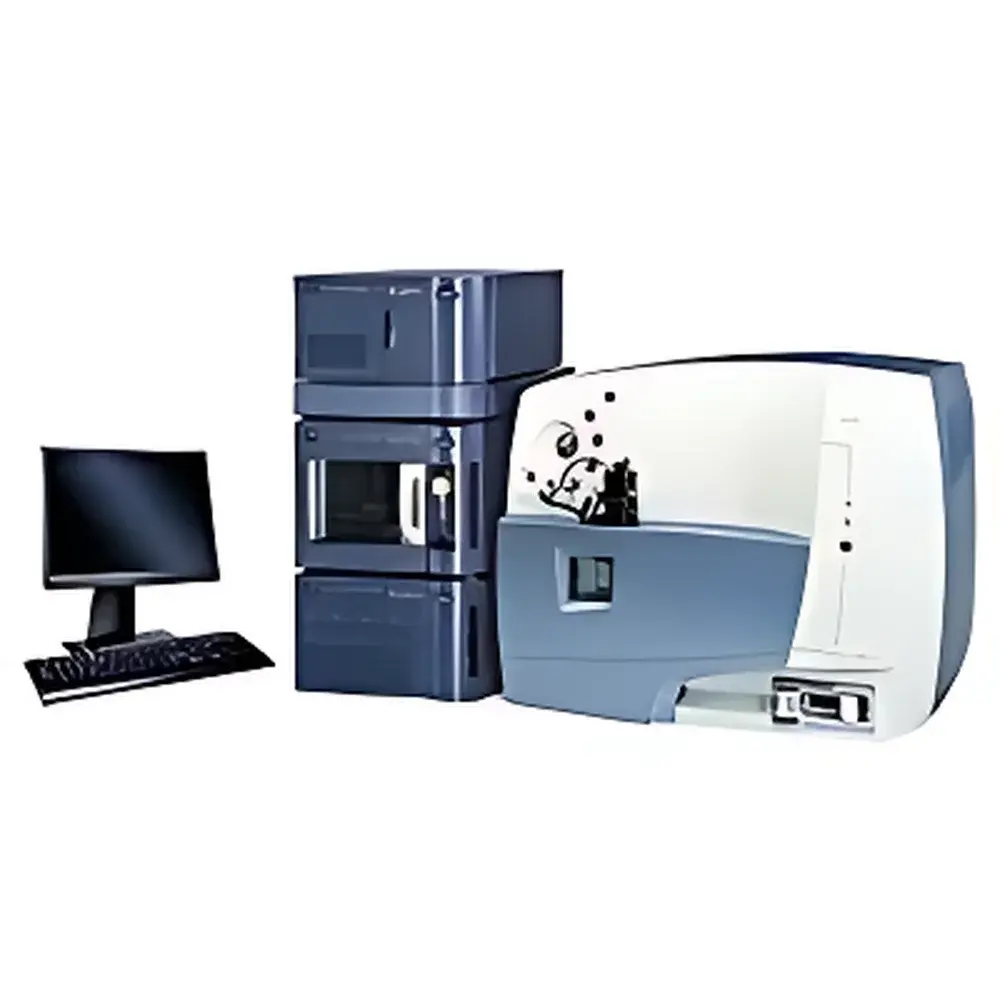
Waters Quattro Micro Triple Quadrupole Mass Spectrometer
| Brand | Waters |
|---|---|
| Origin | USA |
| Manufacturer Type | Authorized Distributor |
| Import Status | Imported |
| Model | Quattro Micro |
| Pricing | Available Upon Request |
Overview
The Waters Quattro Micro is a compact, high-performance benchtop triple quadrupole mass spectrometer (TQMS) engineered for robust quantitative and qualitative analysis in regulated and research laboratory environments. Based on collision-induced dissociation (CID) within a tandem quadrupole architecture—where Q1 selects precursor ions, Q2 acts as a collision cell, and Q3 analyzes product ions—the system delivers exceptional selectivity and sensitivity for targeted compound detection. Its design integrates decades of Waters’ mass spectrometry expertise with optimized ion optics, vacuum architecture, and detector electronics to achieve high reproducibility across diverse sample matrices. The instrument is purpose-built for liquid chromatography–mass spectrometry (LC-MS/MS) workflows and supports seamless integration with Waters Alliance and ACQUITY UPLC systems, enabling precise retention time alignment and method transferability.
Key Features
- Compact benchtop footprint with enhanced analytical throughput—optimized for laboratories with space constraints without compromising performance.
- Triple quadrupole configuration enabling multiple reaction monitoring (MRM), precursor ion scanning, neutral loss scanning, and product ion scanning modes.
- Z-Spray™ interface technology—a patented orthogonal electrospray ionization (ESI) source geometry that decouples droplet desolvation from ion transmission, delivering superior sensitivity and stability across volatile and non-volatile mobile phases (including ammonium acetate, ammonium formate, and phosphate buffers).
- Electron multiplier detector with extended dynamic range and low-noise amplification for reliable signal detection at sub-picomolar levels.
- Embedded PC Acquisition System (EPCAS) enabling real-time data acquisition at up to 5000 amu/s scan speed, supporting rapid polarity switching and high-density MRM transitions.
- Modular ion source compatibility: ESI, APCI, and ESCi™ (electrospray combined with atmospheric pressure chemical ionization) sources are interchangeable without hardware modification or venting the vacuum system.
Sample Compatibility & Compliance
The Quattro Micro demonstrates broad compatibility with thermally labile, polar, and high-molecular-weight analytes—including pharmaceuticals, metabolites, peptides, pesticides, environmental contaminants, and neonatal screening biomarkers. Its Z-Spray interface maintains stable ion signal under high-flow HPLC conditions (up to 1 mL/min) and tolerates >0.1% formic acid or 10 mM ammonium acetate without suppression artifacts. From a regulatory standpoint, the system supports GLP/GMP-compliant operation when deployed with MassLynx software configured for 21 CFR Part 11 compliance—including electronic signatures, audit trails, and secure user access controls. Method validation parameters align with ICH Q2(R2), USP , and ASTM D7622-19 guidelines for LC-MS/MS quantitation.
Software & Data Management
Control, acquisition, and processing are fully managed by MassLynx™ Software (v4.x), a validated platform developed over two decades for small-molecule MS/MS applications. MassLynx provides intuitive method setup for MRM optimization, automatic peak integration, calibration curve generation (linear/log-linear with weighting), and report export in PDF, CSV, and XML formats. Raw data files (.raw) are stored in a structured, vendor-neutral directory hierarchy with embedded metadata (instrument parameters, sequence logs, calibration history). Audit trail functionality records all user actions—including method edits, data reprocessing, and report generation—with timestamps and operator IDs, satisfying FDA and EMA data integrity requirements.
Applications
The Quattro Micro is routinely deployed in pharmaceutical quality control (QC) for impurity profiling and stability-indicating assays; clinical toxicology labs for therapeutic drug monitoring (e.g., immunosuppressants, antiepileptics); environmental testing laboratories for pesticide residue analysis per EPA Method 1694; food safety programs targeting mycotoxins and veterinary drug residues; and newborn screening programs detecting amino acid and acylcarnitine profiles in dried blood spots. Its sensitivity and specificity make it particularly suited for low-abundance endogenous compounds in complex biological matrices—such as plasma, urine, tissue homogenates, and cell lysates—without requiring extensive sample cleanup.
FAQ
What mass range does the Quattro Micro support in both MS1 and MS2 modes?
The instrument operates from m/z 20 to 2000 in both quadrupole stages.
Is the system compatible with non-volatile mobile phase additives?
Yes—the Z-Spray interface enables robust operation with buffered aqueous phases containing up to 20 mM ammonium acetate or phosphate salts.
Does the Quattro Micro support polarity switching during a single LC run?
Yes—EPCAS allows rapid, user-defined polarity switching (positive/negative) within a single acquisition cycle, critical for multi-analyte methods.
What is the typical detection limit for reserpine using ESI in MRM mode?
At 10 pg on-column injection of reserpine (m/z 609 → 195), signal-to-noise ratio exceeds 20:1 under standard tuning conditions.
Can MassLynx software generate 21 CFR Part 11–compliant audit trails?
Yes—when properly configured with role-based access control, electronic signatures, and enabled audit logging, MassLynx meets core requirements for regulated environments.



