
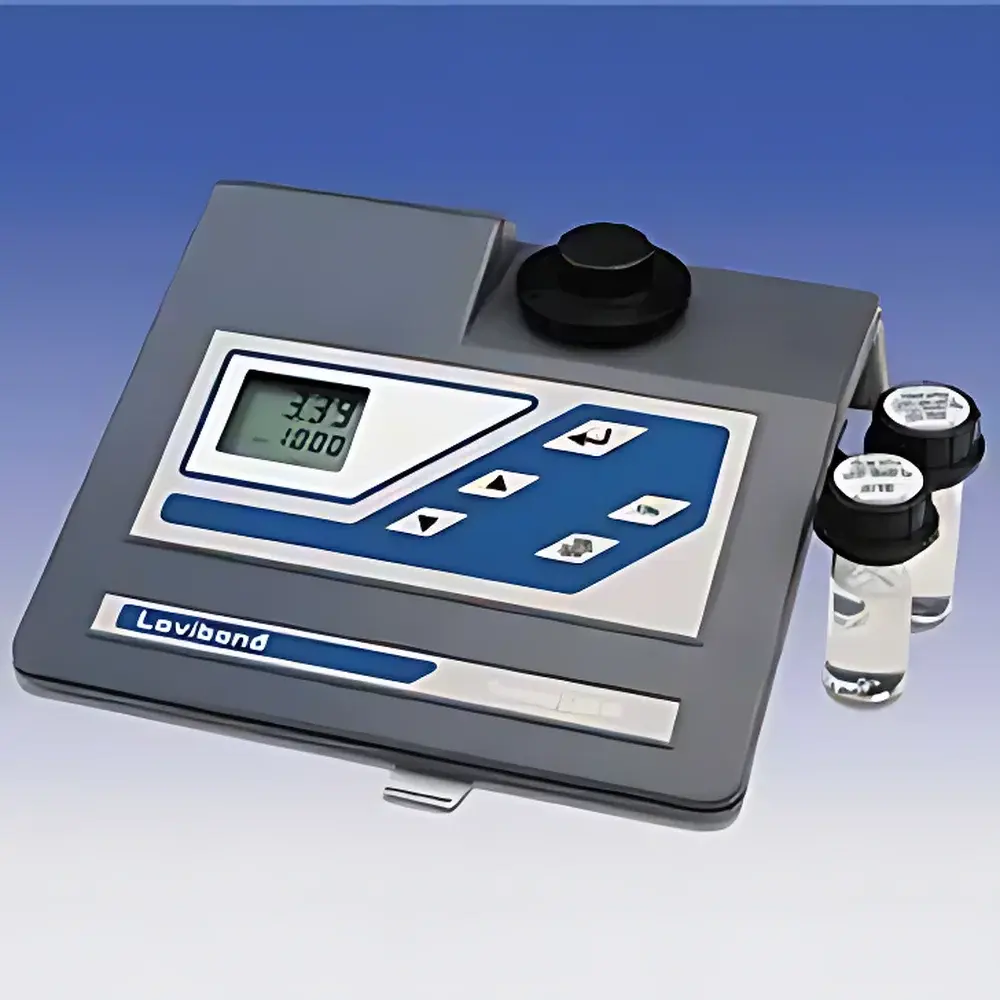
Lovibond ET93810 Advanced Microprocessor Turbidimeter
| Brand | Lovibond (Tintometer) |
|---|---|
| Origin | United Kingdom |
| Model | ET93810 |
| Measurement Standards | ISO 7027 (IR), US EPA Method 180.1 (WS) |
| Range | 0.01–1000 NTU |
| Resolution | 0.01 NTU (0–9.99), 0.1 NTU (10–99.9), 1 NTU (100–1000) |
| Accuracy | ±2% of reading ±0.01 NTU |
| Calibration | Automatic 3-point recognition (0.02, 10, 100, and 1000 NTU standards) |
| Response Time | 6 seconds |
| Sample Volume | 30 mL (min. 27 mL) |
| Light Source | Infrared LED (ISO mode) or Tungsten lamp (EPA mode) |
| Detector Configuration | 90° primary detector + auxiliary photodiode array for chromatic compensation |
| Data Interface | RS-232 |
| Power Supply | 100–240 VAC / 12 VDC |
| Dimensions | 273 × 254 × 95 mm |
| Weight | 1320 g |
| Environmental Operating Conditions | 0–50 °C, 30–90 % RH |
| Certifications | CE, UL, CSA, ISO 7027 compliant |
Overview
The Lovibond ET93810 Advanced Microprocessor Turbidimeter is a high-precision, dual-standard optical instrument engineered for rigorous laboratory and quality control environments where trace-level turbidity quantification is critical. It operates on the principle of nephelometric light scattering—measuring the intensity of light scattered at 90° relative to the incident beam—as defined in ISO 7027 (infrared LED source) and US EPA Method 180.1 (tungsten white-light source). This dual-mode capability enables method-specific compliance across global regulatory frameworks, including drinking water monitoring (EPA), pharmaceutical water testing (USP , Ph. Eur. 2.2.1), and industrial process water validation. Its optimized optical path incorporates a primary 90° detector paired with an auxiliary photodiode array that dynamically compensates for sample color interference—a key differentiator in applications involving yellowed or organically stained waters. The instrument’s microprocessor-controlled auto-ranging system ensures optimal signal-to-noise ratio across its full 0.01–1000 NTU span without manual range selection.
Key Features
- Dual-standard measurement engine supporting both ISO 7027 (850 nm IR LED) and US EPA Method 180.1 (tungsten broadband source), selectable via intuitive menu navigation.
- Automatic 3-point calibration recognition using certified Lovibond reference standards (0.02, 10, 100, and 1000 NTU), eliminating manual entry errors and ensuring traceable metrology.
- Intelligent cuvette detection: sensor-activated positioning confirmation triggers automatic gain adjustment and optimal photometric integration time.
- Chromatic interference correction: real-time background color compensation via auxiliary photodiode array enhances stability in colored samples (e.g., humic acid-rich surface waters or amber pharmaceutical process streams).
- Condensation-resistant cell chamber design allows direct dry-air purging of the sample cell—critical for low-NTU measurements where dew formation induces spurious scatter.
- Self-diagnostic firmware performs continuous internal verification of optical alignment, LED intensity, detector linearity, and power regulation prior to each measurement cycle.
- RS-232 serial interface supports GLP-compliant data export with embedded timestamps, operator ID fields (via optional software), and audit-trail-ready ASCII output for LIMS integration.
Sample Compatibility & Compliance
The ET93810 accommodates standard 25 mm round glass cuvettes (supplied as ET98551) and is compatible with all Lovibond-certified turbidity standards traceable to NIST SRM 2102. It meets the performance requirements of ISO 7027:2016, ASTM D6708, and EN ISO 7027-1:2016 for instrumental turbidimetry. In regulated environments—including pharmaceutical manufacturing (cGMP Annex 1), clinical diagnostics (CLIA), and municipal water utilities—the instrument satisfies data integrity expectations under FDA 21 CFR Part 11 when used with validated third-party data acquisition software. Its CE, UL, and CSA certifications confirm electrical safety and electromagnetic compatibility per IEC 61326-1. The device is routinely deployed in applications requiring adherence to WHO Guidelines for Drinking-water Quality, EU Directive 98/83/EC, and China’s GB/T 5750.4–2006.
Software & Data Management
While the ET93810 operates as a standalone benchtop instrument, its RS-232 port enables seamless connection to Windows-based PCs running Lovibond’s optional TurbSoft™ v3.x software (sold separately). This application provides automated report generation (PDF/CSV), statistical process control (SPC) charting, calibration log archiving with digital signatures, and electronic batch record linkage. All exported datasets include immutable metadata: measurement timestamp, instrument serial number, calibration status flag, selected standard (ISO/EPA), unit type (NTU/FNU/FAU/EBG), and raw analog-to-digital converter (ADC) counts—ensuring full traceability for internal audits or regulatory inspections. Data files are structured to comply with ALCOA+ principles (Attributable, Legible, Contemporaneous, Original, Accurate, Complete, Consistent, Enduring, Available).
Applications
- Drinking water treatment plants: routine monitoring of filtration efficiency and disinfection by-product precursor removal.
- Pharmaceutical water systems: qualification of Purified Water (PW) and Water for Injection (WFI) per USP and EU GMP Annex 1.
- Environmental laboratories: analysis of surface water, wastewater effluents, and sediment-laden runoff per EPA-approved protocols.
- Food & beverage QA/QC: verification of clarity in juices, brewing wort, bottled water, and dairy processing streams.
- Academic research: kinetic studies of coagulation-flocculation processes and nanoparticle dispersion stability.
- Chemical manufacturing: in-process control of polymer emulsions, catalyst suspensions, and colloidal formulations.
FAQ
Does the ET93810 support both ISO 7027 and US EPA Method 180.1 simultaneously?
Yes—the instrument allows user-selectable optical modes via firmware configuration. Switching between infrared (ISO) and tungsten (EPA) illumination requires no hardware modification.
Can calibration standards be reused indefinitely?
Lovibond’s certified formazin-free standards (0.02, 10, 100, and 1000 NTU) are chemically stable for ≥24 months when stored in amber glass vials at 2–8°C and protected from light; however, best practice recommends annual revalidation against primary NIST-traceable references.
Is the RS-232 interface compatible with modern USB-equipped computers?
Yes—standard USB-to-RS-232 adapters (FTDI chipset recommended) enable connectivity; TurbSoft™ includes driver support for Windows 10/11 and legacy Windows 7 systems.
What is the minimum detectable turbidity level under optimal conditions?
With clean optics, temperature-stabilized operation (25°C ±1°C), and zero-turbidity rinse water (filtered through 0.1 µm membrane), the practical limit of detection is 0.008 NTU (based on 3× RMS noise of repeated blank measurements).
Does the instrument meet FDA 21 CFR Part 11 requirements out-of-the-box?
The ET93810 itself is not Part 11–validated; however, when integrated with TurbSoft™ v3.x under a site-specific validation protocol—including electronic signature implementation, audit trail activation, and role-based access control—it fulfills core technical requirements for regulated data capture.






