
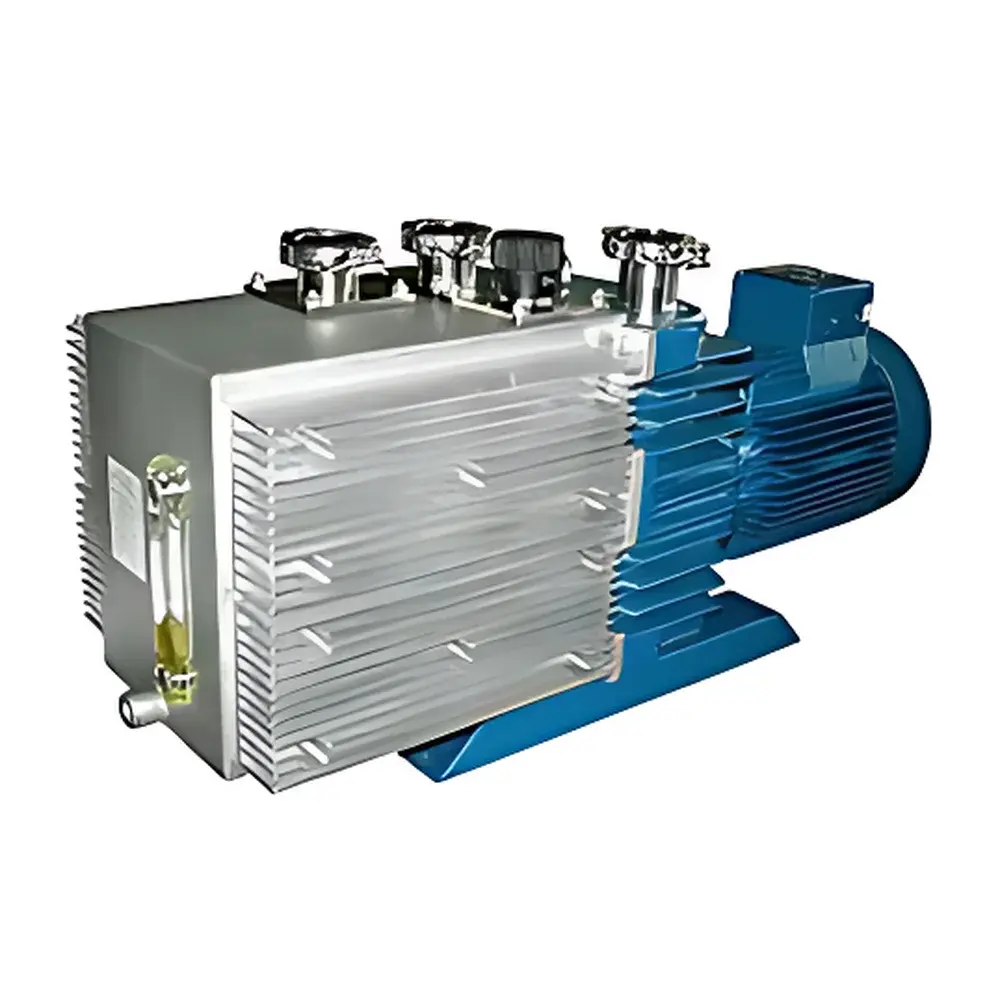
ILMVAC P 65 D Two-Stage Rotary Vane Vacuum Pump
| Origin | Germany |
|---|---|
| Manufacturer Type | Authorized Distributor |
| Origin Category | Imported |
| Model | P 65 D |
| Quotation | Upon Request |
| Ultimate Pressure | <3×10⁻³ mbar |
| Pumping Speed | 60.0 m³/h (1000 L/min) |
| Weight | 90.0 kg |
| Voltage | 220 V AC |
| Oil Sight Gauge | Integrated Linear Window |
| Gas Ballast Valve | Standard |
| Noise Level | ≤58 dB(A) |
| Motor Protection | IP54 |
| Oil Capacity | ~2.2 L |
Overview
The ILMVAC P 65 D is a two-stage rotary vane vacuum pump engineered for reliable, continuous operation in demanding laboratory and light industrial vacuum applications. Based on the proven Couette-flow principle of positive displacement, it achieves ultimate pressures below 3×10⁻³ mbar through sequential compression stages—first stage pre-compresses gas to intermediate pressure, while the second stage further compresses and exhausts it against atmospheric backpressure. Its robust cast-iron housing, precision-ground vanes, and optimized oil circulation system ensure long-term dimensional stability and minimal wear under sustained load. Designed and assembled in Germany, the P 65 D meets stringent CE and RoHS directives and is constructed to comply with ISO 8573-1 (compressed air purity) and ISO 21809-2 (vacuum system safety) reference frameworks.
Key Features
- Two-stage rotary vane architecture delivering high volumetric efficiency and stable ultimate vacuum performance
- Integrated linear oil-level sight gauge enabling real-time visual monitoring without disassembly
- Gas ballast valve standard-equipped for controlled admission of dry air during pumping of condensable vapors (e.g., water, solvents), preventing oil emulsification
- Oil-retention design prevents backstreaming upon shutdown—maintaining chamber integrity and eliminating need for isolation valves in many configurations
- Low-noise operation (<58 dB(A) at 1 m) achieved via balanced rotor dynamics, vibration-damped mounting, and acoustically insulated housing
- High resistance to water vapor and mild chemical vapors due to corrosion-inhibited internal coatings and mineral-based vacuum oil compatibility
- IP54-rated motor with thermal overload protection ensures safe operation in variable ambient conditions
- Compact footprint (L×W×H ≈ 620×320×410 mm) and integrated carrying handles facilitate repositioning within shared lab spaces
Sample Compatibility & Compliance
The P 65 D is compatible with standard KF-25/40 and ISO-KF flange interfaces and supports integration into vacuum systems handling non-aggressive, non-explosive gases and vapors. It is routinely deployed as a forepump for diffusion pumps, turbomolecular pumps, and cryogenic traps in analytical instrumentation (e.g., mass spectrometers, electron microscopes). The pump complies with EU Machinery Directive 2006/42/EC and Electromagnetic Compatibility Directive 2014/30/EU. Its oil management system adheres to ISO 21509:2016 guidelines for lubricant retention in vacuum equipment. While not intrinsically safe, it may be used in Class 1, Division 2 environments when installed per NEC Article 500 requirements and paired with appropriate vent filtration.
Software & Data Management
As a standalone mechanical vacuum source, the P 65 D operates without embedded firmware or digital control interfaces. However, its analog operational parameters—including inlet pressure (via optional Pirani or capacitance manometer), motor current draw, and oil temperature—are readily integrable into centralized lab monitoring systems (e.g., LabVIEW, Siemens Desigo, or DeltaV) via 4–20 mA or 0–10 V analog outputs (available with optional sensor kits). All maintenance logs—including oil change intervals, filter replacements, and vibration trend data—can be recorded in accordance with GLP Annex 11 and FDA 21 CFR Part 11 audit-trail requirements when entered into validated electronic lab notebooks (ELNs).
Applications
- Freeze-drying (lyophilization) of biological samples and pharmaceuticals
- Vacuum distillation and solvent recovery in organic synthesis workflows
- Membrane filtration under reduced pressure for particulate analysis and microbiological testing
- Leak detection via helium mass spectrometry (as backing pump)
- Thin-film deposition processes including thermal evaporation and sputtering
- Outgassing conditioning of ultra-high vacuum chambers prior to bake-out
- Support vacuum for gloveboxes, desiccators, and vacuum ovens in materials science labs
FAQ
What is the recommended oil change interval for continuous operation?
Under typical laboratory use (8 h/day, ambient temperature ≤30°C), oil replacement is advised every 3,000 operating hours or annually—whichever occurs first. Extended intervals require oil analysis per ASTM D6595.
Can the P 65 D be operated vertically or inverted?
No. It must be installed horizontally on a level, vibration-isolated surface per IEC 60034-14 to maintain oil distribution and vane lubrication integrity.
Is the pump suitable for pumping hydrogen or oxygen?
Hydrogen is permissible with strict adherence to ISO 21028-1:2018 explosion risk mitigation protocols; oxygen service requires specialized stainless-steel components and oxygen-clean assembly—not standard on the P 65 D.
Does it include an exhaust filter?
A standard activated carbon–impregnated oil mist filter is factory-fitted to minimize hydrocarbon emissions and meet ISO 8573-1 Class 4 particulate limits.
How does gas ballast affect ultimate pressure?
Engaging the gas ballast valve intentionally degrades ultimate pressure to ~1×10⁻² mbar but enables sustained pumping of saturated vapors without oil degradation—critical for freeze-dryer regeneration cycles.



