
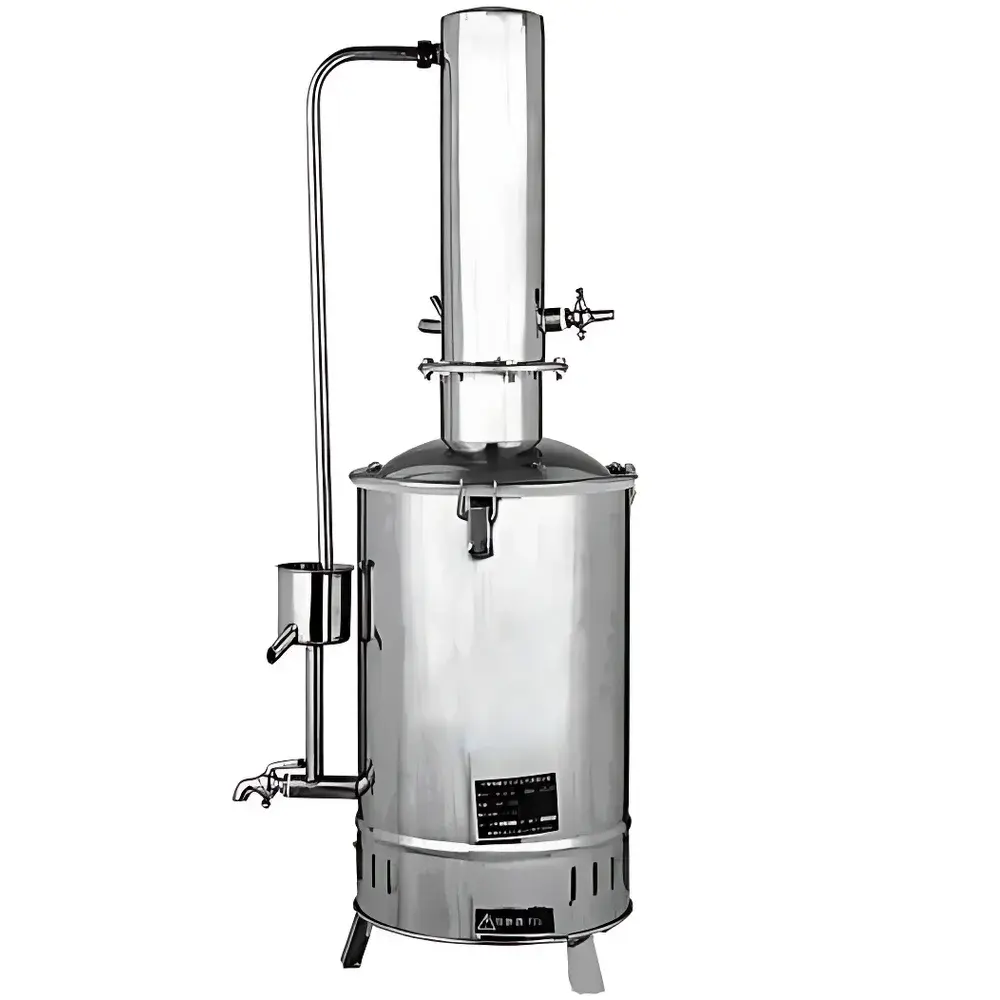
BenAng 20L/H Stainless Steel Electrically Heated Distillation Apparatus
| Brand | BenAng |
|---|---|
| Origin | Shanghai, China |
| Manufacturer Type | Authorized Distributor |
| Country of Origin | China |
| Model | 20L/H |
| Instrument Type | Sub-boiling Distiller |
| Output Capacity | 20 L/h |
| Heating Power | 13.5 kW |
| Supply Voltage | 380 V AC |
| Construction Material | 304 Stainless Steel |
| Cooling Method | Recirculating Water Condensation |
| Compliance | GB/T 6682–2008 (Laboratory Water Specifications), GB 4706.1–2005 (Household and Similar Electrical Appliances Safety) |
Overview
The BenAng 20L/H Stainless Steel Electrically Heated Distillation Apparatus is a laboratory-grade sub-boiling distiller engineered for continuous, reliable production of Type III purified water per GB/T 6682–2008 and ISO 3696:1987 standards. It operates on the principle of controlled electric resistance heating of municipal tap water within a stainless steel boiling chamber, followed by efficient vapor condensation via an integrated recirculating water-cooled condenser. Unlike flash or multi-stage systems, this unit employs single-pass, low-temperature evaporation—minimizing volatile organic compound (VOC) carryover and silica leaching—making it suitable for applications demanding consistent purity in routine analytical support, buffer preparation, glassware rinsing, and non-critical cell culture media formulation. Its robust 304 stainless steel construction ensures long-term resistance to chloride-induced pitting and thermal fatigue under sustained operation.
Key Features
- Stable 20 L/h distilled water output at rated power (13.5 kW), optimized for uninterrupted supply in medium-throughput labs.
- Full 304 stainless steel fabrication—including boiler chamber, condenser jacket, and collection vessel—ensuring compliance with corrosion resistance requirements for prolonged exposure to heated chlorinated feedwater.
- Hermetically sealed vapor path with precision-machined flange joints and high-temperature silicone gaskets, preventing steam leakage and maintaining thermal efficiency.
- Integrated water-level sensing and automatic dry-run protection circuitry to prevent heater element damage during low-feed conditions.
- Front-panel analog voltage meter and dual-pole isolation switch for operational monitoring and safety-compliant power disconnection.
- Modular design facilitating field serviceability: removable condenser assembly, accessible heating element housing, and tool-free drain valve.
Sample Compatibility & Compliance
This apparatus accepts standard municipal tap water (conductivity ≤ 500 µS/cm, residual chlorine ≤ 1.0 mg/L) as both feed and coolant source. It does not require pretreatment for typical urban water supplies but is incompatible with high-hardness (>200 ppm CaCO₃), high-iron (>0.3 ppm), or seawater-derived sources without upstream softening or dechlorination. The unit conforms to GB 4706.1–2005 for electrical safety and meets mechanical integrity requirements outlined in GB/T 150.1–2011 (Pressure Vessels). While not certified for USP Purified Water or ASTM D1193 Type I specifications, its output consistently achieves resistivity >0.5 MΩ·cm (25°C) and total oxidizable carbon (TOC) < 500 ppb—suitable for GLP-aligned routine lab use where full GMP-grade water is not mandated.
Software & Data Management
As a standalone analog-operated distillation unit, this apparatus does not incorporate digital controllers, data logging, or network connectivity. All operational parameters—including input voltage stability, heating cycle duration, and manual flow adjustment—are monitored via front-panel instrumentation. For laboratories requiring audit-ready records, integration with external environmental monitoring systems (e.g., Vaisala viewLinc or DeltaTRAK BlueView) is achievable via optional 4–20 mA analog output modules (sold separately). The device supports basic traceability through engraved serial number plates and complies with GLP documentation prerequisites for equipment qualification (IQ/OQ protocols available upon request).
Applications
- Routine preparation of rinse water for volumetric glassware calibration and titration workflows.
- Feedstock for autoclave reservoirs and ultrapure water system pre-tanks in multi-tier purification setups.
- Production of solvent-grade water for HPLC mobile phase dilution (when combined with post-distillation polishing filters).
- Supporting histology tissue processing, hematology analyzers, and general-purpose reagent preparation in clinical and academic core facilities.
- Teaching laboratories requiring demonstrable phase-change purification principles with minimal operator intervention.
FAQ
What feed water quality is required for optimal performance?
Tap water with total dissolved solids (TDS) below 300 ppm and free chlorine concentration under 1.0 mg/L is recommended. Pre-filtration using activated carbon and sediment cartridges is advised for regions with high iron or turbidity.
Can this unit be connected to a closed-loop chiller instead of tap water cooling?
Yes—the condenser inlet/outlet ports accept standard 1/2″ BSP threaded connections; compatible with chillers delivering 15–25°C coolant at ≥2.5 L/min flow rate.
Is the distilled water output compliant with CLSI EP28-A3c guidelines?
No. This unit produces Type III water per GB/T 6682; CLSI-recommended applications require Type I or II water generated via additional deionization or ultrafiltration stages.
What maintenance intervals are recommended?
Descale the boiler chamber every 200 operating hours using 5% citric acid solution; inspect gasket integrity and condenser tube cleanliness quarterly.
Does the unit include validation documentation for ISO 17025 accreditation?
Factory test reports (including pressure test certificates and material traceability) are provided. Full IQ/OQ documentation packages may be commissioned separately for regulated environments.



