
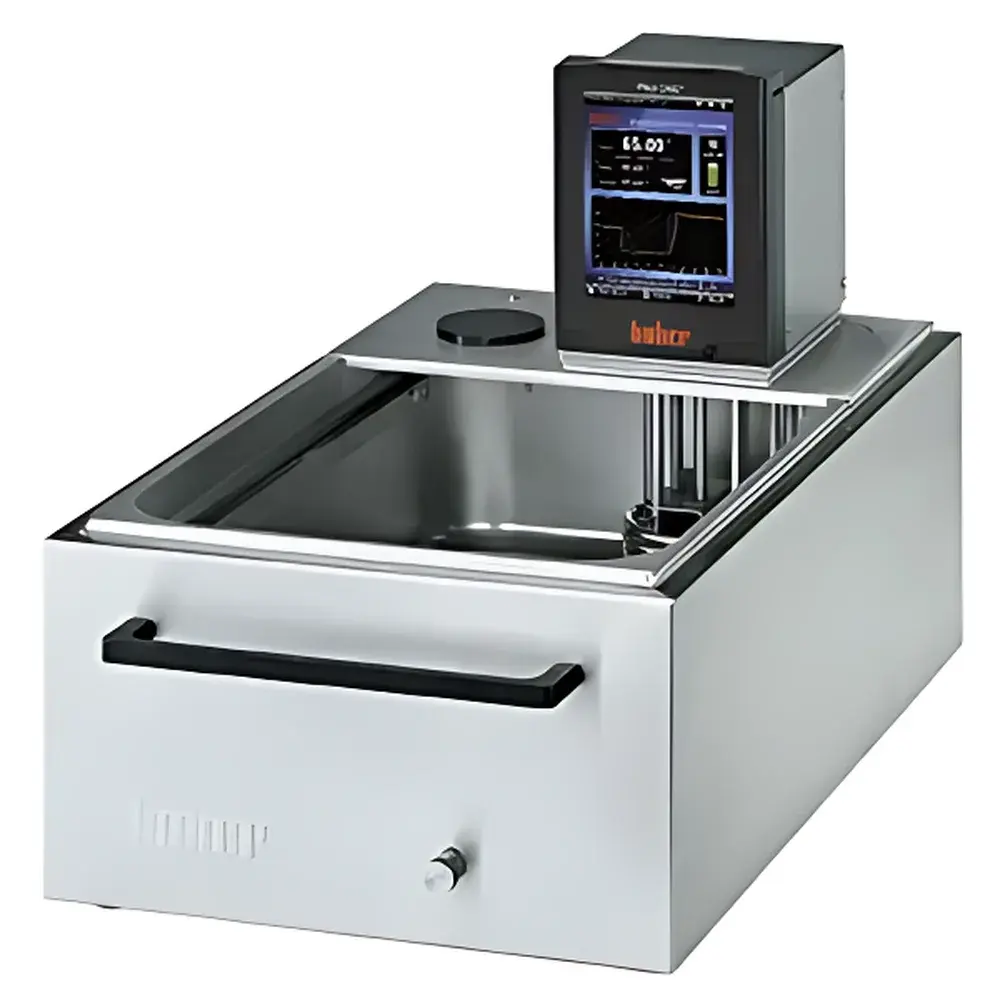
Huber CC-220B Pilot ONE Heating/Cooling Circulating Bath
| Brand | Huber |
|---|---|
| Origin | Germany |
| Model | CC-220B |
| Bath Volume | 20 L |
| Temperature Range | –30 to +200 °C |
| Temperature Stability | ±0.02 °C |
| Circulation Type | Internal & External |
| Cooling/Heating Mode | Dual-function |
| Pump Flow Rate (Pressure) | 27 L/min at 0.7 bar |
| Pump Flow Rate (Suction) | 22 L/min at 0.4 bar |
| Controller | Pilot ONE E-grade (5.7" touchscreen) |
| Safety Class | III / FL (DIN 12876 compliant) |
| IP Rating | IP20 |
| Power Supply | 230 V, 1~ 50/60 Hz, 2 kW heating capacity |
| Dimensions (W×D×H) | 350 × 555 × 375 mm |
| Weight | 14 kg |
| Interfaces | RS232, Ethernet, USB Device & Host |
| Bath Opening | 290 × 329 mm (depth 150 mm) |
| Minimum Fill Volume | 20 L |
| Ambient Operating Temperature | 5–40 °C |
Overview
The Huber CC-220B Pilot ONE is a high-precision, dual-mode (heating and cooling) circulating bath engineered for demanding laboratory applications requiring exceptional thermal stability and reproducible temperature control across an extended range from –30 °C to +200 °C. Based on Huber’s proven thermofluid architecture, the unit employs a closed-loop refrigeration system with cascade compressor technology for sub-zero operation and a robust 2 kW electric heating element for rapid ramp-up and sustained high-temperature performance. Its stainless steel bath vessel—designed for chemical resistance, mechanical durability, and long-term thermal integrity—ensures compatibility with water, silicone oils, glycol/water mixtures, and other DIN 12876-compliant flammable heat transfer media (Safety Class III / FL). The integrated high-capacity circulation system delivers uniform thermal distribution both within the 20 L bath chamber and through external process loops, making it suitable for precise sample conditioning, material testing, analytical instrument temperature regulation (e.g., HPLC column ovens, viscometers), and controlled reaction environments.
Key Features
- Stainless steel bath tank with optimized geometry for laminar flow and minimal thermal stratification
- Pilot ONE E-grade controller featuring a 5.7-inch capacitive touchscreen, intuitive graphical interface, and context-sensitive navigation—designed for ergonomic, smartphone-like operation in glove-compatible lab settings
- Dual-pump architecture: independent pressure pump (max. 27 L/min at 0.7 bar) and suction pump (max. 22 L/min at 0.4 bar) enabling stable external loop control without flow compromise
- Thermal stability of ±0.02 °C maintained under dynamic load conditions, verified per ISO/IEC 17025 traceable calibration protocols
- Comprehensive safety system including overtemperature cutoff, low-level fluid detection, dry-run protection, and real-time fault logging
- Multi-interface connectivity: RS232 for legacy instrument integration, Ethernet (TCP/IP) for LAN-based remote monitoring, and dual USB ports (Device + Host) supporting firmware updates, data export, and peripheral attachment (e.g., USB keyboard or flash drive)
- Compact footprint (350 × 555 × 375 mm) and IP20-rated enclosure suitable for benchtop deployment in ISO 14644-1 Class 7 cleanrooms or standard QC laboratories
Sample Compatibility & Compliance
The CC-220B is validated for use with a broad spectrum of heat transfer fluids—including deionized water, polydimethylsiloxane oils (e.g., Dow Corning 200 Fluid), and ethylene glycol/water blends—provided they meet DIN 12876 Part 2 requirements for flammability classification (FL) and thermal stability. Its Safety Class III / FL rating permits operation with fluids having flash points as low as 60 °C, subject to local hazardous area regulations. The unit complies with IEC 61010-1:2010 for electrical safety in laboratory equipment and meets EMC requirements per EN 61326-1:2013. For regulated environments (e.g., pharmaceutical QC labs), its deterministic alarm logging, timestamped event history, and audit-ready parameter change tracking support adherence to FDA 21 CFR Part 11 and EU Annex 11 principles when paired with validated software workflows.
Software & Data Management
The Pilot ONE controller natively supports real-time data logging at user-defined intervals (1 s to 60 min resolution) with automatic timestamping and CSV export via USB or network transfer. Optional Huber LabManager software enables centralized multi-unit supervision, automated report generation (PDF/Excel), and integration into LIMS or ELN platforms via OPC UA or Modbus TCP. All temperature setpoints, ramp rates, hold times, and alarm thresholds are stored with full revision history and operator ID tagging—facilitating GLP/GMP-compliant documentation and internal audit readiness. Firmware updates are performed securely over HTTPS with SHA-256 signature verification.
Applications
- Precise thermal conditioning of samples prior to rheological, calorimetric, or spectroscopic analysis
- Temperature stabilization of HPLC autosamplers, detectors, and column ovens in compliance with USP and ASTM D341
- Controlled curing and aging studies for polymers, adhesives, and composites per ISO 293, ASTM D638, and DIN EN 1209
- Calibration of temperature sensors (Pt100, thermocouples) against NIST-traceable references
- Food microbiology incubation support (e.g., pathogen enrichment at defined temperatures per ISO 6579)
- Environmental simulation for electronics reliability testing (e.g., thermal cycling per JEDEC JESD22-A104)
FAQ
What heat transfer fluids are certified for use with the CC-220B at temperatures above 150 °C?
Silicone-based oils meeting DIN 53241 Part 2 specifications (e.g., Wacker SE 1000 series) are recommended for continuous operation up to 200 °C. Mineral oils are not advised above 120 °C due to oxidation risk.
Can the CC-220B be integrated into a SCADA system?
Yes—via its native Ethernet interface using Modbus TCP or optional OPC UA server license; RS232 supports legacy PLC communication with ASCII protocol.
Is external temperature feedback supported for cascade control?
Yes—the unit accepts external Pt100 input (standard 2-wire or optional 4-wire) for process temperature feedback, enabling jacketed reactor or inline sensor control modes.
Does the device support password-protected parameter locking for SOP compliance?
Yes—Pilot ONE allows hierarchical user roles (Operator, Technician, Administrator) with configurable access rights to setpoints, calibration functions, and system configuration.
What is the minimum required ambient ventilation for continuous operation at 200 °C?
A minimum clearance of 100 mm on all sides and unobstructed airflow above the unit is required; ambient temperature must remain ≤40 °C with relative humidity <80% non-condensing.



